Outdoor Kitchen Grill Islands: How to Choose One That Lasts
ByJohn White
Learn how to choose a durable outdoor kitchen island for your backyard. Compare grill islands, carts and built-in kitchens, then evaluate burner capacity, stainless steel construction, propane or natural gas setup, storage, refrigeration, delivery and warranty coverage. Find the right 4+2 or six-burner grill island for everyday family meals, entertaining and long-term outdoor cooking.
An outdoor kitchen island is a long-term purchase disguised as a grill: it brings together the cooking surface, storage, prep space and often a refrigerator or sink, and it is expected to survive years of weather, heat and heavy use. Choosing one that lasts means looking past the burner count to the structure underneath — materials, build, burner layout, fuel setup and the realities of delivery and assembly. This guide walks through what an island adds over a cart, how to right-size the burners and cooking area, and the decisions that decide whether the island still looks and works well in year five. The built-in-versus-portable question is answered by the outdoor kitchen setup comparison; once an island is the chosen direction, this page helps you pick one that lasts.
Island, cart or built-in?
An island sits between a portable cart and a fully built-in outdoor kitchen. A cart rolls, stores compactly and costs less, but it offers limited cooking area and storage and lives at the mercy of the weather unless covered. A built-in kitchen is constructed on site — masonry, cabinetry and counters built around the grill — with the highest cost, the longest timeline and the most permanent footprint. An island is a factory-built, freestanding unit: a complete cooking station with burners, cabinetry, counter space and often extras, delivered as one piece or a few modules and placed on a prepared spot. It delivers most of the built-in experience without the construction project, which is why it is the fastest route to a serious outdoor kitchen.
The trade-offs are real. An island still takes a permanent footprint and needs a level, fire-safe base; it is heavy and difficult to move once placed; and its materials must be chosen for the local climate. If the grill needs to travel or the patio space changes year to year, a cart is the honest answer. If the yard has a permanent cooking corner and the budget supports a serious station, an island earns its place — the question becomes which one.
Right-sizing burners and cooking area
Burner count is the first number buyers chase, but it only matters relative to how you cook. A four-burner island handles most households: direct heat for the main grate, a zone for sides and room to move food away from the flame. Six burners add a second true cooking zone — useful for cooks who run two proteins or a full spread at once. Islands with extra side burners are worth counting separately: a side burner can hold a pot of sides or sauce without taking main-grate space. The total heat output, usually listed in BTUs, is less important than how the burners are arranged; a wide, even burner layout with independent control beats a higher BTU number crowded into a small footprint.
Match the cooking area to the biggest group you feed on a normal weekend, not the once-a-year party. Measure the main grate — can it hold the protein plus a side in one round? — and confirm the island's counter gives you a heat-safe landing spot beside the grill. An island with too many burners for your cooking wastes fuel and counter space; one with too few turns every meal into a relay. Write down the three meals you cook most, lay them out on the grate in your head, and let that sketch pick the burner count.
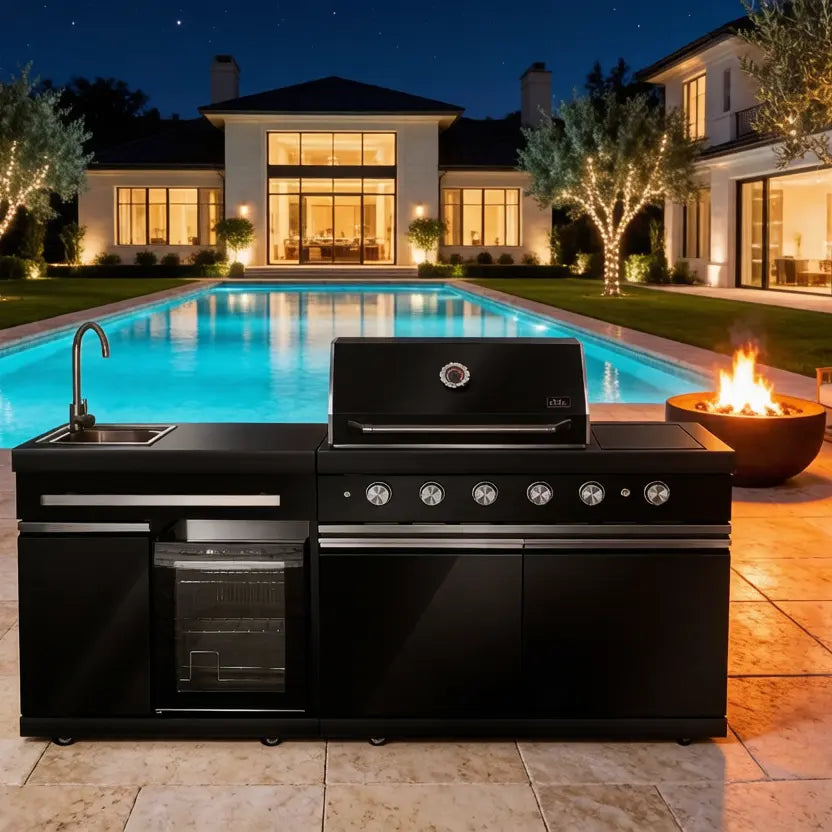
A four-plus-two burner island balances main-grate cooking with a dedicated side burner — enough capacity for most family cooks without a six-burner footprint.
Materials that survive outside
Materials decide how the island ages. Stainless steel is the benchmark for outdoor cooking: it resists rust and heat, cleans easily and holds up in weather, though marine-grade or heavier-gauge stainless costs more and resists corrosion longer in coastal and high-humidity areas. Powder-coated steel lowers the price but asks for care — a chip in the coating can let moisture reach the metal. Check the island's frame and body construction, not just the front panels: the cart base, doors and internal shelves take the same weather as the visible skin, and a unit with weak internal structure wobbles and rusts from the inside out long before the exterior shows it.
Look at the details that separate a durable island from a disposable one. Solid door hinges and handles that do not rattle loose, sealed seams and drainage that keep water from pooling, a lid or cover design that protects the burners when closed, and counters rated for heat and weather. Ask what the manufacturer recommends for winter — some islands are built to sit outside year-round, while others want a cover or sheltered storage. The island that lasts is the one whose weakest component is still built for the outdoors, and that is often the hinges, the shelves or the burners rather than the shiny front.
Gas hookup and tank decisions
Fuel is the infrastructure decision. Most islands run on propane from a tank stored beside or beneath the island, which works anywhere but means checking and swapping tanks and routing the hose clear of heat. Natural gas removes the tank entirely — a permanent line feeds the island like a house appliance — but requires a gas line, a licensed installer in many areas and a location near the supply. If you choose an island now with propane and think you may convert later, confirm the model supports a conversion kit before you buy; not every grill is convertible.
Plan the fuel spot before delivery. A propane tank needs an accessible, ventilated location that keeps the cylinder out of direct heat and weather; a natural-gas island needs a shut-off valve and a clear path for the line. Check local rules for tank placement and gas work, and include the hookup cost in the budget — the island's price is rarely the full cost of getting it running. The island that "lasts" also includes its fuel system, and a corroded regulator or a kinked hose fails faster than any panel on the body.
Storage, refrigeration and extras
An island's storage turns a grill into a kitchen. Count the doors, drawers and shelves and measure them against what you will store: fuel, tools, platters, sauces and the cover all need a home, and shallow decorative doors hide a surprisingly small shelf behind them. A built-in refrigerator is the upgrade that changes hosting — cold drinks, prepped food and sauces within arm's reach of the grill — but it adds cost, weight and a small power or battery consideration. Sinks add real utility for hand-washing and cleanup but need a water supply and drainage plan, which is why they appear mostly on premium islands or permanent builds. Choose extras by what you will use weekly: for most owners, deep drawers and a solid shelf beat a sink that never gets plumbed.
Think about accessories as part of the island too. Rotisserie kits mount to the grill and need clearance above the burners; a side burner needs a stable pot; a cover must fit the island's full dimensions, including the side shelves and handles. If the island includes a refrigerator or rotisserie, confirm replacement parts and service exist before you buy. The extras that make an island great are the ones integrated from the start, not the ones you hope to bolt on later.
Warranty, parts and long-term service
An island is a multi-year purchase, so the after-sale support deserves the same scrutiny as the burners. Before ordering, find out what the warranty actually covers: many grills warrant the burners and cooking components separately from the painted body and small parts, and the difference matters when a knob, hinge or burner fails in year three. Ask who honors the claim — the brand directly or a dealer — and what the process requires, since saving the receipt and registering the product at purchase is often the condition for coverage. Confirm that replacement parts are available for the model, not just for the line: a burner or rotisserie motor that cannot be bought separately turns a repairable grill into a premature replacement.
Long-term service is also about the environment the island lives in. Coastal owners should check the corrosion resistance of the frame and fasteners; cold-climate owners should confirm the island tolerates freezing or plan a cover and drain routine; anyone with a gas line should keep the connection serviceable with an accessible shut-off valve. Write the purchase date, model number and warranty terms on a card kept with the manual, and inspect the island twice a year — hinges, burners, electrical and gas connections — so small problems are found under warranty, not after it expires.
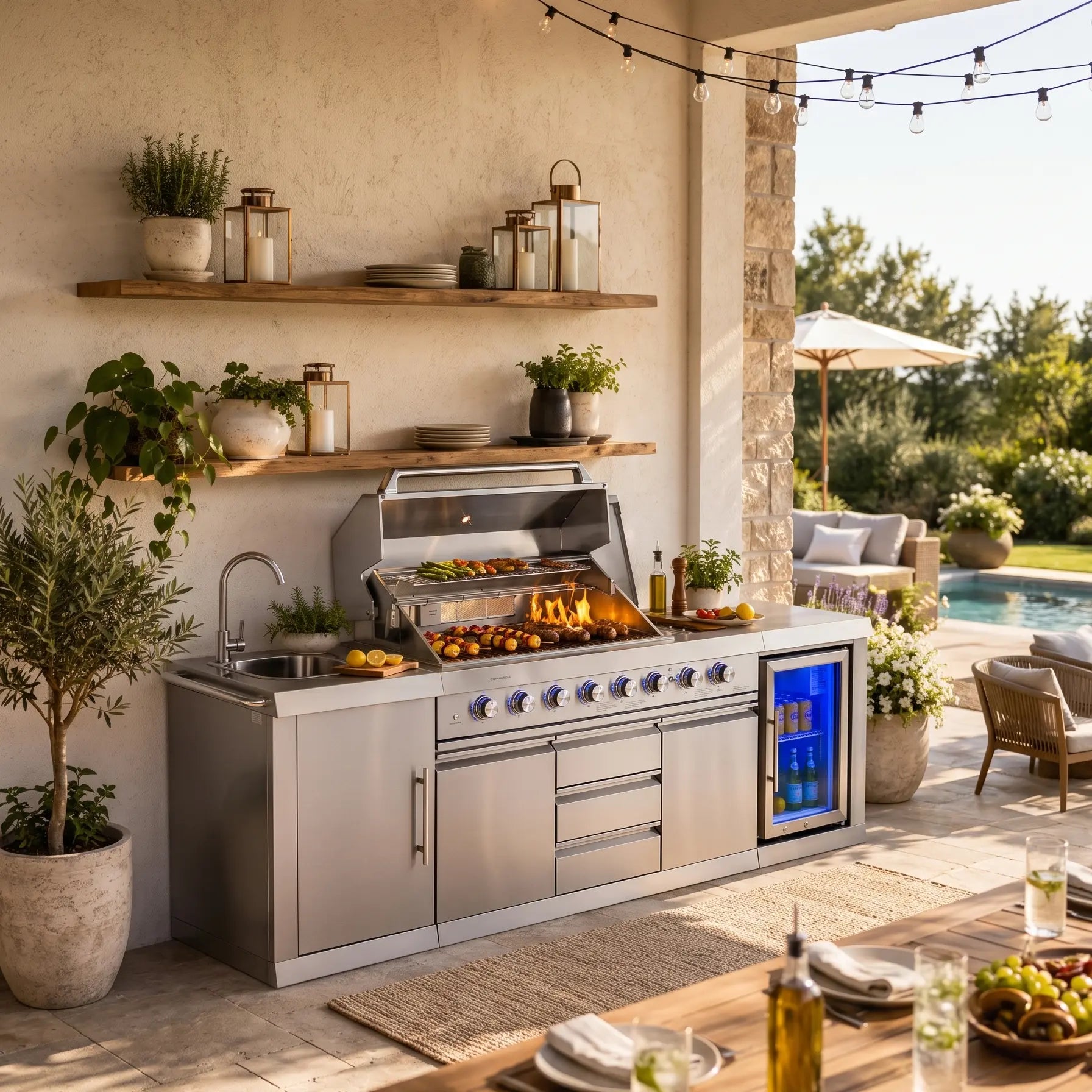
Stepping up to a six-burner island with a side burner, fridge and rotisserie kit turns the cooking corner into a full outdoor kitchen.
Planning budget and delivery
Cost layer
What it covers
Planning tip
Island price
The unit, burners and included extras
Compare what is in the box, not the sticker
Delivery
Freight to the curb or door
Confirm whether delivery includes placement
Base / pad
Level fire-safe surface
Budget for concrete, pavers or a deck pad
Hookups
Propane tank or gas line, electric for extras
Include licensed installation if required
Cover & care
Weather protection and maintenance
Add a fitted cover to the first-year budget
The sticker price is the smallest part of the real cost. Delivery of a large island may stop at the curb, leaving you to arrange moving a very heavy unit to the patio; the base must be level and non-combustible; hookups may need a professional; and a fitted cover is not optional for an island expected to last. Before ordering, measure the path from the delivery point to the patio — width, turns, steps — and confirm the unit fits through gates and doors. The island that lasts is the one that was planned for, delivered properly and set on a base that keeps it level for years.
Before you place the order, write down the answers to five questions: the island's total heat output and fuel type, which extras are included in the price, the full assembled dimensions and weight, the delivery method and what the driver will and will not do, and the warranty terms in writing. If the island is designed to be built into a surround rather than used freestanding, confirm the cutout dimensions and ventilation match your plan, because forcing a freestanding unit into an enclosure blocks the airflow it needs. The five answers turn a photo-driven purchase into a spec-checked one, and they are the difference between an island that fits the yard and one that only fits the truck.
Product details and prices in this guide were verified against official Big Horn Outdoors listings during the September 5, 2026 review; re-check prices and availability at checkout.
Embark on a culinary adventure with us. Receive exclusive recipes, expert tips, and special offers tailored for outdoor cooking enthusiasts. Unsubscribe anytime—no hard feelings :)