
By the Big Horn Outdoors Product Team
Published September 16, 2026
In a high-heat pizza oven, turn the pizza every 20–30 seconds after the crust firms up, usually about 20–30 seconds after launching. Rotate it roughly 90 degrees at a time with a small metal turning peel. For a lower-temperature home oven, one turn halfway through baking is usually enough because the heat is less directional.
When Should You Turn Pizza?
Turn pizza for the first time after 20–30 seconds, when the dough has begun to set and the crust is starting to puff. Turning too early can stretch or tear the soft base, while waiting too long may allow the side facing the burner or flame to scorch.[help.alfaforni]
A high-heat pizza oven, including many portable gas, pellet, and wood-fired models, does not heat the pizza evenly from every direction. The burner or fire usually creates a hotter zone on one side of the cooking chamber. Rotating the pizza exposes each section of the rim and toppings to a similar amount of radiant heat.
For a typical 60–90-second Neapolitan-style bake:
- Launch the pizza onto the hot stone.
- Wait approximately 20–30 seconds.
- Slide a turning peel beneath the pizza and rotate it about 90 degrees.
- Continue turning every 20–30 seconds.
- Remove the pizza when the crust is browned, blistered, and fully baked.
This usually means three or four turns during the bake, although the exact number depends on the oven’s hot spots, flame strength, pizza thickness, and topping load.
How Much Should You Rotate It?
A 90-degree turn is the easiest rotation for most pizzas because it moves a new section of crust toward the hottest area without requiring a large, awkward movement. Smaller turns may be better when the pizza is close to the flame or when the crust is browning unevenly.
Use a small round metal turning peel rather than a large transfer peel. A turning peel is designed to slide beneath a partially baked pizza, lift it slightly, and reposition it quickly without folding the crust.
A practical turning pattern
- First turn: approximately 90 degrees after 20–30 seconds.
- Second turn: another 90 degrees after 20–30 seconds.
- Third turn: rotate the remaining pale section toward the heat.
- Final adjustment: turn or reposition only if one area still needs browning.
Do not force a full 180-degree rotation in one movement. A quick, controlled quarter-turn reduces the chance of disturbing cheese, sauce, or wet toppings. Keep the peel nearly parallel with the stone and lift only enough to free the crust.
If the pizza sticks, do not yank the peel. Slide it farther underneath with a short forward-and-back motion, then lift gently. A well-preheated stone, a freely moving pizza before launch, and a properly dusted transfer peel all help prevent sticking.
Does Every Pizza Need Frequent Turning?
No. Turning frequency depends on the oven temperature, heat pattern, and pizza style. High-temperature pizzas need frequent rotation because the cooking process is fast and the side closest to the flame can darken quickly; lower-temperature pizzas may need only one turn or no turn at all.
| Cooking setup | Typical turning approach |
|---|---|
| High-heat gas, wood, or pellet oven | Begin after 20–30 seconds; turn every 20–30 seconds |
| Lower-temperature outdoor oven | Turn when the side nearest the heat browns noticeably |
| Conventional home oven | Turn once halfway through baking if browning is uneven |
| Pan pizza or thick-crust pizza | Turn less often; prioritize even bottom cooking and internal doneness |
These are practical starting points rather than rigid rules. A high-heat oven may require more frequent turns if the flame is strong or positioned close to the pizza. A thick pizza may need a slower bake, so turning every few seconds is unnecessary and can interfere with crust development.
In a conventional home oven, heat is generally distributed more evenly than in a compact flame-driven pizza oven. If the pizza is baking on a stone or steel, rotating it halfway through the bake is often sufficient. If the oven has a strong rear or side hot spot, turn it earlier.
Why Does Pizza Need to Be Turned?
Pizza is turned to balance exposure to radiant heat, the direct infrared energy emitted by a flame, burner, heating element, or hot oven surface. The side nearest that heat source browns and blisters faster than the side facing the oven opening.
Turning also helps manage the difference between the top and bottom of the pizza. The stone transfers heat directly into the dough, helping the bottom cook and crisp, while the flame or upper heating source develops color on the rim and toppings. Moving the pizza prevents one area from receiving excessive radiant heat before the rest of the crust is ready.
Several visual cues indicate that it is time to turn:
- The outer rim has begun to puff.
- The bottom is firm enough to slide a peel underneath.
- The side closest to the flame is browning faster.
- Cheese is melting but is not yet fully browned.
- The pizza can move without collapsing when lifted slightly.
Turning does not replace temperature control. If the bottom burns before the top cooks, the stone may be too hot, the pizza may be too close to the flame, or excess flour may be burning underneath. If the top remains pale, the oven may need more preheating or the pizza may need brief repositioning closer to the upper heat.
Heat Management for Even Baking
An even pizza depends on both rotation and heat management. Preheat the stone thoroughly, launch a pizza that slides freely, and adjust its position when one area browns much faster than the rest.
Before launching, check that the cooking surface has reached the intended temperature with an infrared thermometer when appropriate. The stone can be cooler or hotter than the air inside the oven, so an air-temperature reading alone does not always show whether the base is ready.
Once the pizza is inside:
- Watch the side nearest the flame continuously.
- Turn before that edge becomes deeply charred.
- Move the pizza toward a cooler area if the rim darkens too quickly.
- Keep the door or opening closed when the oven design requires it for heat retention.
- Avoid adding excessive flour or semolina to the peel because loose material can burn on the stone.
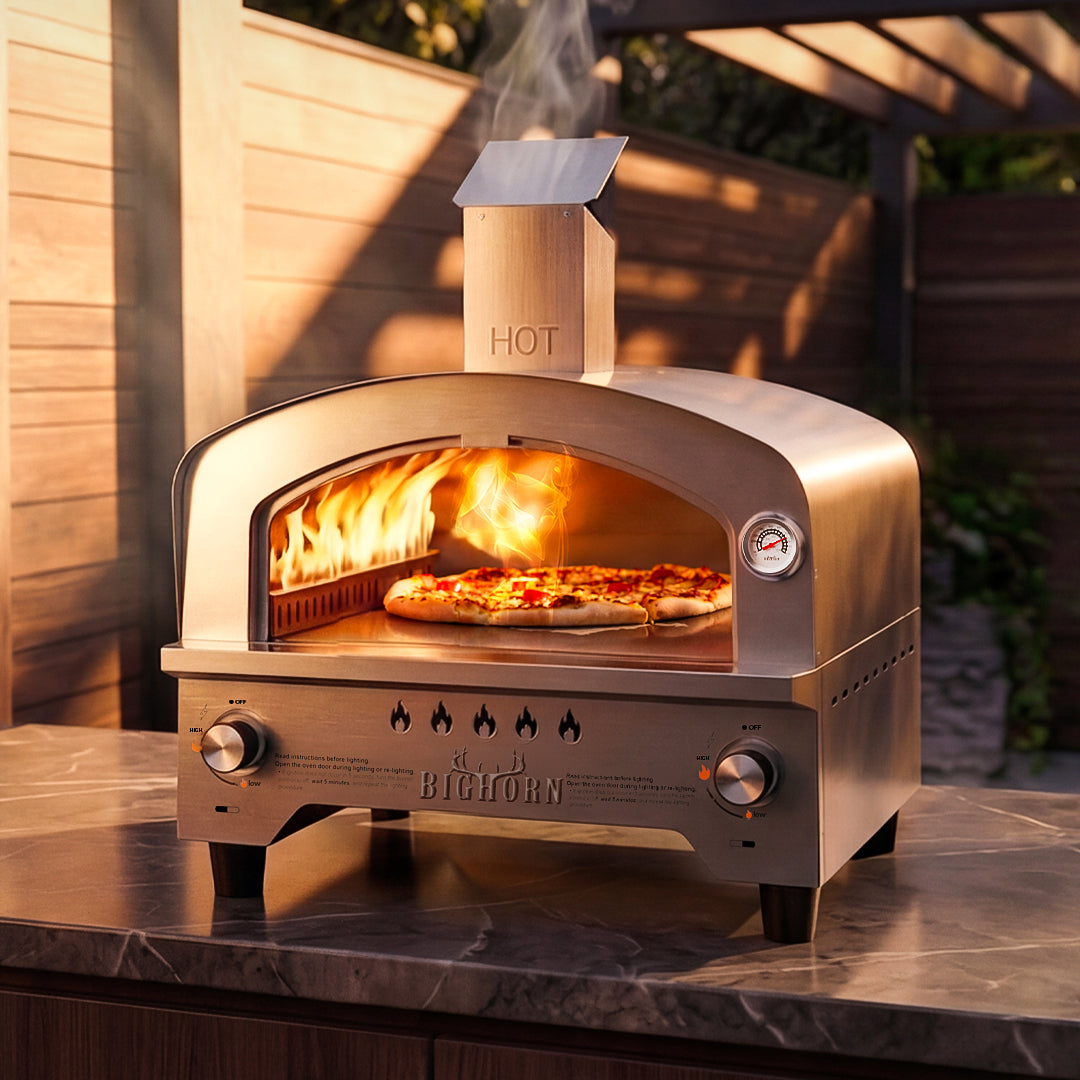
A Big Horn Outdoors pizza oven should always be used according to the instructions for its exact model. The brand’s portable 12-inch wood-pellet pizza oven, for example, is listed with an 18–20-minute preheat and temperatures up to 887°F (475°C), with 60–90-second pizzas under appropriate conditions. Those specifications apply only to that model and should not be generalized to Big Horn Outdoors gas, electric, or other multi-fuel ovens.
The same principle applies to fuel management. Pellet and wood-fired ovens may develop changing hot spots as the fire shifts, while gas ovens can produce a more consistent directional heat pattern. Electric countertop ovens may distribute heat differently and may require less frequent turning. Always follow the model-specific manual for fuel, operating environment, clearances, and accessories.
How to Turn Pizza Without Tearing It
To turn pizza safely and cleanly, use a metal turning peel after the crust has set. Slide the peel under the pizza, lift the edge slightly, rotate the pie in a controlled motion, and return it to the stone without dragging the soft dough.
Step-by-step technique
- Wait until the crust is firm enough to support itself.
- Position the turning peel under the edge closest to you.
- Slide it underneath with a shallow angle.
- Lift the pizza only slightly.
- Rotate it about 90 degrees.
- Lower it gently onto the stone.
- Check the crust color and repeat as needed.
Avoid pressing down on the top of the pizza. Do not use a fork or sharp utensil, which can puncture the crust and release steam. If cheese or toppings are sliding, make smaller rotations and reduce the lifting angle.
A wooden or composite transfer peel is generally useful for launching raw dough, while a compact metal peel is more maneuverable for turning and removing a baked pizza. The correct peel size and accessory compatibility depend on the oven opening and the exact product design.
Safety While Turning Pizza
Use heat-resistant gloves and keep your hands, clothing, and face away from the flame and hot oven opening. Pizza ovens can retain extreme heat after the burner or fire is reduced, and the metal peel can become hot during use.
Important precautions include:
- Operate fuel-burning pizza ovens outdoors in a well-ventilated area.
- Keep the oven on a stable, noncombustible surface.
- Maintain the manufacturer’s required clearance from walls, roofs, foliage, and other materials.
- Never use a fuel-burning outdoor pizza oven indoors, in a garage, or in an enclosed space.
- Keep children and pets away from the oven and peel.
- Allow the oven to cool completely before cleaning, covering, moving, or storing it.
- Use only the fuel and attachments approved for the exact model.
An electric countertop pizza oven is a separate category and may be intended for indoor use, but its product instructions still control placement, ventilation, electrical requirements, and clearance. Do not assume that an attachment or accessory designed for one Big Horn Outdoors model is compatible with another.
Big Horn Outdoors Expert Views
“Treat the first turn as a heat-management decision, not just a timing rule. In a high-temperature oven, inspect the side facing the burner after roughly 20–30 seconds and rotate before that section becomes too dark. Then use smaller, controlled turns to finish the bake. If the bottom is burning, moving the pizza away from the hottest stone area may be more effective than turning it more often. The right rhythm depends on flame position, stone temperature, dough thickness, and toppings, so visual control should always take priority over a stopwatch.”
A Simple Turning Routine
For most high-heat portable pizza ovens, use this routine: preheat the stone, launch the pizza, wait 20–30 seconds, rotate 90 degrees, and continue turning at 20–30-second intervals until the crust is evenly browned.
Choose your approach based on your cooking style:
- For a fast, thin-crust pizza: turn every 20–30 seconds.
- For a thicker pizza: turn when the exposed side browns, but allow more time between turns.
- For a home-oven pizza: rotate once halfway through if needed.
- For a pizza with wet or heavy toppings: use gentle turns and allow enough time for the center to cook.
- For a pizza with a burning bottom: reduce the stone heat or move the pizza rather than simply rotating faster.
Big Horn Outdoors offers pizza ovens across pellet, gas, electric, and multi-fuel formats, but operating methods vary by model. Match the turning routine to the oven’s fuel system, burner arrangement, cooking surface, and instructions—not to the brand name alone.
People Also Ask
Can I turn pizza too often?
Yes. Excessive turning can disturb a soft crust, spill toppings, and make launching or repositioning more difficult. Wait until the base sets, then use deliberate turns based on browning rather than moving the pizza continuously.
Should I turn pizza in a regular oven?
Usually, turn it once halfway through baking if one side browns faster. A regular oven generally provides more even heat than a flame-driven pizza oven, so frequent 20–30-second turns are usually unnecessary.
What tool should I use to turn pizza?
Use a small metal turning peel. Its compact, round shape makes it easier to slide under a partially baked pizza and rotate it without removing the entire pie from the oven.
Why does one side of my pizza burn?
The pizza may be too close to the burner or flame, or the oven may have a strong hot spot. Turn it sooner, move it toward a cooler area, reduce the heat if the model allows it, and check whether excess flour is burning on the stone.
How many times should I turn a 90-second pizza?
A 90-second pizza commonly needs about three or four controlled turns, beginning after the first 20–30 seconds. Adjust the number according to crust color, flame intensity, and the location of the oven’s hottest zone.
The practical rule is simple: in a high-heat pizza oven, make the first turn after the crust sets, then rotate approximately every 20–30 seconds. Watch the pizza rather than relying on time alone, because flame direction, stone temperature, dough thickness, and toppings all affect the ideal turning rhythm.