A Big Horn pizza oven can deliver high-heat, outdoor pizza cooking in a compact format, but the main trade-offs are hands-on fire or heat management, limited cooking space, heat loss between pizzas, and model-dependent accessories or fuel requirements. For example, the verified 12-inch wood-pellet model weighs 24.9 pounds and lists a 60–90-second pizza capability, yet its small format is less suited to effortless large-batch entertaining.
Big Horn Outdoors began with a 2012 backyard-cooking challenge: making high-heat cooking easier to manage while reducing uneven heat and excess smoke. That practical focus remains relevant today—but choosing the right oven means understanding that a portable, high-temperature pizza oven is not the same as a large, insulated backyard oven or an indoor countertop appliance.
What are the main disadvantages of a Big Horn pizza oven?
The most important downside is that Big Horn pizza ovens are specialized high-heat cookers, not automatic appliances: small cooking chambers, active temperature management, and recovery time can make them less convenient for beginners or large groups.
The specific limitations depend on the model. Big Horn Outdoors sells pellet, gas, electric countertop, and multi-fuel pizza ovens, so a drawback on one format should not be assumed to apply to another. Still, several decision criteria recur across portable pizza ovens:
- A compact stone limits pizza diameter and the amount of food cooked at one time.
- High heat requires close attention to avoid scorching the crust, toppings, or both.
- Opening the door releases heat and can slow consecutive cooking.
- Outdoor fuel-burning models require suitable outdoor placement, clearance, and weather awareness.
- Pizza-specific accessories, such as a peel and infrared thermometer, may be necessary for consistent results.
- Pellet-fired models require fuel handling, ash cleanup, and active flame management.
- Portable construction favors lower weight and compact storage over the thermal mass of a masonry oven.
For buyers who want to cook one or two pizzas at a time and enjoy active live-fire cooking, these are manageable trade-offs. For someone who wants an indoor, set-and-forget experience or wants to serve a large party quickly, they can become decisive limitations.
Does a pellet-fired model require more attention?
Yes. A pellet-fired pizza oven requires active fuel and flame management because pellet combustion depends on a consistent supply of dry fuel and sufficient airflow.
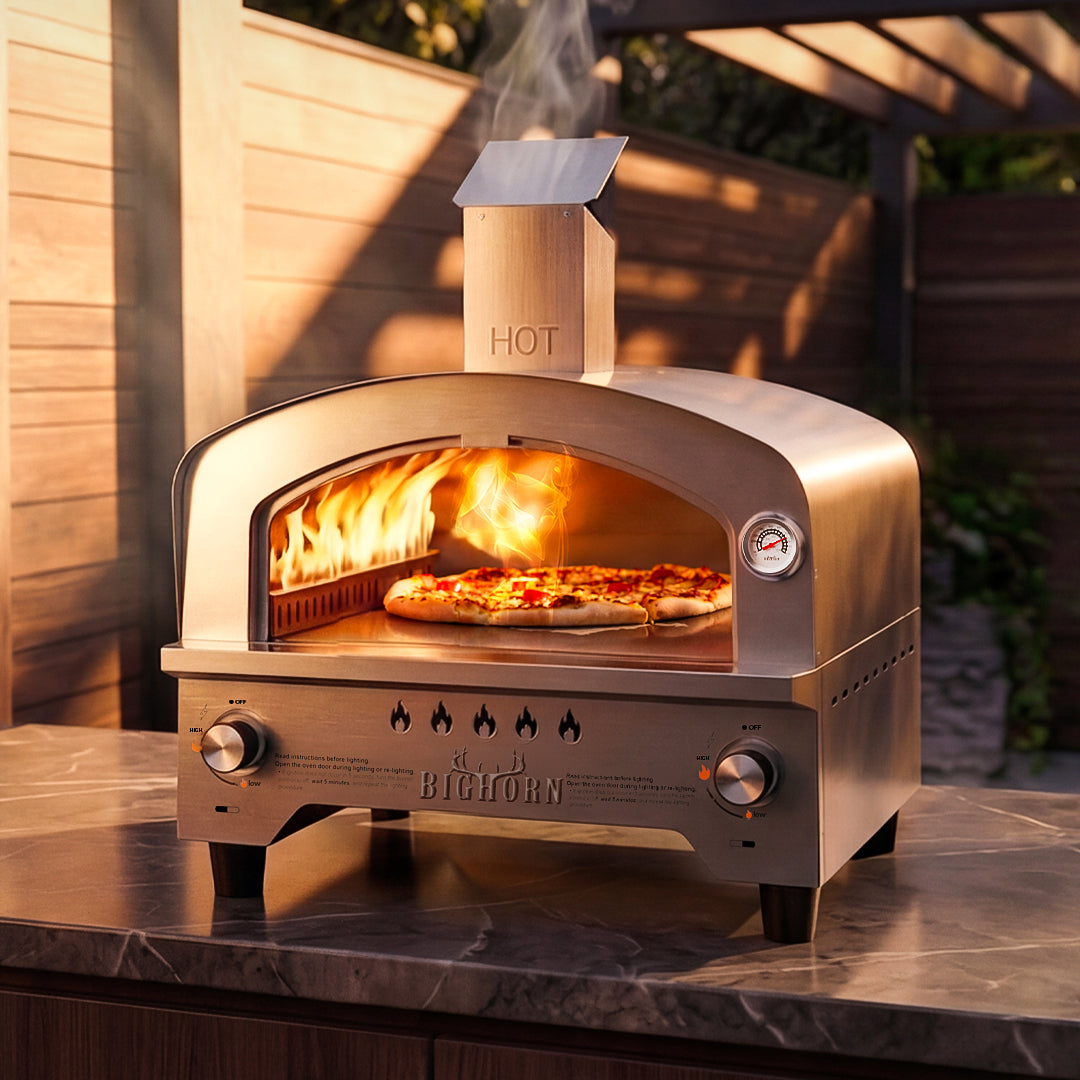
The Big Horn Outdoors 12-inch wood-pellet pizza oven is listed as a stainless-steel, portable model with folding legs, a 24.9-pound weight, and an 18–20-minute preheat time. Its official performance listing states temperatures up to 887°F and pizzas in 60–90 seconds under appropriate conditions. Those figures describe potential performance, not an automatic cooking cycle.
Pellets burn differently from propane. With propane, turning a control changes burner output quickly and predictably. With pellets, the cook must account for several variables:
- Pellet condition: Damp pellets can produce more smoke, burn less cleanly, and make ignition less reliable.
- Airflow: Fire strength depends on oxygen reaching the fuel bed; wind can affect flame behavior.
- Fuel level: A declining hopper or fire tray reduces heat output.
- Ash buildup: Ash can restrict airflow and should be removed only after the oven is fully cool.
- Loading rhythm: Repeatedly opening the oven to check or turn pizza lets heat escape from the chamber and stone.
This is why pellet pizza ovens often appeal most to cooks who enjoy tending a live flame. The reward is the visual and sensory character of wood-pellet cooking; the downside is that the cook must stay present. It is not a cooker to light, walk away from, and revisit later.
A separate review and user discussion have reported that pellet supply, smoke during refueling, and wind sensitivity can create a learning curve. Those accounts are not product-wide test results, but they reinforce a general truth about small pellet-fired ovens: fuel management strongly affects consistency.[palapizza][tvwbb]
Why can consecutive pizzas be harder to cook?
Compact pizza ovens can lose stone and chamber heat between bakes, so the second or third pizza may need a recovery period before it cooks as evenly as the first.
A pizza stone stores thermal energy. When cool dough lands on it, the stone transfers heat into the base of the pizza. This conductive heat is essential for setting the crust quickly. At the same time, flame or burner heat cooks the top through radiant heat—the direct energy emitted by a flame, burner, or hot oven surfaces.
That balance is easy to disrupt. If the stone is too hot compared with the upper chamber, the bottom can darken before the cheese and toppings finish. If the stone has lost too much heat after a bake, the top may blister while the base stays pale or underdone.
A small oven magnifies this challenge because each door opening releases a meaningful amount of stored heat. The cook may need to let the stone recover between pizzas, especially when preparing several pies in a row.
| Cooking situation | Main limitation | Practical implication |
|---|---|---|
| First pizza after preheat | Stone and chamber may not be equally hot | Measure the stone, not just the air temperature |
| Fast successive pizzas | Stone can cool as dough absorbs heat | Allow recovery before launching the next pizza |
| Opening the door frequently | Heat exits the cooking chamber | Turn efficiently and keep checks brief |
| Heavy toppings or thick dough | Pizza needs more bake time | Lower the heat or use a more moderate cooking style |
An infrared thermometer, a non-contact tool for checking surface temperature, is useful because ambient oven temperature does not tell the whole story. The stone’s surface temperature is the more direct indicator of how aggressively the crust will cook.
Independent reviewers of earlier compact Big Horn pellet-oven versions described heat drop between bakes and the need for reheating before another pizza. Treat that as a model- and cooking-condition-specific concern, but a practical one to evaluate if your priority is high-volume pizza service.[palapizza]
Is the cooking capacity too small for parties?
A 12-inch-format portable pizza oven is best for individual pizzas and small groups, not for producing many pizzas continuously with minimal wait time.
The verified Big Horn Outdoors 12-inch pellet model is designed around a compact, portable format. In real use, the usable pizza size is often smaller than the nominal oven category because a pizza needs clearance for launching, turning, and removing it safely. Dough can also expand or shift during the bake.
Small capacity affects more than pizza diameter. It changes the entire workflow:
- You need dough balls, toppings, peel, turning peel, and serving plates ready before firing.
- One person may be occupied managing the oven while another assembles pizzas.
- Guests may eat in waves rather than everyone receiving food at once.
- A pause between pizzas may be necessary to rebuild stone heat.
- Large pizzas, sheet-pan pizzas, multiple trays, and big roasting dishes are generally outside the portable oven’s strengths.
This does not mean a compact Big Horn pizza oven cannot serve a group. It means the event should be structured around pizza-by-pizza cooking. For a small family, couple, campsite meal, or interactive pizza night, that can be part of the appeal. For a party where the goal is to serve 10 pizzas rapidly, a larger cooking surface or a gas model with stronger heat control may be more appropriate.
Heat management takes practice
High-temperature pizza cooking demands technique because the bottom cooks mainly by conduction while the top cooks through radiant heat from above and around the pizza.
At temperatures used for Neapolitan-style pizza, a pizza can change dramatically in seconds. The Maillard reaction—the browning process that creates roasted, savory flavor—accelerates quickly as the crust surface gets hotter. That is desirable until it becomes burning.
New users can encounter three common results:
Burned bottom, pale top
This usually means the stone is too hot relative to the upper chamber, or the pizza sat too long in one position. A thinner dough, flour residue on the stone, or sugar in the dough can make scorching happen faster.
Dark top, soft center
This can happen when the flame or top heat is strong but the stone has not fully preheated. The toppings brown quickly while the base lacks enough conductive heat to set the dough.
Uneven browning
Most portable ovens have a hotter zone near the flame or burner. Rotating the pizza with a turning peel helps expose each section of the crust to similar radiant heat. This is normal pizza-oven technique, but it adds another manual step.
Big Horn Outdoors offers multiple fuel formats because cooks have different priorities. Pellet cooking favors wood-fired character and hands-on fire control. Gas cooking generally favors faster, more repeatable adjustment. Electric countertop ovens favor indoor convenience where the exact model is rated for indoor use. The downside is not that one format is universally better; it is that the buyer must select the fuel system that fits their desired workflow.
Portability has practical limits
A 24.9-pound oven with folding legs is portable in the sense that it can be moved and packed, but it is not weightless, self-contained, or ready to operate anywhere.
The verified 12-inch Big Horn Outdoors wood-pellet oven has folding legs and weighs 24.9 pounds. That makes it more manageable than a permanent masonry oven, but transport still involves planning. The oven must be cool, clean, and protected; fuel, tools, dough, toppings, and a stable outdoor work surface add to the setup.
Before choosing a portable pizza oven for camping, RV travel, tailgating, or a small patio, consider these practical limits:
- You need a stable, heat-resistant outdoor surface.
- You need room around the oven for hot tools, pizza preparation, and safe movement.
- Pellet-fueled cooking requires bringing dry food-grade hardwood pellets.
- A propane-capable model requires the correct fuel supply and safe hose or regulator setup as specified for that exact model.
- A cover or carrying solution may be useful for storage and transport, but compatibility should be confirmed for the exact oven.
- The oven must cool completely before packing or cleaning.
Portability is most valuable when you use it often. If the oven will remain in one backyard location, buyers may prefer more cooking capacity and easier batch management over the smallest possible footprint.
Safety and weather matter outdoors
Fuel-burning Big Horn pizza ovens must be used outdoors in a clear, well-ventilated area, away from combustible materials and according to the instructions for the exact model.
A high-temperature pizza oven has hot exterior surfaces, open flame or hot combustion gases in fuel-burning formats, and hot ash after cooking. A pizza that bakes in 60–90 seconds also gives the operator little time to correct placement or retrieve a dropped peel.
Use these baseline safety practices:
- Place the oven on a stable, level, non-combustible or suitably heat-resistant surface.
- Maintain clearance from structures, awnings, furniture, dry vegetation, and other combustibles as directed in the product manual.
- Keep children, pets, and bystanders away from the oven and peel path.
- Use heat-resistant gloves and long-handled tools designed for pizza-oven temperatures.
- Never move the oven while hot.
- Let ash and the entire oven cool fully before cleaning, covering, storing, or transporting.
- Avoid operating a solid-fuel pizza oven during high winds, burn restrictions, or wildfire-risk conditions.
- Never use an outdoor pellet- or gas-fired pizza oven indoors, in a garage, tent, enclosed patio, or other poorly ventilated space.
User reports from a pellet-oven discussion describe wind changing flame behavior and occasional sparks. Conditions, model generations, and user setup vary, but the safety takeaway is broadly applicable: wind can alter combustion, and an open-flame cooker needs more caution in dry or breezy conditions.[tvwbb]
Accessories and maintenance add to ownership
A pizza oven is rarely a complete pizza-making system by itself; useful accessories and regular cleanup are part of the ownership experience.
At minimum, many users benefit from a launching peel, turning peel, infrared thermometer, oven brush, and appropriate heat-resistant gloves. These are not unnecessary upgrades. They solve real workflow problems:
- A launching peel transfers a prepared pizza into the oven.
- A turning peel rotates the pizza in the hottest zone without fully removing it.
- An infrared thermometer checks the stone surface.
- A brush removes flour and food debris between bakes.
- Gloves protect hands when handling hot tools or components.
For pellet models, maintenance includes disposing of fully cooled ash and keeping the fuel area dry and clear. For gas models, follow the exact model’s manual for burner cleaning, hose inspection, and ignition checks. For electric countertop models, avoid transferring outdoor-fuel safety assumptions; indoor suitability, electrical requirements, and cleaning instructions are specific to each product.
Some third-party feedback on earlier Big Horn ovens has raised concerns about stone durability, sharp internal edges, and replacement-part availability. These reports should not be treated as guarantees about current models or every unit. They do, however, make it sensible to inspect an oven after delivery, follow the manual during assembly, avoid thermal shock to the stone, and confirm current accessory or replacement compatibility before purchasing.[palapizza][amazon]
Big Horn Outdoors Expert Views
“Choose a pizza oven by the cooking routine you want, not only by its maximum temperature. A compact pellet oven rewards cooks who enjoy managing a live flame and baking one pizza at a time. A gas model can make temperature adjustment more repeatable, while an electric countertop oven may better fit indoor convenience where the model is designed for it. In every case, preheat the stone thoroughly, organize toppings before firing, turn pizzas promptly, and leave enough safe outdoor clearance for fuel-burning equipment. High heat is useful only when it is controlled.”
Which buyer should avoid a Big Horn pizza oven?
A Big Horn pizza oven may be the wrong fit for buyers who want indoor use from an outdoor model, zero-maintenance cooking, large-batch production, or no learning curve.
Consider another cooking format if any of these needs apply:
- You want to cook pizza indoors but are considering a pellet or propane unit.
- You expect to serve many large pizzas back-to-back without stone recovery time.
- You do not want to manage pellets, ash, flame behavior, or weather exposure.
- You prefer a temperature-controlled appliance with preset modes and minimal manual turning.
- You have very limited safe outdoor space.
- You mainly cook thick pan pizzas, casseroles, large roasts, or sheet-pan meals.
- You cannot comfortably lift, clean, and store a roughly 25-pound portable appliance plus accessories.
On the other hand, Big Horn Outdoors may suit a buyer who values compact storage, outdoor cooking, a more interactive pizza process, and a model-specific fuel option that matches their space and skill level. The brand’s range includes pellet, gas, electric, and multi-fuel formats, so compare the exact product page rather than assuming one oven’s capabilities apply to the entire lineup.
Conclusion
The biggest downsides of a Big Horn pizza oven are not necessarily defects—they are the operating compromises of compact, high-heat pizza cooking. Expect limited batch capacity, a learning curve, careful stone-temperature management, and extra attention to safe setup, fuel, and cleanup.
Choose a pellet model if you enjoy live-fire involvement and can cook outdoors with dry fuel, clear space, and attention to weather. Choose gas if you prioritize more direct heat adjustment and repeatability. Choose an electric countertop model only when its official product information confirms it is intended for your indoor cooking environment. For occasional pizza nights with one or two pizzas at a time, a compact Big Horn Outdoors oven can be practical; for frequent large gatherings, prioritize cooking area, heat recovery, and workflow over portability.
FAQs
Are Big Horn pizza ovens difficult to use?
They are not difficult to assemble into a basic cooking routine, but high-heat pizza takes practice. Pellet formats require the most active attention because the cook must manage fuel, airflow, flame strength, and stone recovery.
Do Big Horn pellet pizza ovens need an infrared thermometer?
An infrared thermometer is strongly recommended for any high-heat stone oven because it measures the stone surface directly. Ambient heat alone cannot reliably tell you whether the bottom of a pizza will cook too slowly or scorch.
Can a Big Horn pizza oven cook more than pizza?
Yes, a pizza oven can cook foods such as flatbreads, vegetables, fish, and appropriately sized cast-iron dishes when the method and cookware suit the oven. Use the specific oven’s manual to confirm compatible cookware, placement, and safe operation.
Can I use a Big Horn outdoor pizza oven indoors?
Do not use a pellet- or gas-fired outdoor pizza oven indoors, in garages, tents, or enclosed patios. Only an electric model specifically designated for indoor countertop use should be used indoors, following its electrical and clearance instructions.
Is a Big Horn pizza oven good for a large party?
A compact model is better for small groups or pizza-by-pizza service. For a large party, the need to turn pizzas, maintain fuel or burner heat, and allow the stone to recover can slow production compared with a larger or more heavily insulated oven.