A 16-inch pizza oven is ideal for families, frequent entertainers, and home cooks who want larger pizzas without making multiple small batches. A 16-inch pizza has approximately 78% more surface area than a 12-inch pizza, making it useful for backyard gatherings and family meals. However, smaller ovens may be more practical for couples, occasional cooking, and limited outdoor spaces.
By the Big Horn Outdoors Product Team
Published: September 19, 2026
Who Benefits Most From a 16-Inch Pizza Oven?
A 16-inch pizza oven is particularly useful for households of three to five people, backyard entertainers, and pizza enthusiasts who prefer large, shareable pies. Its main advantage is cooking capacity: one 16-inch pizza provides approximately 201 square inches of pizza, compared with 113 square inches for a 12-inch pie.
That difference changes how outdoor pizza nights work.
Families Who Want One Pizza to Share
A family with two adults and two children may find that a single 12-inch pizza disappears before everyone has been served.
A 16-inch pizza offers significantly more food in one baking cycle. Depending on appetite, toppings, and side dishes, one large pizza may provide a reasonable meal for three or four people.
Families also gain more flexibility with toppings. A larger pizza can be divided into sections, allowing children to enjoy simple cheese or pepperoni while adults choose vegetables, sausage, or other ingredients.
Instead of preparing several separate pizzas, families can make one larger pie that accommodates different preferences.
Homeowners Who Regularly Entertain Guests
Hosting six or eight people with a compact pizza oven can mean preparing a long sequence of personal pizzas.
A 16-inch oven allows the host to prepare larger pizzas, cut them into shareable slices, and serve guests while subsequent pizzas cook.
This approach works particularly well for:
-
Weekend backyard pizza parties.
-
Family birthday celebrations.
-
Outdoor movie nights.
-
Game-day gatherings.
-
Neighborhood cookouts.
The advantage is not necessarily that every pizza bakes faster. It is that each completed pizza can provide more food.
Pizza Enthusiasts Who Enjoy Larger Styles
Not everyone wants an 11-inch Neapolitan pizza.
Some home cooks prefer larger, thinner pizzas inspired by New York-style pizzerias. Others enjoy generous toppings, a broad crust, or a pizza intended for sharing.
A 16-inch oven accommodates these preferences without requiring the cook to divide one large dough batch into multiple smaller pizzas.
It also offers room to experiment with different pizza diameters rather than limiting every baking session to personal-sized pies.
How Much More Pizza Does a 16-Inch Oven Make?
A 16-inch pizza provides approximately 78% more pizza area than a 12-inch pizza, assuming both pizzas are circular and their stated diameters are accurate. The increase is substantial because pizza area grows with the square of its radius, not simply with diameter.
Consider the following comparison:
| Pizza Diameter | Approximate Pizza Area | Typical Serving Use |
|---|---|---|
| 10 inches | 79 sq. in. | Personal pizza |
| 12 inches | 113 sq. in. | One or two people |
| 14 inches | 154 sq. in. | Two or three people |
| 16 inches | 201 sq. in. | Three or four people |
Serving estimates depend on crust thickness, appetite, and accompanying dishes.
A 16-inch pizza has approximately the same surface area as 1.78 twelve-inch pizzas.
For a family preparing four 12-inch pizzas, switching to larger pies could potentially reduce the number of baking cycles needed to provide a similar quantity of food.
However, pizza diameter alone does not determine how many guests an oven can serve per hour. Heating performance, baking time, stone recovery, and preparation speed also influence overall output.
Why Does Extra Cooking Space Matter Beyond Pizza Size?
A 16-inch oven offers more working room for launching, positioning, and rotating pizzas. This matters because a pizza needs enough clearance around its edges to move without touching the oven walls or becoming difficult to retrieve.
In a smaller oven, a nearly full-size pizza may leave very little room for correction after launching.
If the dough stretches unevenly or lands slightly off-center, repositioning it can become challenging.
The larger cooking chamber provides additional flexibility.
More Room for Turning
Many outdoor pizza ovens expose one side of the pizza to stronger heat.
Rotating the pizza helps distribute browning across the crust and prevents the side nearest the flame from burning before the remaining dough finishes cooking.
A larger stone can make this process easier, especially when preparing a 12- or 14-inch pizza inside a 16-inch oven.
The cook has room to lift and rotate the pizza without repeatedly approaching the chamber walls.
Some ovens address this challenge mechanically.
For example, the Big Horn Outdoors 16-inch gas pizza oven features a 360-degree auto-rotating ceramic stone designed to reduce the need for manual turning.
Greater Flexibility With Pizza Diameter
Buying a 16-inch oven does not mean every pizza must measure 16 inches.
A larger oven can still accommodate smaller pizzas when the occasion calls for them.
A couple might prepare two 10-inch pizzas with different toppings on a weeknight, then make larger pizzas when friends visit.
That flexibility can be valuable for homeowners who want one outdoor oven to serve different occasions.
When Is a 16-Inch Oven Better Than a 12-Inch Oven?
A 16-inch oven makes more sense when cooking capacity, entertaining, and larger pizza styles matter more than compact storage. A 12-inch oven generally suits smaller households and people who prioritize portability, simpler setup, or personal-sized pizzas.
The following comparison summarizes the practical differences.
| Buying Consideration | 12-Inch Oven | 16-Inch Oven |
|---|---|---|
| Pizza size | Personal-sized | Personal to family-sized |
| Typical household | One or two people | Families and frequent hosts |
| Outdoor space | Smaller setup | More counter space required |
| Transportation | Generally easier | Depends on model weight and dimensions |
| Pizza turning | Less working room | More room around smaller pizzas |
| Cooking flexibility | Smaller food portions | Larger pizzas and suitable cookware |
A larger oven is not automatically more efficient.
If you regularly prepare only one 10-inch pizza, heating a bigger cooking chamber may provide little practical benefit.
On the other hand, if you frequently find yourself making three or four small pizzas because your oven cannot accommodate larger dough portions, upgrading the cooking area may improve your experience.
The deciding question is simple:
Are you buying extra capacity that you will regularly use, or extra capacity that will mostly remain empty?
Which Cooking Styles Make a 16-Inch Oven Useful?
A 16-inch pizza oven accommodates personal-sized Neapolitan pizzas, larger thin-crust pizzas, and other suitable stone-baked foods. The actual cooking possibilities depend on the specific oven's chamber height, temperature controls, opening dimensions, and approved cookware.
Large pizzas are the obvious attraction, but cooking style matters just as much.
New York-Style Pizza
New York-style pizza commonly features a relatively thin, foldable crust and larger slices.
A 16-inch oven provides the diameter needed for a substantial shareable pizza.
However, large New York-style pizzas may require a different baking approach from small Neapolitan pizzas.
Rather than simply using the highest available flame setting, cooks should balance stone heat and overhead heat to bake the crust thoroughly without burning the toppings.
Neapolitan-Style Pizza
Neapolitan-style pizzas are commonly made at smaller diameters.
A 16-inch oven is not essential for this style, but the additional space can simplify turning and handling.
If you prefer working with a peel rather than using an automatic rotating stone, this extra room can be particularly useful.
Flatbreads and Other Outdoor Foods
A larger chamber may also accommodate appropriately sized flatbreads, vegetables, and oven-safe cookware.
For example, the Big Horn Outdoors 16-inch wood-pellet pizza oven is designed for pizza and suitable outdoor cooking applications involving foods such as meat and vegetables.
Use an appropriate cast-iron pan when cooking foods that release substantial grease or liquid.
Do not place unsuitable cookware inside a high-temperature pizza oven or assume every pizza oven supports identical cooking applications.
Which Fuel Type Suits a 16-Inch Pizza Oven?
The right fuel depends on how much flame management you enjoy and whether you prioritize convenient temperature adjustments or wood-fired cooking. Big Horn Outdoors offers different 16-inch pizza oven configurations, including propane and wood-pellet options, with fuel compatibility varying by exact model.
Propane for Convenient Outdoor Cooking
Propane is useful for households that want to make pizza regularly without maintaining a wood or pellet fire.
With a suitable gas oven, the cook can adjust burner output to manage the cooking environment.
This is particularly helpful when preparing several pizzas consecutively.
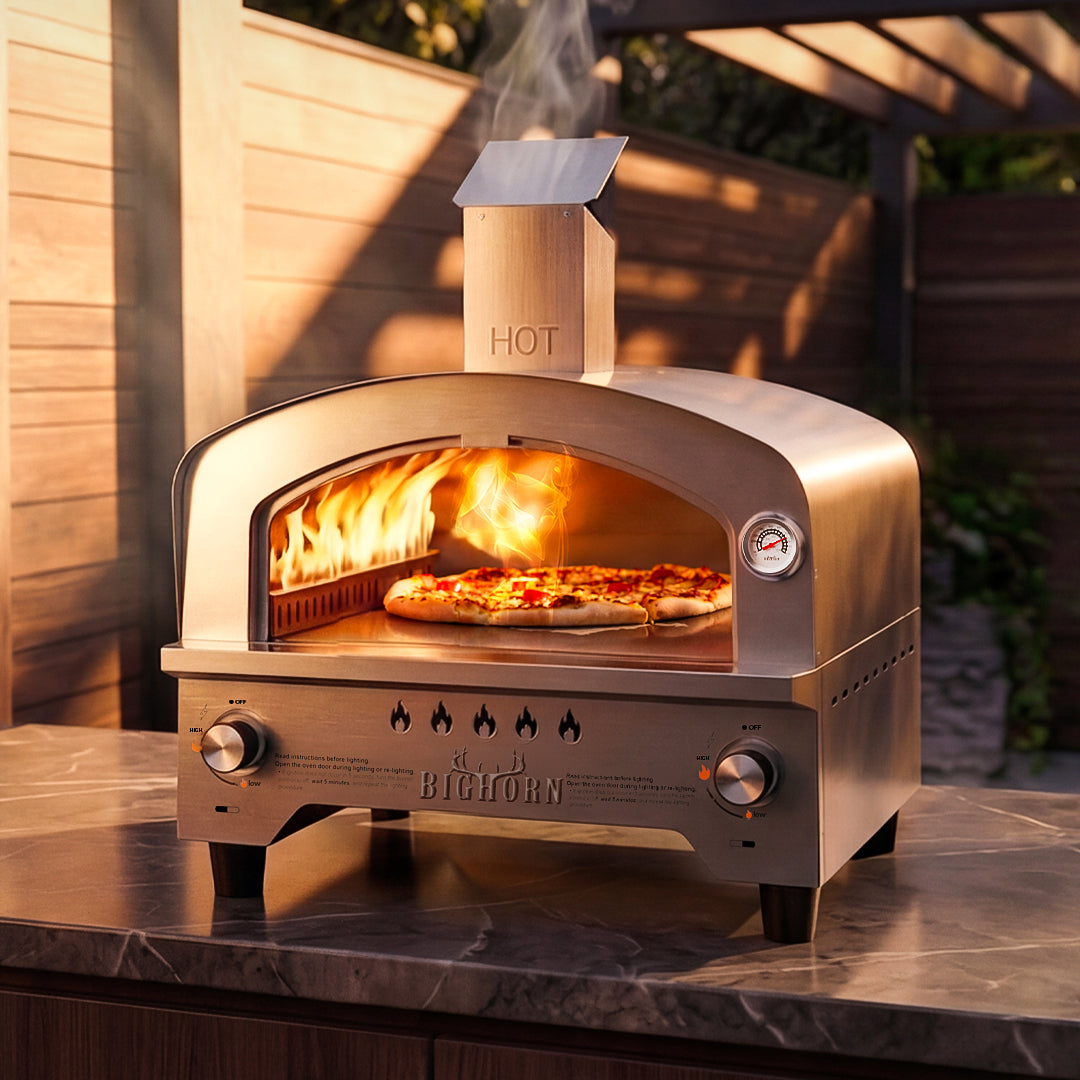
The Big Horn Outdoors 16-inch gas pizza oven includes:
-
A maximum pizza capacity of 16 inches.
-
A dual-gas-burner system.
-
A 360-degree auto-rotating ceramic stone.
-
A built-in digital thermometer.
-
A listed maximum temperature of 950°F.
-
An outdoor-only operating designation.
Its listed weight is 42 pounds.
This configuration is designed for people who want larger pizzas and assisted rotation rather than a hands-on pellet-firing process.
The built-in thermometer monitors the oven's internal temperature; a separate infrared thermometer remains useful for checking pizza-stone surface temperature.
Wood Pellets for Hands-On Pizza Making
A pellet pizza oven appeals to cooks who enjoy building and maintaining a live fire.
Wood pellets produce heat through combustion, while airflow and fuel supply influence flame intensity.
Big Horn Outdoors offers a 16-inch wood-pellet pizza oven with a 16-inch stone, adjustable airflow plate, built-in thermometer, and visible flame window.
The product is also compatible with a separately sold 16-inch gas-burner attachment.
This arrangement suits cooks who want to begin with pellet-fired pizza making while retaining the option to use compatible gas equipment later.
Importantly, pellet-and-gas compatibility does not mean that every package includes the gas burner. Check the selected configuration before purchasing.
How Should You Manage Heat When Cooking Larger Pizzas?
Larger pizzas require enough stored stone heat to cook the center of the dough while overhead heat browns the toppings and crust. A 16-inch pizza contains more dough and toppings than a 12-inch pizza of comparable thickness, making balanced heat management particularly important.
A larger cooking area does not eliminate the need to preheat properly.
The oven's air temperature and stone temperature are also different measurements.
A hot chamber can brown toppings quickly even when the stone has not stored enough energy to finish the bottom crust.
Preheat the Stone, Not Just the Air
The baking stone transfers heat directly into the dough through conduction.
This contact helps the crust set, drives moisture from the surface, and contributes to browning.
Before launching a large pizza, allow the stone to reach the appropriate temperature for your intended style.
An infrared thermometer can help you assess the stone surface.
Avoid Overloading the Center
A 16-inch pizza provides more topping space, but that does not mean every inch should be heavily covered.
Excess moisture from vegetables, fresh mozzarella, sauces, or other ingredients can leave the center undercooked.
Distribute toppings evenly and avoid creating a thick, wet layer in the middle.
Allow Heat Recovery Between Pizzas
Every pizza removes heat from the baking stone.
When cooking several large pizzas, check whether the stone needs additional recovery time before launching the next one.
This is especially important when entertaining guests and maintaining a continuous cooking schedule.
A larger oven can serve more food per pizza, but actual serving speed still depends on temperature recovery and preparation.
How Much Outdoor Space Does a 16-Inch Pizza Oven Need?
A 16-inch pizza oven needs more space than the pizza stone itself. Account for the oven's complete exterior dimensions, required safety clearances, fuel equipment, and room to handle a pizza peel.
The Big Horn Outdoors 16-inch gas pizza oven has listed exterior dimensions of:
28.54 × 25.98 × 15.75 inches.
These measurements describe the oven, not the full outdoor workstation.
You will also need space for dough preparation, toppings, a landing area for finished pizzas, and safe access to the oven opening.
Before choosing a location, consider whether you can comfortably:
-
Open and position the pizza peel.
-
Move around the oven without touching hot surfaces.
-
Keep children and pets away from the cooking area.
-
Maintain manufacturer-required clearances.
-
Store and connect the appropriate fuel safely.
Use a stable, suitable outdoor cooking surface that can support the appliance and tolerate the heat associated with its operation.
Never operate an outdoor-only gas or pellet pizza oven indoors, inside a garage, or in an enclosed tent.
Covered patios and other partially enclosed spaces also require particular care. Follow the manufacturer's placement and ventilation instructions rather than assuming that an open doorway provides adequate ventilation.
Is a 16-Inch Pizza Oven Practical for Camping and Tailgating?
A 16-inch pizza oven can be practical for outdoor trips when its dimensions, weight, fuel requirements, and setup process match the vehicle and destination. However, it is not automatically the better travel oven simply because it is advertised as portable.
A 42-pound oven, for example, requires different handling from a compact 12-inch model.
You also need to transport its fuel, cooking accessories, and a suitable support surface.
For occasional camping trips, a smaller oven may be more convenient.
For extended stays, RV trips, or tailgating with several people, the larger cooking capacity may justify the additional equipment.
The important distinction is between an oven that can be transported and one that you are comfortable transporting regularly.
Big Horn Outdoors Expert Views
A 16-inch pizza oven is most useful when its extra cooking area solves a recurring problem. Families benefit from preparing larger pizzas, frequent hosts can serve more food per baking cycle, and enthusiastic home cooks gain room to handle different pizza styles. But oven size should never be considered independently of fuel, heat control, storage, and the available outdoor cooking space.
The practical approach is to choose the pizza size you actually prepare most often, then select an oven that accommodates it comfortably. Extra capacity is valuable when it supports your cooking habits—not simply because the advertised diameter is larger.
Conclusion: Do You Really Need a 16-Inch Pizza Oven?
A 16-inch pizza oven is a practical choice for families, frequent outdoor entertainers, and home cooks who want to prepare large, shareable pizzas.
Its greatest advantage is capacity. A 16-inch pizza provides approximately 78% more surface area than a 12-inch pizza, making larger ovens useful when feeding several people or preparing larger pizza styles.
However, capacity should not outweigh everyday convenience.
Choose a larger oven when you regularly cook for groups, enjoy experimenting with pizza sizes, and have sufficient outdoor space.
Choose a compact oven when portability, limited storage, and personal-sized pizzas matter more.
For Big Horn Outdoors shoppers, the next decision is whether propane convenience, pellet-fired cooking, or a compatible multi-fuel configuration better matches the way they intend to cook.
The right pizza oven is not necessarily the largest one available. It is the one that makes the pizzas you want, in the setting where you will actually use it.
Frequently Asked Questions
Can you cook a 12-inch pizza in a 16-inch oven?
Yes. A 16-inch oven can accommodate smaller pizzas, including 10-inch and 12-inch pies. The extra stone space can make launching and turning easier, depending on the oven's design.
How many people can one 16-inch pizza feed?
A 16-inch pizza can typically serve approximately three or four people as a main meal, depending on appetite, crust thickness, and toppings. It may serve more when accompanied by salads, appetizers, and other dishes.
Does a 16-inch pizza take longer to cook?
Not necessarily. Baking time depends on dough thickness, topping quantity, stone temperature, overhead heat, and pizza style. A larger pizza can require additional attention to ensure the center cooks properly.
Can beginners use a 16-inch pizza oven?
Yes. Beginners can use a 16-inch oven, provided they understand preheating, launching, and temperature control. Models with assisted features, such as the Big Horn Outdoors 16-inch gas oven's auto-rotating stone, can reduce the need for manual pizza turning.
Is a 16-inch pizza oven too large for a couple?
Not necessarily. A couple who frequently entertains guests or enjoys making large pizzas may benefit from the additional capacity. However, couples who primarily prepare one or two small pizzas may find a 12-inch oven more convenient.