
There is no single best countertop electric pizza oven, because the right model depends on three numbers that interact: how hot it gets, how big a pizza you cook, and how it fits your counter and outlet. This guide turns "best" into a comparison you can make yourself — the criteria to weigh, the spec sheet fields that matter, and the questions to ask about any model — then shows how the Big Horn 14-inch electric oven fits that framework. We have not run independent lab tests on other brands, so this guide gives you a decision method and the verified specifications of the oven we sell rather than a ranking built on borrowed numbers.
Decide the criteria before you compare
Write down four answers before opening any product page: the largest pizza you regularly make, where the oven will sit, what outlet it will use, and how patient you are with preheat. Those four answers eliminate more models than any review. A 12-inch pizza household does not need a 16-inch deck; a kitchen with one free outlet does not want an oven that demands a dedicated circuit; a cook who wants pizza on weeknights cares more about preheat time than maximum temperature. Criteria first, comparison second — that order is the whole method.
Budget belongs in the criteria, but it belongs after the first four answers, not before them. An oven that fails your size or outlet needs is not a bargain at any price, and an oven that passes them at a slightly higher price can be the cheaper purchase if it bakes reliably for years. Set a comfortable range, then let the four answers narrow the field before the price filters the finalists. If the price still feels high for the finalist, ask what it would cost to replace the cheaper alternative in two years — durability and even baking often justify the difference.
What to compare: temperature, size, presets and wattage
Four spec fields carry most of the decision weight. Maximum temperature tells you what style of pizza the oven can attempt — higher heat suits Neapolitan-style crusts, while more moderate peaks still bake New York and pan styles well. Pizza size is usually stated as the largest diameter that fits; compare it to the pizzas you actually make. Preset modes tell you whether the oven can do more than pizza — many countertop models include modes for baking, broiling or air-frying. Wattage and outlet needs matter for kitchen reality: most countertop ovens run on a standard 120V outlet, but the wattage affects preheat speed and whether the oven can share a circuit comfortably.
| Comparison field | What it tells you |
|---|---|
| Maximum temperature | What pizza styles the oven can handle |
| Pizza size capacity | Whether your regular pizza fits |
| Preset modes | Whether it replaces other countertop tasks |
| Wattage / outlet | Preheat speed and kitchen circuit reality |
| Stone or deck | How evenly the bottom crust bakes |
| Footprint and height | Whether it fits your counter and clearance |
A spec sheet with those six fields filled in tells you more about fit than any review summary, because the summary is written for an average buyer who is not you.
Two less obvious fields deserve attention. Stone material and thickness affect how evenly the bottom bakes and how quickly the oven recovers between pizzas — a heavier stone holds heat through back-to-back bakes, while a thin deck drops temperature after the first pizza. Interior height matters if you plan to roast or bake anything taller than a pizza, and it is a field many listings leave out; if it is not stated, ask or assume the chamber is pizza-height. Write those two into your table alongside the obvious specs, because they are the ones buyers discover after the first few bakes, not before the purchase.
Counter space is a decision input, not an afterthought. Measure the footprint and the clearance above the oven before you compare models, because a 14-inch oven still needs breathing room on every side and a clear path to the outlet. Most countertop ovens also need to sit away from cabinets that can scorch, so check the manual's clearance guidance for the model you are considering and confirm your counter can provide it. An oven that fits the pizza but not the kitchen is a recipe for frustration no matter how well it bakes.
The Big Horn 14-inch countertop electric oven
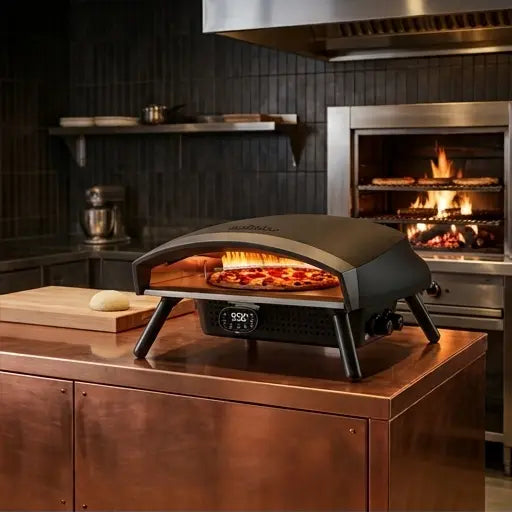
Big Horn's 14-inch indoor electric countertop pizza oven fits the framework with verified specs: it bakes up to a 14-inch pizza, runs on a standard household outlet, and includes six preset modes that cover more than pizza. Its countertop footprint makes it the indoor answer in a lineup that is otherwise built around outdoor gas and pellet ovens. If your answers point to indoor cooking with a standard outlet and pizzas up to 14 inches, this is the model in the family to compare against.

Reading reviews without being misled
Once you have the criteria, use reviews to test your shortlist rather than to choose for you. Look for reviewers who state the pizza size, crust style and outlet setup they used — those details tell you whether their experience applies to yours. Treat "restaurant-quality" promises as marketing until the reviewer shows the crust and the method. And beware the review that praises only temperature: an oven that gets hot but bakes unevenly is worse than one that peaks slightly lower and bakes evenly. Your own criteria table filters the noise better than any single review can.
Weight reviews by recency and volume of detail. A single five-star review from someone who baked one frozen pizza tells you little; a pattern of comments about the same issue — uneven browning, slow recovery, a noisy fan — tells you a lot. Search the question-and-answer sections for fit questions about the stone, the outlet and the counter clearance, because those are the details owners actually learn. And remember that a review written for a 12-inch pizza household may not apply to your 16-inch plans, even when the star rating is high.
Finally, set a realistic expectation for what an electric countertop oven can do. It will bake excellent New York and pan pizzas, and a good model with a hot stone can turn out respectable Neapolitan-style pies, but it is not identical to a wood-fired outdoor oven. If your priority is authentic wood-fired flavor above all else, an electric countertop model is the wrong category regardless of the specs; if your priority is convenient indoor pizza several nights a week, it is the right category, and the comparison table above will find the model that fits.
Where to go from here
After the comparison, the deeper questions are practical: whether the oven is worth it for your cooking frequency, how long it takes to preheat, what else you can cook in it, and how to clean it. The worth-it guide, the preheat explainer and the cleaning guide in this same family answer those in order, and the electric pizza oven collection keeps the current models together so you can compare specs side by side. Start with your criteria table, confirm the specs, and let the reviews test your shortlist — that sequence produces a choice you will not second-guess after the first pizza.
Before you order, do one final check on the store listing: confirm the current price, shipping and return policy, and the availability date, because those change faster than specs. If the listing omits any of the six comparison fields, ask the seller or check the manufacturer page rather than guessing. And once the oven arrives, keep the box until your first bake — not because you expect to return it, but because the box is the safest storage for the stone and accessories while you confirm the oven earns its counter space. The criteria table got you to a shortlist; the first pizza confirms the choice.
Product details and prices in this guide were verified against official Big Horn Outdoors listings during the September 5, 2026 review; re-check prices and availability at checkout.
Explore more in the Electric Pizza Oven Guides.