
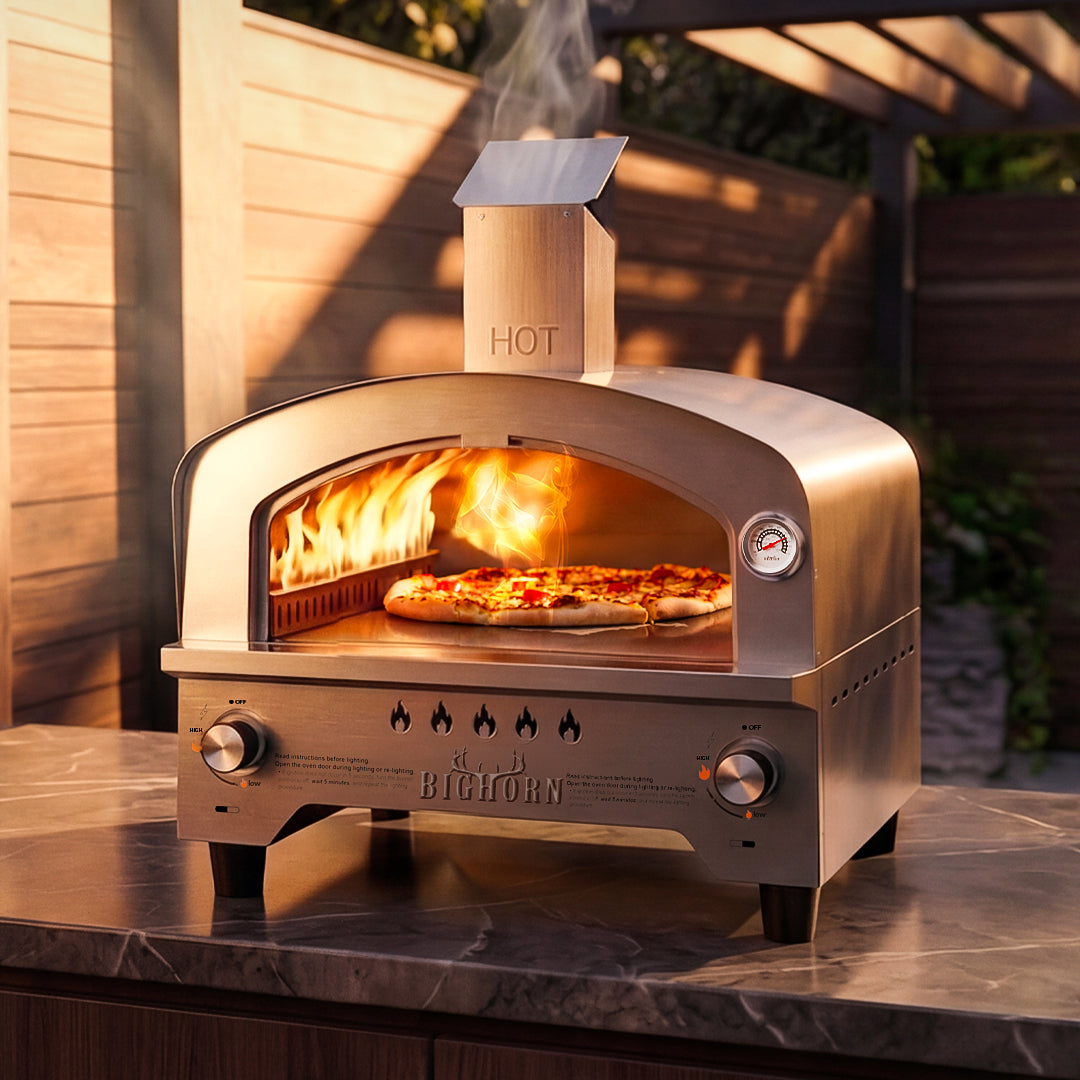
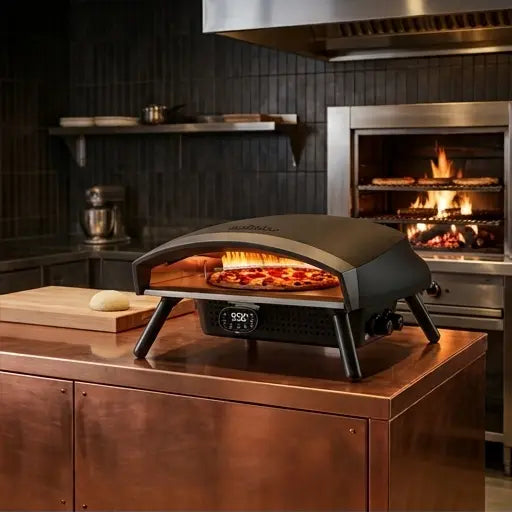

A portable pizza oven makes roughly 15–30 pizzas per hour in steady use — the exact number depends on the bake time (60–90 seconds per pie), the stone recovery between bakes (1–2 minutes), and the cook’s pace at the peel and launch. In practice, plan for about one pizza every 2–3 minutes with a single portable oven, which serves a party of 6–15 guests comfortably. This guide explains the throughput math, the limits that reduce it, and how to plan an oven for your party size.
The throughput figures are general estimates for a portable high-heat pizza oven like the Big Horn lineup; your real number depends on your model, your stone’s recovery, and how smoothly you run the launch flow.
What actually matters for this decision
- Bake time. A high-heat oven bakes each pizza in 60–90 seconds — the fast part of the equation.
- Stone recovery. The stone must return to temperature between pies; 1–2 minutes is the real bottleneck.
- Cook pace. Launching, rotating, and pulling smoothly keeps the oven busy; fumbling adds minutes between pies.
- Party size. Throughput decides whether one oven serves your group or you need a second station.
Understanding the throughput math
Think of throughput as bake time plus recovery time per pie. A 60–90 second bake plus a 1–2 minute stone recovery works out to roughly one pizza every 2–3 minutes, which is about 20–30 pizzas per hour in ideal steady flow. Real-world throughput is lower — 15–20 per hour — because launches, rotation, and serving take time. Use the ideal number to plan capacity and the realistic number to plan the party.
The key factors, ranked
| Factor | Effect on throughput | How to improve |
|---|---|---|
| Stone recovery | Determines time between pies | Let the stone return to heat; don’t rush consecutive launches |
| Cook pace | Adds time per pie | Stage dough; one person runs the oven |
| Bake time | Sets the fast part | 60–90 s bakes on a hot stone |
| Oven size | Larger deck recovers faster | A 16-inch deck holds more heat between pies |
| Party volume | Defines the target | Plan 1 pizza per 1–2 guests |
Matching the choice to your situation
For a party of 6–10, a single portable oven at one pizza every 2–3 minutes keeps the table full — about 6–10 pizzas over an hour of steady flow. For 15+, the same oven works if you pace the service in waves, but a larger deck or a second station removes the wait. Match the oven to the biggest group you feed on a normal weekend, and plan the throughput around the realistic 15–20-per-hour number rather than the ideal.
What the experts look for
Experienced hosts judge an oven’s party capability by recovery, not peak heat: how fast the stone returns to temperature between pies decides how many pizzas an hour the oven can genuinely hold. They also watch the launch flow — a staged dough supply and one person at the oven keeps the 2–3 minute rhythm steady, while a cluttered station turns a 20-per-hour oven into a 10-per-hour one.
Common mistakes and how to avoid them
- Rushing the stone recovery. Launching into a cooled deck gives pale bases; the recovery minute is part of the throughput, not wasted time.
- Judging by peak heat. Peak temperature does not equal throughput; recovery and cook pace do.
- Under-staging dough. Cold dough or an unprepared topping bar stalls the flow; stage ahead.
- Letting one person do everything. A dedicated oven runner keeps the bakes moving; the host should be serving, not juggling.
- Planning by the ideal number. Use the realistic 15–20 per hour for party planning, not the theoretical max.
Realistic expectations and results
In real use, a single portable pizza oven delivers about 15–20 pizzas per hour — enough for a party of 6–15 served in waves, and a strong show for a small gathering. The limit is the stone’s recovery and the cook’s pace, not the oven’s heat. Expect about one pizza every 2–3 minutes, plan the menu around that rhythm, and the oven keeps the table full all afternoon.
The takeaway in one paragraph
A portable pizza oven makes roughly 15–30 pizzas per hour in ideal flow and about 15–20 per hour realistically — one pizza every 2–3 minutes with a hot stone and a smooth launch pace. Plan one pizza per 1–2 guests, stage the dough and toppings, and let the stone recover between pies. Match the oven and the service plan to your party size, and throughput stops being a bottleneck.
See the pizza ovens and party-capable sizes. 12-inch pellet pizza oven · pizza oven collection
FAQ
How many pizzas can a pizza oven make per hour?
A portable high-heat pizza oven makes about 15–20 pizzas per hour in realistic use — one pizza every 2–3 minutes including stone recovery. The ideal math (60–90 second bakes, no delays) is higher, but plan a party around the realistic number.
What is the 3/8 pizza rule?
The “3/8 rule” is a party-planning shorthand used on some Big Horn tools and recipes — it relates dough or servings to pizza counts for a crowd. For throughput planning, use the simpler estimate of one 12-inch pizza per 1–2 guests and pace the oven at one pie every 2–3 minutes.
What is the 55 rule for pizza?
The “55 rule” varies by recipe — it often refers to a 55–65% hydration window or a time/temperature combination. For throughput planning, the reliable numbers are a hot stone, a 60–90 second bake, and a 1–2 minute stone recovery between pies.
What is the 2 pizza rule?
The “2 pizza rule” is a party estimate meaning about one pizza per 1–2 guests, and ordering or baking accordingly. For a high-heat pizza oven, that translates to roughly 6–15 pizzas for a party of 10–15, paced at one pie every 2–3 minutes.