Yes—if the venue permits that fuel type and you can operate the oven safely in a designated outdoor tailgating area. A portable pizza oven can work well for a tailgate, but stadium policies vary widely: some allow propane grills only, while others prohibit wood, pellets, charcoal, open flames, or all cooking appliances. Confirm the rules before packing.
Can You Legally Use a Pizza Oven at a Tailgate?
You can use a pizza oven at a tailgate only when the stadium, venue, or parking operator permits both tailgating and your oven’s specific fuel source. A portable propane oven may be allowed where pellet, wood-fired, charcoal, or open-flame cooking is prohibited.
The first decision is not which pizza oven to buy—it is whether your event allows one. Tailgating rules are venue-specific and can change by lot, event, parking pass type, weather condition, and local fire restrictions.
For example, some stadium lots permit natural-gas and propane grills but prohibit charcoal grills, wood stoves, oil fryers, open-pit fires, and other cooking stations. Other venues permit barbecue grills in designated areas but do not allow open flames or equipment that could damage people, vehicles, landscaping, or pavement.
Before loading a pizza oven into the car, check these details:
- Whether tailgating is allowed in your parking lot and with your parking pass
- Whether propane, butane, pellets, wood, charcoal, or electricity is permitted
- Whether the venue defines a pizza oven as a grill, stove, open flame, or prohibited cooking station
- When the lot opens and when all cooking must end
- Whether your setup must stay directly behind your vehicle
- Whether generators are allowed for electric equipment
- Whether fire extinguishers are required or strongly recommended
- Whether local burn bans, wind advisories, or weather restrictions apply
Do not assume a portable oven is automatically acceptable because it is small. A compact pellet pizza oven still produces flame, heat, smoke, hot exhaust, and ash. A propane pizza oven still uses a pressurized fuel cylinder and an open burner. The venue’s written policy and on-site staff instructions control the decision.
Which Pizza Oven Fuel Is Best for Tailgating?
For many stadium tailgates, propane is the most practical pizza-oven fuel because it lights quickly, provides adjustable heat, and is more commonly allowed than wood, charcoal, or pellets. However, a propane oven is appropriate only where venue rules specifically permit propane cooking.
Fuel selection affects setup speed, temperature control, smoke output, cleanup, and the likelihood that a venue will allow the appliance. Use the following comparison to match the oven to the location—not simply to your preferred pizza style.
| Fuel or power source | Tailgate strengths | Main limitations |
|---|---|---|
| Propane | Fast ignition, adjustable flame, low ash, straightforward shutdown | Requires an approved cylinder, leak checks, clearance, and venue permission |
| Butane | Compact canisters and convenient stove-style portability | Fuel supply and cold-weather performance can be limiting; rules may vary |
| Wood pellets | High-heat live-fire cooking and wood-fired flavor | Smoke, embers, ash, refueling, and restrictions can make it unsuitable for stadium lots |
| Hardwood or charcoal | Traditional live-fire character | Often prohibited because of sparks, ash, smoke, and open-flame restrictions |
| Electric | No combustion or live flame at the oven | Requires adequate power and a venue-approved generator or outlet; many electric countertop ovens are for indoor use only |
| Multi-fuel | Flexibility where compatible accessories and local rules allow | The allowed fuel, not the oven’s capability, determines whether it can be used at the event |
A propane pizza oven is usually the lower-friction choice for a permitted stadium tailgate. The burner creates heat by combusting gas, while the oven’s interior reflects and circulates heat around the pizza. The cook can adjust the flame during service, which is useful when guests arrive all at once and you need to balance stone recovery with topping doneness.
Pellet and wood-fired ovens can be excellent for outdoor cooking, but they demand more active fire management. Pellet combustion produces hot gases, radiant heat, smoke, and ash. That can be desirable in an open backyard or campsite, yet it may conflict with a stadium’s prohibition on wood stoves, solid fuel, open flames, or smoke-producing appliances.
Electric countertop pizza ovens should never be treated as automatically tailgate-ready. Confirm the model’s approved environment, required wattage, power source, ventilation requirements, and whether generators are permitted. An extension cord crossing a drive lane or pedestrian path is a trip hazard and may violate venue policy.
What Makes a Pizza Oven Tailgate-Ready?
A tailgate-ready pizza oven is portable enough to load safely, stable on a heat-resistant surface, compatible with allowed fuel, and practical to cool and transport after the event. The best setup prioritizes control and safe workflow over maximum peak temperature.
Portability is more than product weight. Consider the total load: oven, stand or table, fuel, pizza stone, peel, infrared thermometer, dough box, toppings, cutting board, hand protection, cleanup supplies, cooler, and fire extinguisher.
A portable oven should have a stable footprint and a setup surface that does not flex, tilt, or create crowding around the hot opening. A pizza oven should not sit directly on a vehicle tailgate unless the manufacturer expressly permits that surface and you can maintain safe clearances from paint, upholstery, fuel containers, plastic trim, and people.
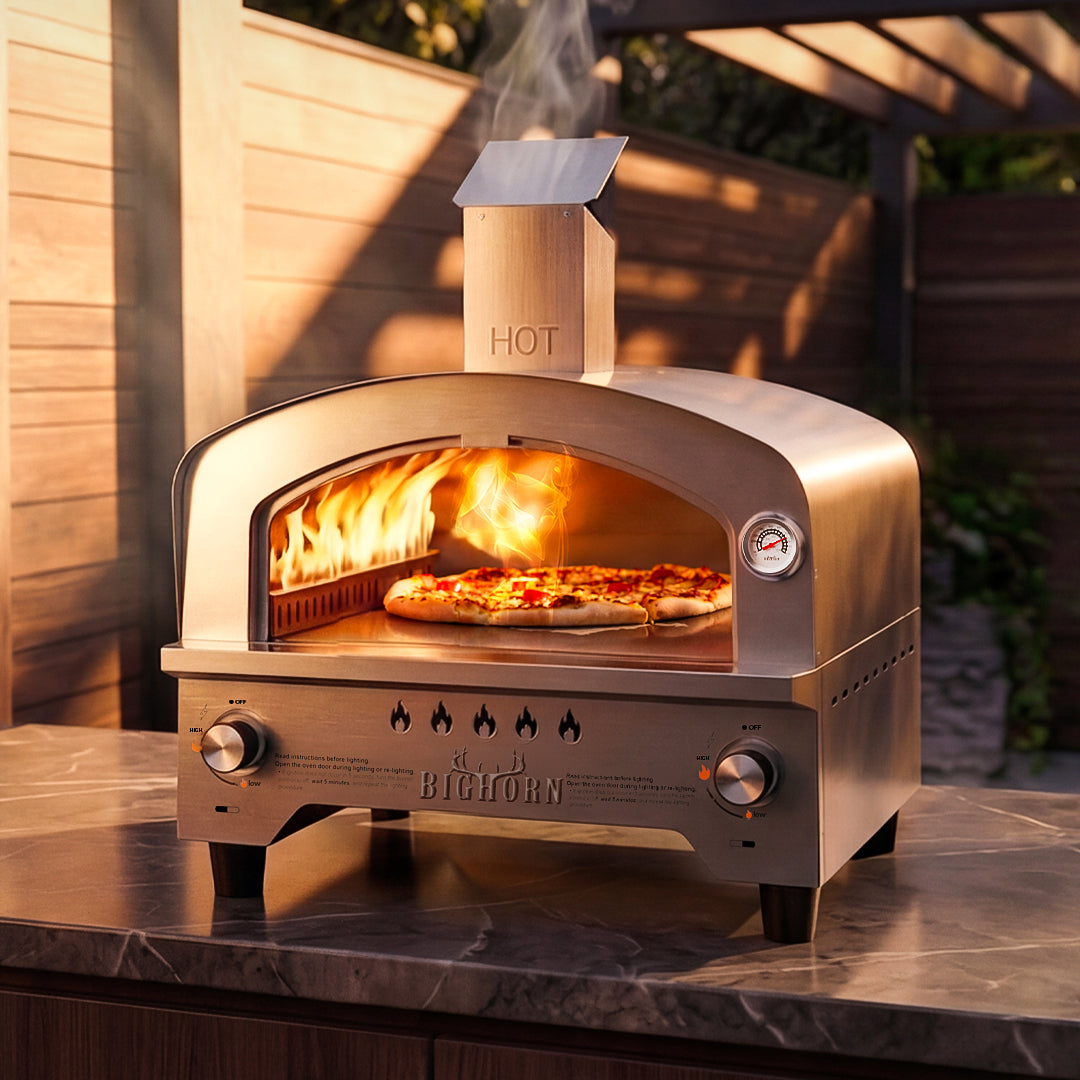
The Big Horn Outdoors 12-inch wood-pellet pizza oven is one example of a compact outdoor format to evaluate for a permitted live-fire setting. The official product page lists stainless-steel construction, folding legs, a detachable chimney, and a listed weight of about 25 pounds. It uses pellets, preheats to 662°F in approximately 18 minutes according to its product information, and is designed for outdoor cooking.
Those details do not make it suitable for every event. A pellet-fired oven may be a sensible choice for a private tailgate, campsite, or venue that allows solid-fuel cooking, but it is not the default option for a stadium lot that allows propane only.
A practical tailgating kit includes:
- A stable metal, aluminum, or manufacturer-approved outdoor table or cart
- A pizza peel sized for the oven opening
- An infrared thermometer for checking stone temperature
- Heat-resistant gloves rated for outdoor cooking tasks
- A food-safe dough box or covered trays
- A small fire extinguisher suitable for cooking and flammable-liquid emergencies
- A leak-check solution for propane connections, if using gas
- Tongs, a turning peel, cutter, trash bags, and disposable wipes
- A heat-safe plan for the oven after shutdown
Big Horn Outdoors began with a 2012 backyard cooking challenge centered on managing uneven heat, excess smoke, and unstable temperatures. That problem still applies at a tailgate: a portable oven should simplify controlled cooking, not introduce avoidable fire, traffic, or packing complications.
How Do You Set Up a Pizza Oven Safely?
Set up a pizza oven on level, noncombustible ground or a sturdy outdoor table, with clear space around the oven, the exhaust path, and the cooking zone. Never operate a combustion pizza oven inside a vehicle, tent, enclosed canopy, garage, RV interior, or any other enclosed or partially enclosed space.
A pizza oven creates several types of heat at once. The stone stores conductive heat that crisps the bottom of the pizza. Flames and hot surfaces radiate heat toward the toppings. Hot air moves through the chamber by convection. The exterior, chimney, and exhaust area can remain hazardous long after the last pizza comes out.
Use this tailgate setup sequence:
- Confirm the location. Stay inside the venue’s assigned tailgate footprint and keep drive aisles, fire lanes, sidewalks, and accessible routes clear.
- Choose a stable cooking surface. Set the oven on a level, sturdy, heat-resistant table or cart. Do not balance it on a cooler, folding chair, plastic tote, unstable pickup-bed surface, or uneven grass.
- Create a controlled cooking zone. Keep guests, children, pets, chairs, coolers, paper products, tents, and fuel containers away from the oven opening, chimney, burner, and hot sides.
- Position for wind. Wind can push flames, destabilize burner performance, increase smoke movement, and cool the stone. Orient the oven according to its manual, without blocking required air intake or exhaust.
- Keep fuel separate. Store spare propane cylinders, pellets, and butane canisters away from the oven and direct heat. Never place fuel beneath the oven or in its exhaust path.
- Check the gas system. For propane, inspect the hose, regulator, connections, and cylinder valve before ignition. If you smell gas, turn off the supply and do not light the burner.
- Preheat the stone. A hot air temperature alone does not guarantee a properly heated pizza stone. The stone needs time to absorb heat, which is why an infrared thermometer is more useful than guessing from the flame.
- Plan the serving line. Keep raw dough and toppings on one side, the oven in the center, and cooked pizza and cutting tools on the other. This reduces cross-traffic around high heat.
A common tailgate mistake is setting the oven up too close to the vehicle because the cooking area feels convenient. Vehicles contain paint, plastic, fuel, fabrics, wiring, and cargo that can be damaged by radiant heat, sparks, grease, or a tipped oven. Leave space, follow the manufacturer’s clearance guidance, and comply with any stricter venue rule.
How Many Pizzas Can You Serve Before Kickoff?
A 12-inch portable pizza oven is best for small batches and continuous service, not for feeding a large crowd all at once. The realistic output depends on oven recovery, dough preparation, topping workflow, fuel management, and how many people are trained to cook.
High-temperature pizza ovens can bake thin pizzas quickly, but a “60-second pizza” does not mean one pizza per minute from arrival to serving. You still need to launch, rotate, retrieve, slice, reload, manage the stone, and replenish fuel when necessary.
The Big Horn Outdoors 12-inch wood-pellet pizza oven’s official page states that it can reach 662°F in about 18 minutes and bake pizza in 90 seconds or less under its stated conditions. The same page advises rotating pizza every 15 to 20 seconds and recommends preheating the stone to 660°F for consistent results.
For a tailgate, build the menu around that rhythm:
- Plan for individual 10- to 12-inch pizzas rather than oversized share pies
- Limit toppings so pizzas launch cleanly and cook evenly
- Pre-portion cheese, sauce, vegetables, and proteins before leaving home
- Keep dough balls covered and cool until shaping time
- Make a few crowd-friendly combinations instead of taking custom orders
- Assign one person to stretch and top pizzas and another to manage the oven
- Include a non-pizza item that does not require oven space, such as chilled salad, fruit, or prepared snacks
Stone temperature is central to pizza quality. If the stone is too cool, the crust can bake slowly while toppings overcook. If it is excessively hot, flour and cheese can burn before the interior of a thicker dough sets. The goal is not simply maximum heat; it is a stable balance between the stone temperature, flame intensity, dough thickness, and topping load.
Big Horn Outdoors Expert Views
“A pizza oven can make a tailgate more memorable, but the venue rulebook is part of the cooking plan. Match the oven’s fuel to the permitted fuel source, choose a stable outdoor setup, and leave enough time for preheating, service, cooldown, and packing. High heat is useful only when it is controlled: keep clear walkways, separate fuel from the oven, check the stone temperature, and never rush a hot appliance back into a vehicle.”
What Safety Rules Matter Most at a Tailgate?
The most important tailgate pizza-oven rule is simple: operate only in an approved outdoor area with clear access for people and emergency vehicles. Never leave a lit or hot oven unattended, and never pack it while it is still hot.
Stadium operators commonly restrict where tailgating can occur, how much space equipment may occupy, and which cooking fuels are permitted. A compliant setup must not block fire lanes, drive aisles, sidewalks, accessible parking spaces, or vehicle traffic.
Use these safety rules for every event:
- Follow the pizza oven’s owner’s manual and the venue’s rules; use the stricter requirement when they differ.
- Keep a fire extinguisher immediately accessible, not buried in the car.
- Keep children and pets outside the cooking area.
- Do not use a combustion appliance in enclosed or partially enclosed structures.
- Do not use an oven under a low canopy unless the oven manufacturer explicitly permits it and required clearances are maintained.
- Keep paper plates, napkins, boxes, decorations, and disposable tablecloths away from heat and flame.
- Do not refill a pellet hopper, change a gas cylinder, or handle fuel near an active ignition source.
- Do not move the oven while it is lit, hot, or loaded with burning fuel.
- Do not pour water into a hot oven or onto burning grease; use the appropriate extinguisher and follow emergency guidance.
- Stop cooking if wind makes flame control, smoke direction, or stability unsafe.
- Shut down early enough for full cooldown before leaving for the stadium gates.
For propane equipment, close the cylinder valve after cooking according to the appliance instructions. Once the oven is cool, disconnect and secure the cylinder for transport as directed by the manufacturer and applicable law. For pellet equipment, allow fuel and ash to cool completely before cleaning or moving the oven.
Cleanup, Cooldown, and Transport
A pizza oven should be completely cool, cleaned of loose food debris, and secured before it goes back into your vehicle. Hot stones, ash, grease, and metal components can damage vehicles and create fire hazards long after the flame is out.
Start shutdown before the venue’s required tailgate end time. A high-heat pizza oven can retain heat in the stone and metal body after the burner is off or pellets stop burning. Build cooldown time into your schedule rather than trying to pack immediately before kickoff.
For pellet ovens, remove ash only after it is fully cold and place it in a noncombustible container. Do not dump ash onto a parking surface, into landscaping, or into a plastic trash bag. For propane ovens, confirm the burner is off and the fuel supply is closed before handling the unit.
The Big Horn Outdoors 12-inch pellet model lists a detachable chimney and folding legs, features that can make storage more compact after the oven has cooled. Those components should be handled only when cool, clean, and dry. Never disassemble a hot oven simply to meet a deadline.
Use a fitted cover or protective transport arrangement only after the oven is cold. Secure the oven so it cannot shift, tip, or strike other cargo during the drive home.
Choose the Right Tailgate Setup
A pizza oven is a strong tailgate option when the venue permits it, you have a stable outdoor workspace, and you can manage heat, fuel, and cooldown without blocking traffic or rushing. For propane-approved stadium lots, a portable gas oven is often the simplest fit; for private gatherings or solid-fuel-friendly sites, a pellet oven can offer a live-fire pizza experience.
Choose based on your actual conditions:
- Select propane when rules allow gas, you want fast startup, and you need straightforward flame control.
- Select pellets only when the location permits solid fuel and you have time and space for ash, smoke, and cooldown management.
- Select electric only when the oven is approved for the environment and you have a safe, legal power source.
- Choose a compact format when vehicle space, table space, and carrying weight matter more than maximum cooking capacity.
- Use a larger cooking setup only when you have enough room, an approved operating area, and enough hands to manage service safely.
Big Horn Outdoors offers pizza ovens and outdoor-cooking equipment across multiple formats, but every model has its own fuel, intended environment, accessories, and operating instructions. Match the exact oven—not a general product category—to the event’s rules and your cooking plan.
FAQs
Can I use a wood-pellet pizza oven in a stadium parking lot?
Only if the venue specifically permits pellet-fired or solid-fuel cooking. Many stadiums allow propane grills while prohibiting charcoal, wood stoves, open fires, or other smoke- and ember-producing appliances, so check the current event policy before bringing a pellet oven.
Can I put a pizza oven on my truck tailgate?
Do so only if the oven manufacturer allows that setup and you can provide a level, stable, heat-safe surface with required clearances. In practice, a dedicated outdoor table or cart is usually easier to control and keeps heat farther from vehicle paint, plastic, fuel, and cargo.
How early should I start a pizza oven before a game?
Arrive early enough to park, unload, set up safely, preheat, cook, shut down, cool the oven, and pack before the venue’s tailgate cutoff. For example, the Big Horn Outdoors 12-inch wood-pellet pizza oven lists an approximately 18-minute preheat to 662°F, but service and cooldown require additional time.
Do I need an infrared thermometer for a tailgate pizza oven?
An infrared thermometer is highly useful because it measures the pizza stone’s surface temperature. That helps you avoid launching dough onto a stone that is too cool for crisp crust or too hot for the dough style and topping load.
Can I cook more than pizza in a portable pizza oven?
Many outdoor pizza ovens can cook suitable foods such as vegetables, fish, and meats when used with the correct cookware and according to the manufacturer’s instructions. In a tailgate setting, keep the menu simple, avoid greasy flare-up-prone preparations, and choose foods that do not compromise safe handling or quick cleanup.