By the Big Horn Outdoors Product Team
Published September 16, 2026
To cook several pizzas without losing too much heat, fully preheat the oven and stone, prepare every pizza before the first launch, keep the door closed, and pause for heat recovery between pies. In most ovens, allow about 5–10 minutes between pizzas; use an infrared thermometer when possible and relaunch only after the stone returns to your target temperature.
Why does a pizza oven lose heat between pizzas?
A pizza oven loses heat because cold dough, wet toppings, an open door, and repeated launches draw energy from the baking surface faster than the oven can replace it. The stone temperature—not the air temperature shown by an oven gauge—has the greatest effect on how quickly the crust browns.
A pizza stone acts like a thermal battery. It stores heat during preheating, then transfers that energy into the dough when you launch a pizza. The first pie may absorb a substantial amount of heat from the stone, especially if the dough is cold, the toppings are wet, or the pizza remains on one area of the deck.
Heat loss usually comes from four sources:
- Opening the door or front opening for too long.
- Launching several cold pizzas in the same location.
- Using a stone that has not fully heat-soaked.
- Reducing the burner or fire immediately after removing a pizza.
Radiant heat from the flame or heating element helps brown the top, while conduction from the stone cooks and crisps the bottom. A strong top flame cannot completely compensate for an underheated stone, so managing both heat sources matters.
How should you preheat for multiple pizzas?
For multiple pizzas, preheat the oven with the stone inside until the stone itself is fully saturated with heat; a typical home stone may need 45–60 minutes, while some high-heat outdoor ovens reach operating temperature sooner according to their design and fuel system. The oven’s air temperature alone is not a reliable readiness test.
Place the stone in the oven before lighting or switching on the heat. A cold stone exposed to a sudden temperature change can experience thermal shock, particularly if it is damp, cracked, or not designed for high-heat use.
Use these preparation steps:
- Heat the stone, not just the oven cavity. If available, check the center and front-left, center, and front-right areas with an infrared thermometer.
- Keep the oven at its normal operating heat. Do not begin cooking as soon as the air thermometer reaches its target if the stone remains cool.
- Prepare toppings in advance. Excess moisture forces the oven to work harder and can leave the crust pale or soft.
- Stretch and top several dough rounds before launching the first pizza. Keep them on lightly floured peels or prepared launch surfaces.
- Use room-temperature dough when practical. Very cold dough removes more heat from the stone and is harder to launch cleanly.
- Keep toppings light and evenly distributed. A heavily loaded pizza takes longer to bake and causes a larger heat drop.
The goal is not to keep the oven door open while waiting for each pizza. The goal is to complete each launch and retrieval quickly, then give the stone time to recover with the heat source operating.
What is the best workflow for a pizza party?
The most reliable workflow is prep first, launch quickly, recover fully, and rotate launch positions. For a stone-based oven, plan on roughly 5–10 minutes of recovery between pizzas, but use the stone temperature and the crust of the previous pizza as practical indicators.
Arrange a small production line before cooking:
- Dough balls ready to stretch.
- Sauce and toppings portioned.
- A launching peel and turning peel available.
- A landing board or cooling rack ready.
- A timer and infrared thermometer within reach.
- Fuel, if applicable, already available beside the oven.
Launch the first pizza toward the cooler side of the stone if your oven has a visible hot spot. Avoid placing every pizza in exactly the same location. A hot area directly beneath the flame may brown one section quickly while the rest of the base remains underdeveloped.
During baking, turn the pizza when the exposed edge begins to blister or darken. Turning helps compensate for uneven radiant heat and prevents one side from scorching. After removing the pizza, close the door immediately and restore the flame or fuel level according to the manufacturer’s operating instructions.
Use a simple recovery test:
- Check the center of the stone.
- Check the area where the next pizza will be launched.
- Relaunch when the stone has returned to the target range for your style.
- If the second pizza browns more slowly, extend the recovery interval rather than simply adding more toppings or cooking it longer at low heat.
For a small oven, cooking pizzas one at a time usually produces more consistent results than trying to overlap them. Many portable ovens are designed for a single pizza deck, so crowding the cooking surface restricts airflow and makes turning difficult.
Which fuel and oven setup recover heat best?
Fuel choice affects how quickly an oven replaces lost heat, but the stone’s thickness, oven insulation, burner position, and airflow also matter. Gas usually offers the fastest control, pellets provide live-fire operation, and electric ovens offer steady adjustment when their rated capacity is sufficient for repeated baking.
| Setup | Heat-management advantage | Main limitation for several pizzas |
|---|---|---|
| Gas-fired outdoor oven | Flame output can be adjusted quickly between launches | Requires an appropriate outdoor fuel setup and ventilation |
| Wood-pellet oven | Adds live-fire character and can maintain strong radiant heat | Fuel feeding and flame control require closer attention |
| Electric countertop oven | Consistent controls and no fuel replenishment | Recovery depends on electrical power, stone mass, and the unit’s heating capacity |
| Baking steel | Conducts heat rapidly and can recover quickly | Can brown the bottom aggressively and requires careful temperature control |
| Pizza stone | Provides familiar stone-baked texture and moderate heat transfer | Usually needs more recovery time than a conductive steel surface |
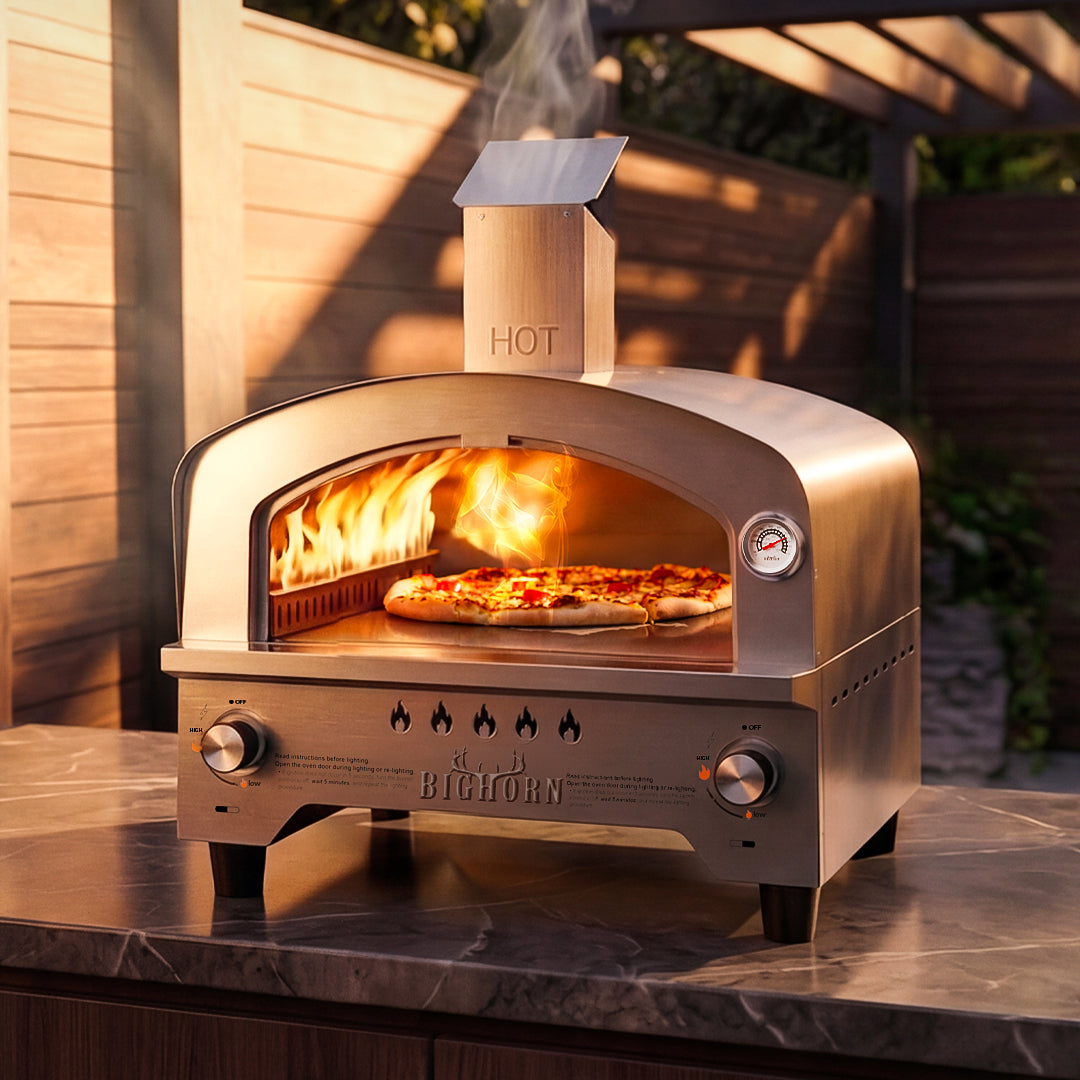
Big Horn Outdoors sells pizza ovens in several formats, so specifications must be checked by exact model rather than assumed across the product range. For example, the official 12-inch Pellet & Gas Pizza Oven is described as a stainless-steel oven with a 12-inch pizza stone, foldable legs, a detachable gas burner, and pellet or gas operation. Its product page states that it reaches 350°C, or 660°F, in about 20 minutes and can bake pizza in 60–90 seconds under suitable conditions. These details apply to that model only.
A multi-fuel oven can be useful for a gathering because gas provides straightforward heat adjustment while pellets offer a different live-fire cooking experience. However, changing fuel systems during a cooking session should follow the model’s instructions. Never improvise a burner, pellet system, regulator, or electrical attachment.
How can you maintain heat while cooking?
Maintain heat by minimizing open-door time, keeping the heat source active between bakes, and matching the cooking schedule to the oven’s capacity. The best technique is controlled recovery—not continuously increasing the flame while a pizza is inside.
Use this sequence for each pizza:
- Remove the finished pizza and place it on a rack or board.
- Close the oven door or opening promptly.
- Check the next launch area for flour, cheese, or toppings that could burn.
- Adjust fuel only as the manufacturer recommends.
- Wait for the stone to recover.
- Launch the next pizza and begin turning when the crust requires it.
Do not sweep loose flour into a live flame. Excess flour can burn and create bitter smoke. Remove debris only when it is safe to do so with the appropriate tool and after following the oven manual.
If the oven has a strong flame near the back or side, move the pizza during the bake rather than positioning the dough directly in the hottest location for the entire cook. Radiant heat can brown exposed toppings quickly, so a lower flame during the bake and a stronger recovery phase may produce better control than maximum heat at every moment.
For very wet toppings, use less sauce, drain fresh mozzarella, and avoid piling ingredients in the center. Moisture must evaporate before the crust can crisp, which extends baking time and increases heat demand.
Can you cook different pizza styles in one session?
Yes, but cook the pizzas that need the highest heat first and finish with styles that perform better at lower temperatures. A thin, lightly topped pizza generally places less demand on the oven than a thick or heavily loaded pie.
A practical order is:
- High-heat, thin-crust or Neapolitan-style pizzas first.
- Moderate-temperature pizzas with more toppings next.
- Thick-crust, pan-style, bread, vegetables, or desserts after the oven has cooled slightly.
This approach reduces the need to force a lower-temperature oven back to an extreme heat level. It also allows the stone to transition naturally from high-heat baking to residual-heat cooking.
When serving a group, keep completed pizzas warm on a rack rather than stacking them tightly. Stacking traps steam against the crust and can soften the base. Slice each pizza only shortly before serving if crispness is important.
If guests want different toppings, standardize the dough size and thickness first. Consistent dough makes it easier to judge recovery time and compare results from one pizza to the next.
Safety and maintenance essentials
Outdoor pizza ovens should be used only in the environment and with the fuel specified by the manufacturer. Keep combustible materials away from the oven, provide adequate clearance and ventilation, and never use an outdoor fuel-burning oven indoors, inside a garage, or in an enclosed space.
Before a multi-pizza session:
- Set the oven on a stable, heat-resistant surface.
- Confirm that the stone is dry and free from visible damage.
- Inspect the burner, hose, regulator, hopper, or power connection as applicable.
- Keep children and loose clothing away from the opening and flame.
- Use heat-resistant gloves and appropriate metal tools.
- Keep a clear route for carrying hot pizzas.
- Follow the exact shutdown and cooling procedure in the manual.
After cooking, let the oven and stone cool naturally. Do not pour water onto a hot stone or use a wet stone in a high-heat oven. Thermal shock can crack the cooking surface.
Brush away cooled flour and food residue with a suitable dry brush. Avoid soap or soaking unless the manufacturer specifically permits it. Cover and store the oven only after it is completely cool and dry.
Big Horn Outdoors traces its backyard-cooking story to a 2012 cooking challenge in Los Angeles focused on reducing uneven heat, excessive smoke, and unstable temperatures. That practical emphasis is relevant to multi-pizza cooking: predictable airflow, adequate thermal mass, and simple heat control are more useful than chasing a temperature number without checking the cooking surface.
Big Horn Outdoors Expert Views
“For several pizzas, treat the stone as the part of the oven that needs recovery. Prepare the next pizza before you remove the current one, keep the opening closed whenever you are not launching or turning, and do not assume that a hot air reading means the deck is ready. If the base is becoming pale, wait for the stone to recover before changing the recipe. On a compatible Big Horn Outdoors multi-fuel model, use only the specified fuel system and follow the product instructions when switching between pellet and gas operation. Consistency comes from controlling the sequence: preheat, launch, turn, remove, recover, and repeat.”
Final checklist for consistent batches
To cook several pizzas without losing heat:
- Fully preheat the stone before the first pizza.
- Prepare all dough and toppings in advance.
- Keep pizzas lightly topped and reasonably dry.
- Open the oven only for launching, turning, and removing.
- Close the door immediately after each step.
- Rotate pizzas to manage hot spots.
- Allow about 5–10 minutes of recovery when using a stone, adjusting for your oven.
- Check the actual stone temperature when possible.
- Keep the heat source active between pizzas according to the manual.
- Cook high-heat styles first and lower-temperature foods later.
- Use only the fuel, accessories, and operating environment approved for the exact model.
Choose the setup that matches your cooking style. Gas favors quick adjustment, pellets suit live-fire cooking, electric countertop ovens offer controlled indoor operation when specifically rated for it, and a portable Big Horn Outdoors oven can suit outdoor gatherings when its exact fuel and capacity match the plan.
Frequently Asked Questions
How long should I wait between pizzas?
A stone-based oven commonly needs about 5–10 minutes to recover after a pizza, although the exact interval depends on stone thickness, oven insulation, fuel output, pizza size, and topping moisture. Relaunch when the next cooking area has returned to the target temperature.
Should I leave the oven door open between pizzas?
No. Keep the door or opening closed between launching, turning, and removing pizzas. An open oven loses heat through convection and allows the cooking surface to cool faster.
Can I cook two pizzas at the same time?
Only if the oven is specifically designed with enough deck area and airflow for two pizzas. A 12-inch single-deck oven, including the Big Horn Outdoors 12-inch Pellet & Gas Pizza Oven, should be treated as a one-pizza-at-a-time oven rather than a two-pizza oven.
Is gas or pellets better for cooking several pizzas?
Gas generally makes heat adjustment and recovery easier, while pellets provide a live-fire fuel experience. Neither is automatically better; choose the fuel system supported by the exact oven and the level of control you need.
Why is my second pizza paler than the first?
The stone probably has not recovered, or the second pizza was launched in the same depleted area. Wait longer, maintain the recommended heat, use a lighter topping load, and move the next pizza to another suitable part of the stone.