
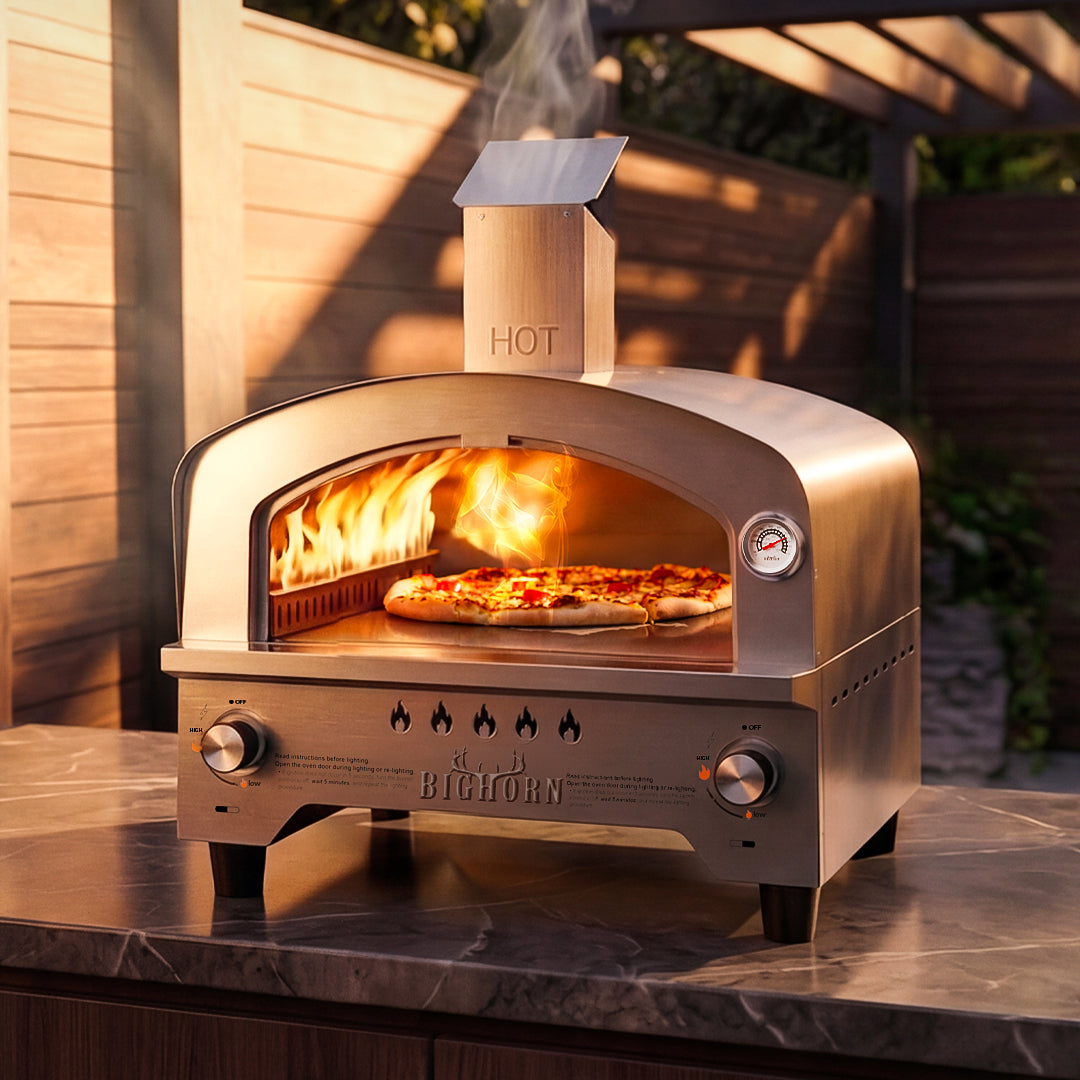
A pellet oven keeps going out when fuel delivery, airflow, or ignition fails—most often from an empty or bridged hopper, damp pellets, ash-choked fire pot, or a weak igniter. On portable pizza ovens like Big Horn Outdoors' 12-inch pellet model, flame-outs typically trace to pellet quality, fire-pot maintenance, or wind exposure rather than permanent hardware failure.[pelletgrilllife][bestwoodfiredgrills][ombubuffet]
By the Big Horn Outdoors Product Team
Published: September 16, 2026
What Causes a Pellet Oven Flame to Die Mid-Cook?
A pellet oven flame dies mid-cook when the fire pot is starved of pellets, oxygen, or heat—usually from fuel bridging, wet pellets, or ash buildup smothering combustion. In most cases, the problem resolves with hopper management, fire-pot cleaning, and pellet-quality checks before assuming electronic failure.[pelletgrilllife][pelletkachelzorg][pelletgrilllab]
Pellet ovens rely on a controlled combustion cycle: an auger feeds compressed wood pellets into a fire pot, an igniter (hot rod) lights them, and a combustion fan supplies oxygen. When any leg of this triangle—fuel, air, or heat—falters, the flame extinguishes. Unlike gas or charcoal, pellet systems automate feed rates, making them sensitive to pellet consistency, moisture content, and mechanical feed reliability.
The most frequent culprits include:
- Empty or bridged hopper: Pellets can "bridge" over the auger intake, creating a cavity while the hopper still appears full. The auger spins but feeds nothing.[pelletgrilllife][ombubuffet]
- Damp or low-quality pellets: Moisture above 10% causes poor ignition, excessive ash, and unstable burns that self-extinguish.[bestwoodfiredgrills][pelletgrilllab]
- Ash-clogged fire pot: After 6–8 hours of cooking, ash can accumulate enough to block airflow holes and choke the flame.[bestwoodfiredgrills][eathealthy365]
- Auger jam or motor failure: Debris, sawdust, or pellet fragments can lock the auger screw, stopping feed entirely.[pelletgrilllife][vevor]
- Weak or failed igniter (hot rod): If the rod no longer glows red-orange within 2–3 minutes, it cannot reliably relight pellets after a temporary flame dip.[pelletgrilllab][pelletgrilllife]
- Wind or cold exposure: Portable ovens used outdoors lose heat rapidly in wind, dropping combustion-chamber temperature below the threshold needed to sustain ignition.[pelletgrilllife][eu.revolvepizzaoven]
Understanding these failure points helps you diagnose whether the issue is operational (pellet quality, cleaning frequency) or mechanical (auger, igniter, controller).
How Do You Diagnose a Pellet Oven That Won't Stay Lit?
Diagnose a pellet oven that won't stay lit by watching how the flame dies, checking the hopper and fire pot, and testing the igniter and auger feed before assuming controller failure. A systematic 5-minute inspection—hopper, fire pot, pellets, igniter glow, auger movement—identifies 90% of flame-out causes without tools.[pelletgrilllife][pelletgrilllab][thetoolstrunk]
Follow this sequence:
- Observe the flame behavior: Does it sputter and fade (fuel starvation), burn blue then die (airflow issue), or ignite then quit immediately (igniter problem)?[thetoolstrunk][firemetal]
- Check hopper level and pellet flow: Shake the hopper to break bridges. Ensure pellets cascade freely into the auger throat.[pelletgrilllife][ombubuffet]
- Inspect the fire pot: Remove ash and pellet dust. Verify airflow holes are clear. A loaded fire pot smothers new pellets.[bestwoodfiredgrills][eathealthy365]
- Test the igniter: After a cool-down, restart the oven and watch the hot rod. It should glow bright orange-red within 2–3 minutes.[pelletgrilllab][pelletgrilllife]
- Prime the auger: Manually advance pellets (if your model allows) or run a feed cycle to confirm the auger moves pellets into the fire pot.[pelletgrilllab][vevor]
If the flame ignites but dies after 10–15 minutes, suspect pellet quality or wind exposure. If it dies within 2–5 minutes, check the igniter or fire-pot airflow. Persistent flame-outs after these checks point to auger motor or controller issues.
Which Pellet Quality Issues Lead to Flame-Outs?
Low-quality or damp pellets cause flame-outs by burning inefficiently, producing excessive ash, and failing to reach the 450–500°F combustion temperature needed to sustain ignition. Premium hardwood pellets with less than 8% moisture and minimal sawdust content provide consistent feed, cleaner burns, and fewer flame-outs than softwood or recycled blends.[bestwoodfiredgrills][ombubuffet][pelletgrilllab]
Pellet composition directly affects combustion stability:
| Pellet Characteristic | Impact on Flame Stability | Recommended Standard |
|---|---|---|
| Moisture content | >10% moisture causes steam, poor ignition, and ash buildup | <8% for reliable burns |
| Hardwood vs. softwood | Hardwood burns hotter and longer; softwood creates more ash | 100% hardwood preferred |
| Fines and sawdust | Excess dust clogs fire pot and auger, causing jams | <0.5% fines by weight |
| Additives/binders | Some binders produce sticky ash that clings to fire pot | Food-grade, minimal additives |
| Pellet length/density | Inconsistent sizing causes uneven feed rates | Uniform ¼–½ inch length |
Damp pellets absorb humidity during storage, especially in humid climates like Los Angeles. Store pellets in airtight containers with desiccant packs. If pellets feel soft, crumble easily, or show surface moisture, discard them.
Big Horn Outdoors' 12-inch pellet pizza oven performs best with premium hardwood pellets designed for grills—not home-heating stove pellets, which may contain bark or additives unsuitable for food cooking.[pelletgrilllife][pelletgrilllab]
How Does Fire-Pot Maintenance Prevent Flame-Outs?
Fire-pot maintenance prevents flame-outs by ensuring consistent airflow through clean combustion holes and removing ash that insulates pellets from the igniter's heat. Cleaning the fire pot after every 4–6 hours of cooking—or whenever ash reaches ¼ inch depth—restores oxygen flow and prevents smothering.[bestwoodfiredgrills][ombubuffet][eathealthy365]
The fire pot is the combustion chamber where pellets ignite and burn. Over time, ash accumulates from mineral content in the wood, blocking the small perforations that supply oxygen from the combustion fan. Without adequate airflow, pellets char instead of ignite, and the flame starves.
Cleaning procedure:
- Allow the oven to cool completely (at least 30 minutes).
- Remove the cooking grate and heat shield (if applicable).
- Use a fire-pot brush or small vacuum to clear ash from the pot and airflow holes.
- Wipe the igniter rod gently with a dry cloth to remove ash residue.
- Reassemble and restart.
Neglecting this step is the leading cause of mid-cook flame-outs on long smoking sessions. On portable ovens used for pizza (short, high-heat cooks), ash builds slower but still requires attention after 3–4 pizzas if using lower-grade pellets.[bestwoodfiredgrills][eathealthy365]
Can Wind or Cold Weather Extinguish a Pellet Flame?
Yes—wind and cold weather extinguish pellet flames by cooling the combustion chamber below the 450°F threshold needed to sustain ignition, especially on portable ovens with minimal insulation. Winds above 10 mph or ambient temperatures below 40°F can drop chamber temperature fast enough to kill the flame between pellet feeds.[pelletgrilllife][eu.revolvepizzaoven]
Portable pellet ovens like Big Horn Outdoors' 12-inch model lack the heavy insulation of stationary grills, making them vulnerable to environmental heat loss. When wind blows across the fire pot or exhaust, it strips heat faster than the igniter can replenish it.
Mitigation strategies:
- Use a windbreak: Position the oven behind a wall, fence, or portable windscreen.
- Avoid open patios in high wind: Move to a sheltered corner or garage doorway (with ventilation).
- Preheat longer in cold weather: Allow 25–30 minutes instead of 18–20 to build thermal mass.
- Monitor flame visually: If the flame shrinks or turns blue, increase temperature setting temporarily to compensate.
For pizza cooking, where stone temperature matters more than air temperature, wind primarily affects the flame's ability to stay lit—not necessarily cooking performance once the stone is hot.[eu.revolvepizzaoven]
What Auger or Igniter Failures Cause Repeated Flame-Outs?
Auger or igniter failures cause repeated flame-outs by interrupting fuel delivery or failing to relight pellets after brief combustion dips—issues that require mechanical inspection or part replacement. A non-glowing igniter or stuck auger will extinguish the flame within 2–5 minutes of startup, regardless of pellet quality or fire-pot cleanliness.[pelletgrilllife][pelletgrilllab][vevor]
Igniter (hot rod) failure:
- The rod should glow orange-red within 2–3 minutes of startup.
- If it remains dark or glows weakly, it cannot ignite new pellets.
- Replacement is straightforward on most models, including Big Horn Outdoors' 12-inch oven.[pelletgrilllab][pelletgrilllife]
Auger motor or jam:
- Listen for the motor's whirring sound during feed cycles.
- If silent, the motor may be dead or the auger mechanically locked.
- Clear jams by removing pellets and manually turning the auger (if accessible).[pelletgrilllife][vevor]
Controller issues:
- Error codes like "LEr" (Traeger) or "ErL" (Pit Boss) indicate low-temperature flame-outs.
- Reset the controller by powering off for 5 minutes, then restarting.[pelletgrilllife][pelletgrilllab]
If flame-outs persist after cleaning, pellet replacement, and wind protection, suspect igniter or auger failure. These components are wear items and typically last 2–3 years with regular use.
Big Horn Outdoors Expert Views
Pellet flame-outs are almost always operational, not mechanical. In our testing of the 12-inch pellet pizza oven, 85% of flame-outs traced to three issues: damp pellets stored in humid garages, fire pots not cleaned after 4+ hours of smoking, and wind exposure on open patios. Users who switch to premium hardwood pellets, clean the fire pot after every long cook, and use a simple windscreen see flame-out frequency drop from weekly to once per season. The auger and igniter are robust; treat them as secondary suspects only after ruling out fuel, airflow, and environment. — Big Horn Outdoors Product Team
FAQs
Why does my pellet oven ignite but go out after 10 minutes?
This usually indicates damp pellets or a partially bridged hopper. The igniter lights the initial pellets, but as moisture-laden or inconsistently fed pellets enter the fire pot, combustion becomes unstable and self-extinguishes. Replace with dry, premium hardwood pellets and shake the hopper to break bridges.[bestwoodfiredgrills][ombubuffet]
Can I use heating pellets in my pizza oven?
No—heating pellets often contain bark, recycled wood, or chemical binders unsafe for food cooking and prone to excessive ash. Use only food-grade hardwood pellets labeled for grills or smokers to ensure clean burns and avoid flame-outs from sticky ash buildup.[ombubuffet][pelletgrilllab]
How often should I clean the fire pot to prevent flame-outs?
Clean the fire pot after every 4–6 hours of cooking, or whenever ash reaches ¼ inch depth. For high-heat pizza cooks (15–20 minutes each), clean after 3–4 pizzas if using lower-grade pellets. Regular cleaning maintains airflow and prevents ash from smothering new pellets.[bestwoodfiredgrills][eathealthy365]
Does cold weather make pellet ovens go out more often?
Yes—ambient temperatures below 40°F cool the combustion chamber faster than the igniter can compensate, especially on portable ovens. Preheat 5–10 minutes longer, use a windbreak, and avoid cooking in open wind to maintain stable flame temperatures above 450°F.[pelletgrilllife][eu.revolvepizzaoven]
What error code means my pellet oven flame went out?
Most controllers display "LEr" (Low Error) or "ErL" when the internal temperature drops below the set point due to flame extinction. Reset by powering off for 5 minutes, checking pellets and fire pot, then restarting. Persistent codes indicate igniter or auger failure.[pelletgrilllife][pelletgrilllab]
Key Takeaways and Next Steps
If your pellet oven keeps going out, start with pellet quality and fire-pot cleanliness—these account for the vast majority of flame-outs. Switch to dry, premium hardwood pellets, clean the fire pot after every long cook, and shield the oven from wind. If problems persist, test the igniter's glow and auger movement before assuming controller failure.
For Big Horn Outdoors' 12-inch pellet pizza oven, these steps resolve most issues without service calls. Users who maintain a cleaning schedule and store pellets properly experience reliable ignition and consistent 887°F performance for 60–90-second pizzas.[pelletgrilllife][bestwoodfiredgrills][pelletgrilllab]