
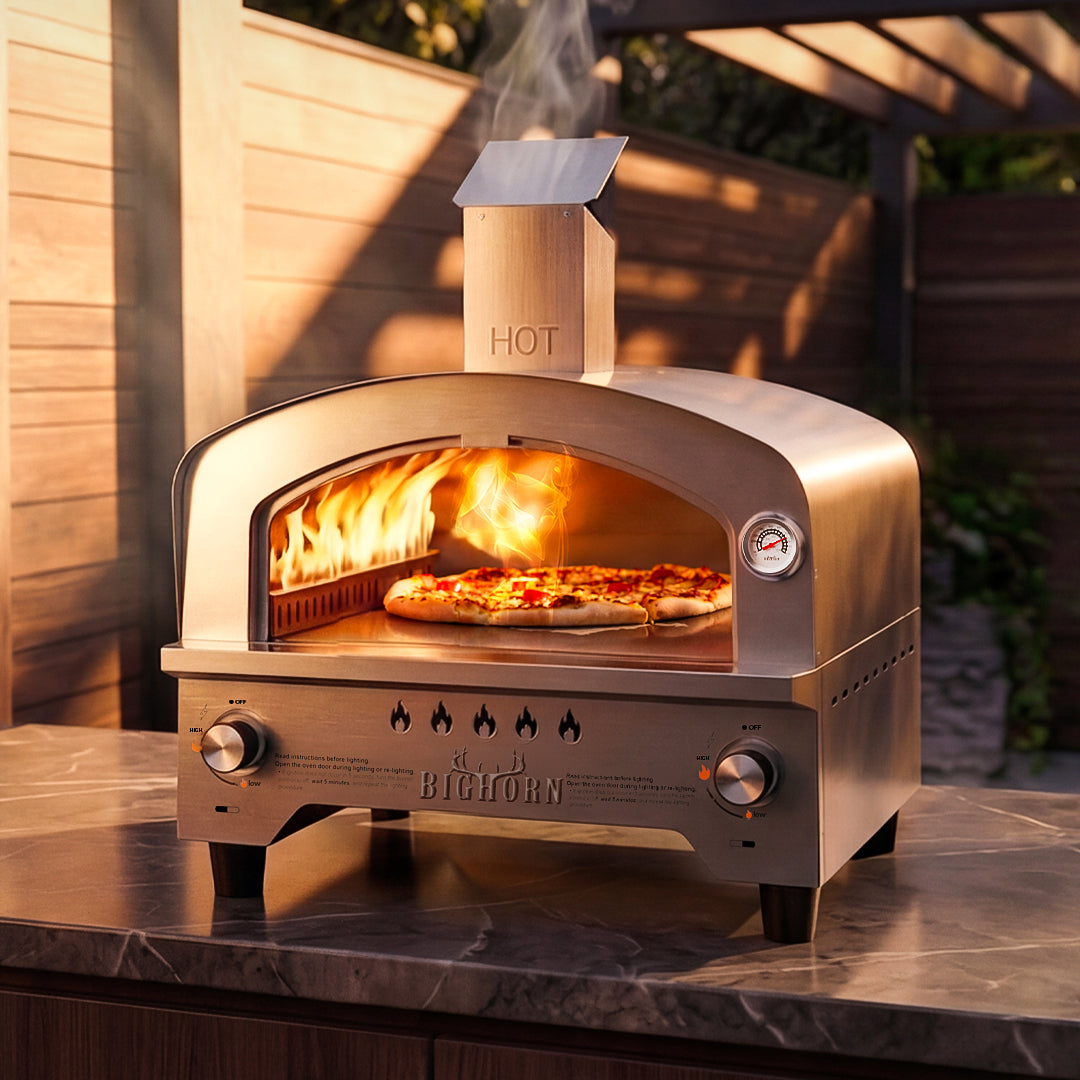
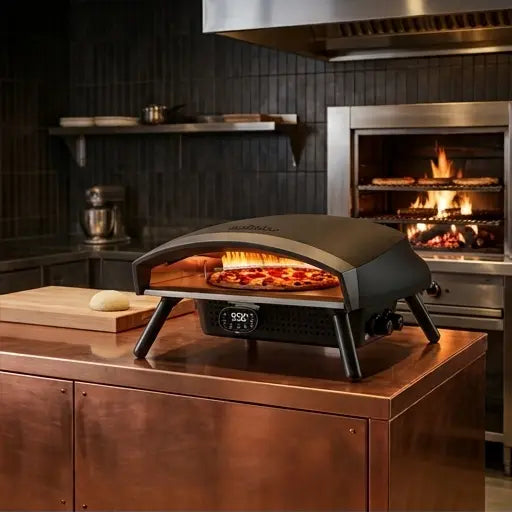
The easiest gas pizza oven to use has simple ignition, adjustable heat, and a cooking surface that helps beginners avoid burning their pizza. The Big Horn Outdoors 15-inch Dual Burner Gas Pizza Oven offers independent burner controls, a built-in thermometer, and a 14.7-inch cooking area. For even less manual intervention, the Big Horn Prime 16-inch model adds an auto-rotating pizza stone.
By the Big Horn Outdoors Product Team
Published: September 19, 2026
What Makes a Gas Pizza Oven Easy to Use?
An easy-to-use gas pizza oven should simplify four tasks: lighting the burner, reaching cooking temperature, controlling heat, and turning the pizza. Propane models eliminate the need to build a wood fire or continuously feed pellets, making them particularly approachable for first-time outdoor pizza makers.
However, gas alone does not guarantee an easy cooking experience.
A pizza oven can ignite quickly but still require considerable attention when the dough is inside. The location of the burner, cooking surface size, and temperature controls all affect how much work the cook must perform.
Look for these practical features:
-
Simple ignition: A built-in ignition system reduces the steps required to start cooking.
-
Adjustable burners: Flame control helps prevent excessive browning when the oven reaches high temperatures.
-
Accessible cooking area: A wider opening provides more room to launch and retrieve pizza.
-
Temperature monitoring: A built-in thermometer helps track oven conditions.
-
Even heat distribution: Multiple burners or a rotating stone can reduce uneven cooking.
-
Straightforward maintenance: Gas combustion produces no wood ash, simplifying routine cleanup.
The biggest advantage of a propane pizza oven is predictability. Once you understand how its cooking stone responds to heat, you can repeat the same preparation and cooking process without rebuilding a fire.
Which Big Horn Outdoors Gas Pizza Oven Is Easy to Use?
Big Horn Outdoors offers two gas pizza ovens with features that address common beginner difficulties: the 15-inch Dual Burner Gas Pizza Oven and the Big Horn Prime 16-inch Gas Pizza Oven. Both use propane, but they simplify the cooking process in different ways.
Big Horn Outdoors 15-Inch Dual Burner Gas Pizza Oven
The Big Horn Outdoors 15-inch Dual Burner Gas Pizza Oven is designed for cooks who want convenient ignition, adjustable heat, and additional room for pizza preparation.
Its verified features include:
-
Two independently controlled gas burners
-
23,000 BTU total burner output
-
14.7-inch cooking area
-
Built-in thermometer
-
Maximum advertised temperature of 1,070°F
-
Advertised preheating to 750°F in approximately 10 minutes
The independent burners are particularly useful.
Rather than relying on a single heat source, the oven distributes heat from two sides. You can adjust the burners separately to influence how the crust and toppings brown.
This does not mean every pizza will cook without turning. Pizza placement, stone temperature, dough thickness, and burner settings can still create uneven browning.
For beginners, the advantage is having more control over the cooking environment without managing multiple fuel types.
Big Horn Prime 16-Inch Gas Pizza Oven
The Big Horn Prime 16-inch Gas Pizza Oven addresses another common difficulty: manually rotating pizza near a hot burner.
Its auto-rotating stone moves the pizza through different heat zones during cooking.
The model also features:
-
A 16-inch maximum pizza size
-
Two gas burners
-
29,000 BTU total burner output
-
Electric pulse ignition
-
Digital thermometer
-
Automatic flameout protection
-
42-pound product weight
A rotating cooking surface can make the baking process more approachable because the cook does not need to perform every rotation manually.
However, the cook must still prepare the dough, check the cooking temperature, monitor browning, and remove the finished pizza.
For someone who wants fewer manual adjustments during baking, the rotating stone is a meaningful feature.
Why Is a Gas Pizza Oven Easier Than a Wood-Fired Oven?
A gas pizza oven simplifies cooking because propane provides an adjustable flame without requiring continuous solid-fuel management. Wood-fired and pellet ovens require additional attention to ignition, fuel supply, combustion, and ash removal.
The differences become particularly noticeable during a busy pizza night.
| Cooking task | Gas pizza oven | Wood or pellet pizza oven |
|---|---|---|
| Starting the fire | Gas ignition procedure | Light solid fuel |
| Controlling heat | Adjust burner settings | Manage fuel and airflow |
| Adding fuel | Check propane supply | Replenish wood or pellets |
| Ash cleanup | No wood ash | Ash removal required |
| Cooking temperature | Adjustable flame | Depends on combustion conditions |
Both cooking methods can produce excellent pizza, but they require different levels of involvement.
With a wood-fired oven, changes in fuel placement and combustion influence how heat reaches the pizza. Adding wood can increase flame intensity, while declining combustion can reduce heat.
Gas lets the cook adjust flame output more directly.
That consistency is valuable when preparing several pizzas. Instead of rebuilding the fire between batches, you can concentrate on dough handling, launching, and checking the cooking stone.
Big Horn Outdoors also offers compatible multi-fuel pizza ovens for people who want to alternate between cooking methods.
However, anyone primarily interested in convenience may find a dedicated gas model more straightforward than a system requiring fuel changes or burner attachments.
How Do You Use a Gas Pizza Oven for the First Time?
Using a gas pizza oven involves six basic stages: prepare the outdoor cooking area, connect propane, ignite the burner, preheat the stone, bake the pizza, and allow the oven to cool. Following the same sequence each time makes cooking more predictable.
Prepare the Cooking Area
Place the oven on a stable, heat-resistant outdoor surface.
Keep it away from combustible materials and follow the manufacturer's required clearances.
Before connecting the propane supply, inspect the hose, regulator, and connections according to the product manual.
Never operate an outdoor-only gas pizza oven inside a house, garage, tent, or enclosed patio.
Connect and Ignite the Burner
Attach the specified propane supply and perform the manufacturer's required leak check.
Follow the model-specific ignition instructions.
Confirm that the burner has ignited correctly before beginning the preheating process.
If ignition fails, shut off the gas and follow the manufacturer's relighting procedure rather than repeatedly attempting ignition without allowing accumulated gas to disperse.
Preheat the Pizza Stone
Allow the oven and pizza stone to heat thoroughly.
The Big Horn Outdoors 15-inch Dual Burner Gas Pizza Oven is advertised to reach 750°F in approximately 10 minutes under the manufacturer's stated conditions.
Actual preheating time can vary with outdoor temperature, wind, propane supply, and starting stone temperature.
Use a suitable infrared thermometer to measure the stone directly.
A built-in oven thermometer is useful, but it may not measure the cooking surface itself.
Prepare and Launch the Pizza
Prepare the pizza shortly before launching it.
Avoid leaving topped dough on the peel for an extended period because moisture can make the dough stick.
For early attempts, start with a relatively small pizza and a moderate amount of toppings.
Shake the peel gently before launching to confirm that the dough moves freely.
Monitor the Bake
Watch the pizza closely after it enters the oven.
In high-temperature cooking, the crust can brown quickly, and a delay of several seconds can noticeably affect the result.
Rotate the pizza when necessary, unless an appropriate automatic rotation system is handling that movement.
Cool and Clean
After cooking, turn off the burners and propane supply according to the manual.
Allow the oven and stone to cool completely before cleaning or moving the equipment.
Never pour cold water onto a hot pizza stone.
Sudden temperature changes can cause thermal shock and cracking.
How Important Are Burner Controls and Stone Temperature?
Burner controls and stone temperature are two of the most important factors in easy pizza cooking. The flame supplies heat to the oven, while the stone transfers stored heat directly into the pizza base.
These two heat sources work together but perform different jobs.
The stone cooks the underside through conduction. Hot air and radiant heat from the burner and oven interior cook the crust edges and toppings.
If the stone is too cool, the cheese may brown before the bottom becomes crisp.
If the stone is too hot relative to the upper heat, the bottom can burn while the toppings remain undercooked.
This explains why maximum temperature alone is not a reliable measure of how easy an oven is to use.
A powerful gas pizza oven can produce excellent results, but the cook needs to balance the heat.
The Big Horn Outdoors 15-inch model provides independent burner controls, allowing adjustments to its two-sided heating system.
The Big Horn Prime 16-inch oven takes a different approach by combining gas heating with automatic stone rotation.
Neither system removes the need to understand stone temperature.
Practical Starting Temperatures
These general starting ranges can help users understand how different pizza styles respond to heat.
| Pizza style | Approximate stone temperature | Cooking consideration |
|---|---|---|
| Neapolitan-style | 750–850°F | Fast baking and frequent observation |
| Thin-crust pizza | 650–750°F | Balance crispness with topping browning |
| Thicker pizza | 550–650°F | Lower heat allows more time for the center to cook |
These are general cooking guidelines, not guaranteed settings for a particular Big Horn Outdoors model.
Dough hydration, thickness, toppings, and recipe requirements can change the appropriate temperature.
Beginners should treat these ranges as starting points and adjust based on actual results.
Does Pizza Oven Size Affect Ease of Use?
Pizza oven size affects both cooking capacity and how comfortably you can handle the pizza. A larger cooking surface provides more room for launching, rotating, and retrieving food, but the oven itself may require additional storage and transportation space.
A compact 12-inch oven can work well for one or two people.
Its smaller footprint may also be convenient for occasional outdoor cooking or travel.
However, a cooking surface that closely matches the pizza diameter leaves less room for positioning mistakes.
The Big Horn Outdoors 15-inch Dual Burner Gas Pizza Oven provides a 14.7-inch cooking area, accommodating pizzas up to approximately 14 inches.
This gives a cook preparing a 12-inch pizza additional working room.
The Big Horn Prime model supports pizzas up to 16 inches, providing capacity for larger family-style pizzas.
Before selecting an oven, consider how you actually expect to use it.
For occasional meals involving small pizzas, compact equipment can be sufficient.
For family gatherings, larger cooking capacity may reduce the number of pizzas required.
Keep in mind that a larger oven is not automatically easier to transport. The Big Horn Prime 16-inch model weighs 42 pounds, so storage and lifting requirements deserve attention.
Can a Gas Pizza Oven Cook Pizza Without Constant Turning?
A gas pizza oven can reduce the amount of turning required through its burner arrangement or an automatic rotating stone. However, conventional ovens may still require manual rotation because heat is rarely distributed perfectly across every part of the cooking surface.
In a single-burner oven, the side nearest the flame generally browns faster.
If the pizza stays in one position, the exposed crust may become dark before the opposite side finishes cooking.
Dual-burner systems can reduce this imbalance by supplying heat from multiple locations.
The Big Horn Outdoors 15-inch Dual Burner Gas Pizza Oven uses two independently adjustable burners to improve heat distribution.
The Big Horn Prime 16-inch model takes the additional step of rotating the pizza stone automatically.
This changes the cooking experience.
Instead of repeatedly reaching into a hot oven with a turning peel, the cook can spend more time observing the crust and adjusting heat.
Nevertheless, automatic rotation cannot correct every cooking problem.
Excessively wet dough, heavy toppings, incorrect stone temperature, or unsuitable burner settings can still produce uneven results.
The most useful approach is to combine consistent movement with appropriate heat management.
What Should You Know About Gas Pizza Oven Safety and Maintenance?
A gas pizza oven is easy to maintain when it is used outdoors, connected correctly, and cleaned after cooling. The absence of wood ash reduces maintenance, but propane equipment still requires regular inspection and careful handling.
Start with the manufacturer's operating manual.
Different ovens may have different regulator requirements, ignition sequences, clearances, and cleaning instructions.
Propane Safety
Use only the fuel type and regulator specified for the exact model.
Before cooking, inspect accessible gas connections and perform the recommended leak check.
Never check for leaks with an open flame.
Keep the propane cylinder in its required operating position and follow the manufacturer's instructions for placement and storage.
If you smell gas, shut off the supply if safe to do so, avoid ignition sources, and follow the manual's emergency guidance.
Cooking Surface Maintenance
Allow the pizza stone to cool completely.
Remove loose flour, crumbs, and burned food residue using an appropriate brush or scraper.
Avoid soaking the stone unless the manufacturer specifically permits it.
Porous cooking stones can absorb moisture, which may affect subsequent heating.
Burner Maintenance
Inspect accessible burner openings and air passages as directed by the manufacturer.
Insects, debris, and grease accumulation can interfere with proper gas combustion.
Never modify a burner, regulator, or safety device to increase heating performance.
Storage
Store the oven in a dry location after it has cooled.
If using an outdoor cover, confirm compatibility with the model.
The Big Horn Prime's automatic rotation system also makes it important to follow the product manual when cleaning around the moving stone assembly.
Which Gas Pizza Oven Should You Choose for Your Cooking Style?
The easiest gas pizza oven for your needs depends on whether you prioritize basic controls, large pizzas, portability, or reduced manual turning. Selecting a model around your actual cooking routine is more useful than choosing solely by maximum temperature.
Consider three common situations.
For first-time outdoor pizza makers: The Big Horn Outdoors 15-inch Dual Burner Gas Pizza Oven provides a practical combination of propane convenience, adjustable burners, and temperature monitoring.
For family pizza nights: A larger oven can accommodate bigger pizzas and provide more room for handling dough. The 15-inch and 16-inch Big Horn Outdoors models both offer more cooking space than a typical 12-inch oven.
For cooks who want fewer manual adjustments: The Big Horn Prime 16-inch Gas Pizza Oven incorporates automatic stone rotation, which reduces the need to turn each pizza by hand.
If storage and transportation are your primary concerns, also compare compact models in the Big Horn Outdoors gas pizza oven collection.
Check product dimensions, weight, included accessories, and required propane equipment before purchasing.
A slightly larger oven may simplify cooking, but only if you have enough room to operate and store it safely.
Big Horn Outdoors Expert Views
From the Big Horn Outdoors Product Team:
The easiest gas pizza oven is not necessarily the one with the highest temperature. It is the one that gives the cook enough control to repeat a successful bake. Reliable ignition, manageable burner settings, a properly heated stone, and adequate cooking space all contribute to a more predictable experience.
Beginners should focus on learning one dough recipe and a consistent cooking process before experimenting with maximum heat. A smaller pizza is often easier to launch and turn, while checking the stone temperature helps explain why one crust cooks differently from another.
Dual burners and rotating stones can reduce common cooking difficulties, but neither replaces attention to dough preparation and heat management.
Conclusion: Which Gas Pizza Oven Is Easiest to Use?
A propane pizza oven with simple ignition, adjustable heat, and a spacious cooking surface is a practical starting point for anyone learning outdoor pizza cooking.
The Big Horn Outdoors 15-inch Dual Burner Gas Pizza Oven offers independently adjustable burners, a built-in thermometer, and a 14.7-inch cooking area. These features help beginners control heat while learning to launch and bake pizza.
The Big Horn Prime 16-inch Gas Pizza Oven adds automatic stone rotation, reducing the need for manual turning during high-temperature cooking.
Whichever model matches your needs, start with manageable pizzas, measure the stone temperature, and develop a repeatable cooking routine.
A consistent cooking process will make a greater difference than simply operating the oven at its maximum temperature.
Frequently Asked Questions
Is a propane pizza oven easy for beginners?
Yes. A propane pizza oven eliminates wood-fire preparation and allows heat adjustment through burner controls. Beginners still need to learn proper stone preheating, pizza launching, and cooking-temperature management.
How long does a gas pizza oven take to preheat?
Preheating varies by model and operating conditions. The Big Horn Outdoors 15-inch Dual Burner Gas Pizza Oven is advertised to reach 750°F in approximately 10 minutes. Use an infrared thermometer to confirm that the cooking stone is ready.
Do you need an infrared thermometer for a gas pizza oven?
An infrared thermometer is strongly recommended because it measures the stone's surface temperature. A built-in thermometer may indicate oven temperature without accurately representing how hot the cooking surface has become.
Can you use a gas pizza oven indoors?
No, unless the exact appliance is explicitly certified and approved by its manufacturer for indoor operation. Big Horn Outdoors' propane pizza ovens discussed here are outdoor-only appliances and must not be operated in enclosed spaces.
Is an automatic rotating pizza oven worth considering?
An automatic rotating stone can make pizza cooking more convenient by reducing manual turning and moving the pizza through different heat zones. It is especially useful for people who find handling a turning peel difficult, although careful heat management remains necessary.