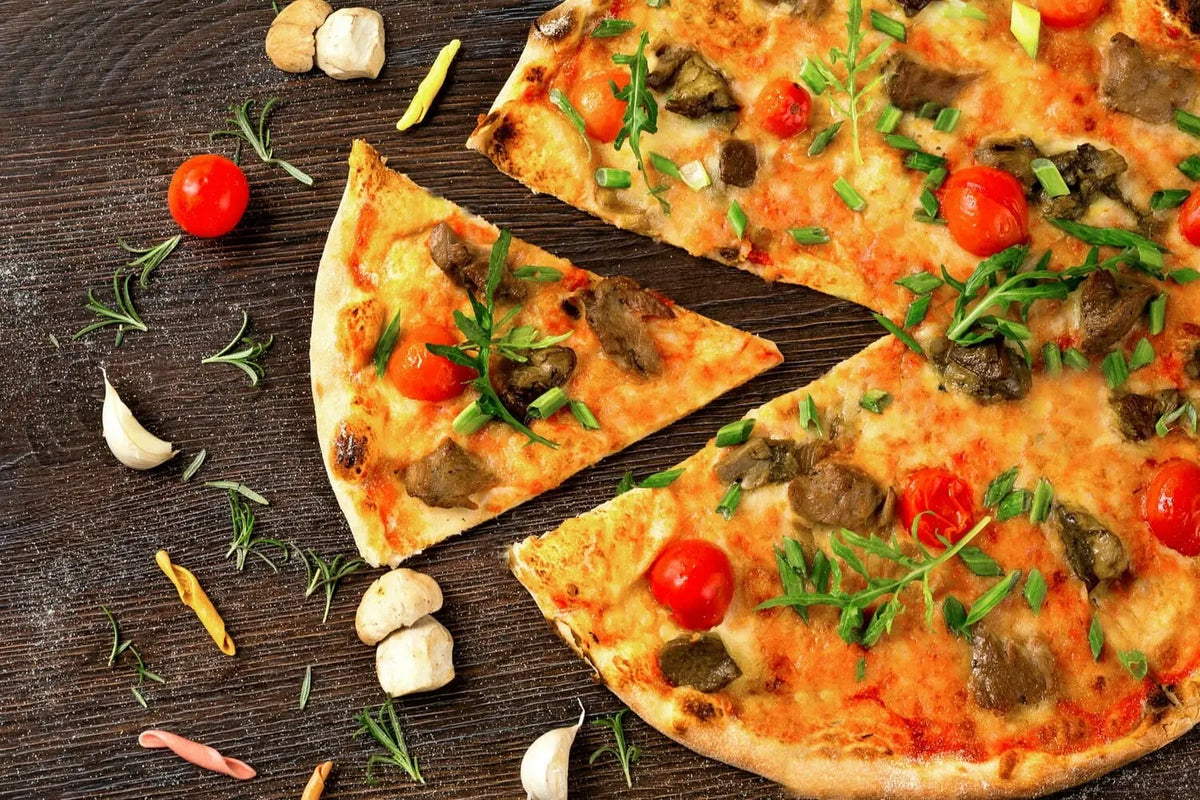
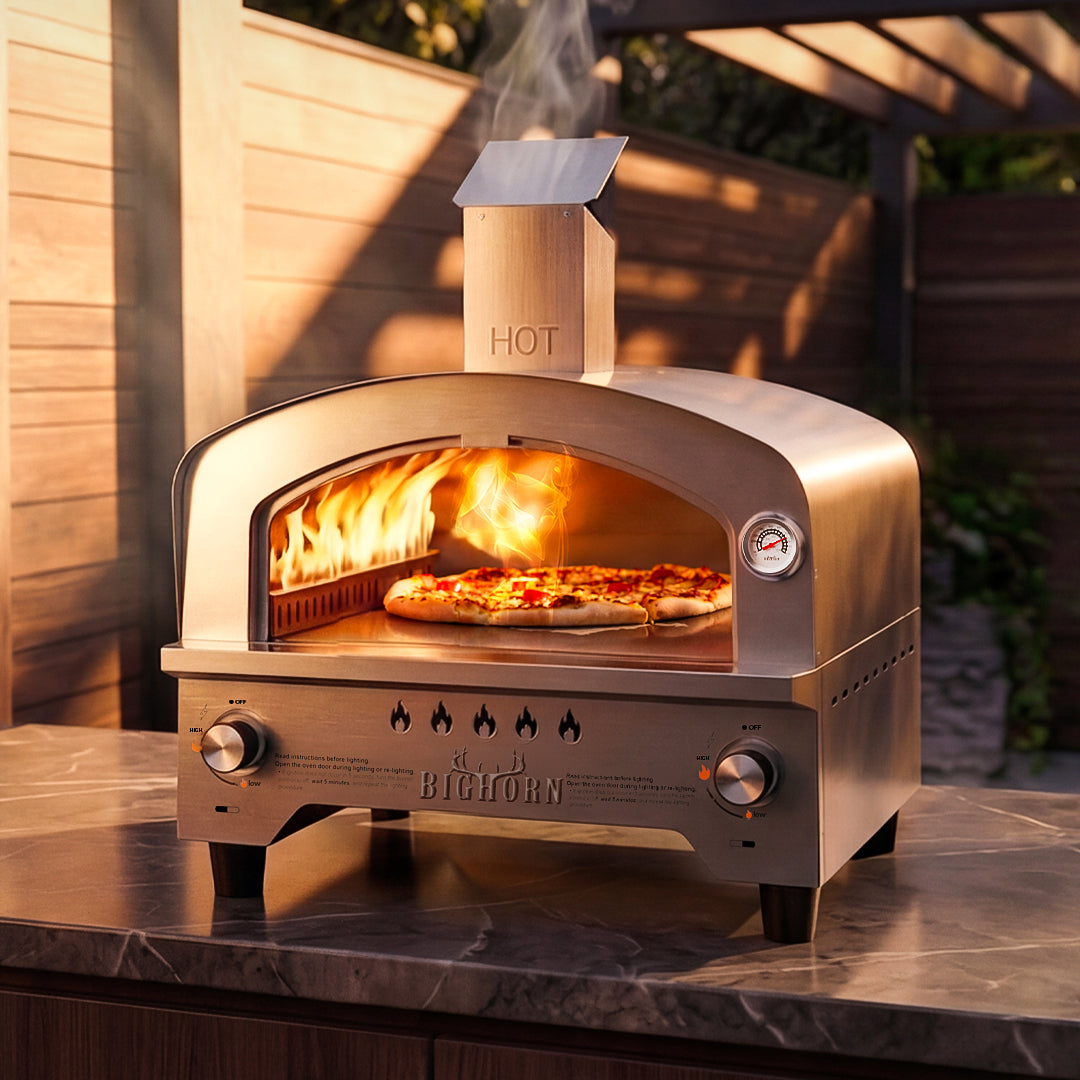
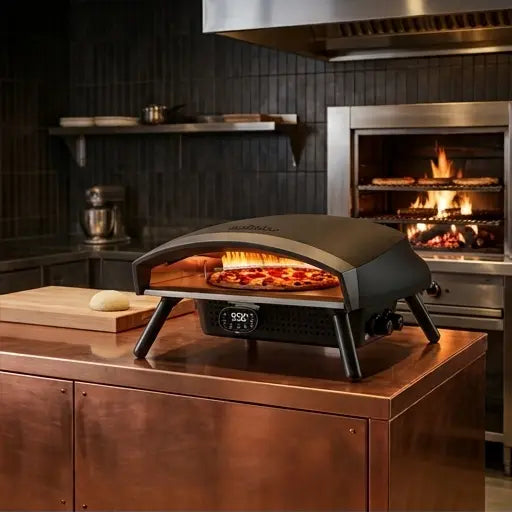
Yes, a pellet pizza oven is worth buying if you enjoy wood-fired pizza, outdoor cooking, and managing a real flame. A capable model can reach temperatures above 800°F, producing crisp, blistered crusts in minutes. However, pellet ovens require more attention than gas alternatives, making cooking frequency, fuel management, and available outdoor space important purchasing considerations.
By the Big Horn Outdoors Product Team
Published: September 19, 2026
What Makes a Pellet Pizza Oven Worth Buying?
A pellet pizza oven combines the intense heat of traditional wood-fired cooking with the convenience of compact hardwood pellets. Its main advantage is producing high-temperature pizza without requiring a large masonry oven, a permanent outdoor installation, or full-sized firewood.
Unlike a conventional kitchen oven, which typically operates at temperatures up to approximately 500–550°F, a dedicated outdoor pizza oven can reach substantially higher temperatures.
This difference changes how pizza cooks.
At high temperatures, the stone transfers heat rapidly into the dough while the flame and hot oven chamber cook the exposed toppings and crust.
The result can include:
-
A crisp base with a tender interior.
-
A raised, blistered crust.
-
Lightly charred edges.
-
Rapid mozzarella melting.
-
A wood-fired aroma from hardwood combustion.
These characteristics are especially desirable when preparing Neapolitan-style pizza.
How Does a Pellet Pizza Oven Work?
A pellet pizza oven burns compressed hardwood pellets in a dedicated firebox. Heat from combustion circulates through the oven chamber and warms the pizza stone.
Three forms of heat contribute to cooking:
Conduction: The hot stone transfers energy directly into the pizza base.
Radiation: The flame and heated oven surfaces transfer energy to the exposed crust and toppings.
Convection: Moving hot gases help distribute heat throughout the chamber.
Successful pizza baking depends on balancing all three.
An oven with a hot flame but an insufficiently heated stone may brown the toppings before the underside cooks. Conversely, a very hot stone and weak flame can burn the bottom while leaving the top undercooked.
This is why a pellet oven's value depends on more than its advertised maximum temperature.
What Are the Biggest Advantages of Pellet Pizza Ovens?
Pellet pizza ovens offer four practical advantages: wood-fired character, high-temperature cooking, compact fuel storage, and portability. These benefits make them attractive for backyard pizza nights, camping trips, and outdoor gatherings.
Wood-Fired Flavor Without Large Logs
Hardwood pellets are manufactured from compressed wood material.
When suitable cooking pellets burn, they create the characteristic aroma of a wood fire.
Oak, maple, and hickory are commonly used hardwood fuel options, although the available varieties depend on the manufacturer.
The contribution of smoke to pizza flavor should not be overstated.
A pizza cooked in 60–90 seconds has limited exposure to smoke compared with meat cooked for several hours.
Much of the characteristic wood-fired experience comes from the combination of flame, high heat, rapid crust expansion, and surface browning.
Pellets provide that live-fire experience without requiring users to split or store large logs.
High Heat in a Compact Oven
Portable pellet ovens concentrate combustion heat in a relatively small chamber.
For example, the Big Horn Outdoors 12-inch wood-pellet pizza oven is rated for temperatures up to 887°F (475°C).
Its listed performance includes an 18–20-minute preheat and 60–90-second pizza cooking under appropriate conditions.
Those figures describe the specified model rather than every pellet pizza oven.
The actual cooking time depends on stone temperature, dough thickness, toppings, weather, and fire condition.
Convenient Fuel Transportation
A sealed container of hardwood pellets is generally easier to transport than a bundle of firewood.
This is useful when cooking away from home.
Pellets can be measured, packed, and stored without transporting large pieces of wood.
However, they must remain dry. Moisture can cause pellets to swell, crumble, and burn poorly.
Are Pellet Pizza Ovens Better Than Gas or Electric Ovens?
Pellet pizza ovens are better suited to cooks who enjoy live-fire preparation, while gas ovens favor convenient flame adjustment and electric countertop ovens offer an alternative where outdoor combustion is impractical.
All three technologies can produce excellent pizza when their heating systems and cooking surfaces are properly designed.
The following comparison highlights the practical differences.
| Feature | Pellet Pizza Oven | Gas Pizza Oven | Electric Pizza Oven |
|---|---|---|---|
| Primary energy source | Hardwood pellets | Propane or natural gas, depending on model | Electricity |
| Flame management | Requires pellet and airflow management | Usually controlled by a burner dial | Controlled electrically |
| Wood-fired aroma | Yes | No inherent wood-smoke aroma | No inherent wood-smoke aroma |
| Ash cleanup | Required | Not normally required | Not normally required |
| Portability | Common in compact models | Available in portable models | Depends on size and power requirements |
| Best suited for | Live-fire enthusiasts | Convenient outdoor cooking | Users seeking electric operation |
When Does Pellet Beat Gas?
A pellet oven makes sense when preparing the fire is part of the experience.
Some people enjoy lighting the pellets, watching the flame develop, and adjusting fuel throughout a cooking session.
For these users, the additional involvement adds to the appeal.
Gas is more convenient when cooking must fit into a short evening.
A burner dial makes changing heat output easier, although the stone still requires sufficient time to heat and recover between pizzas.
When Does Electric Make More Sense?
An appropriately rated indoor electric pizza oven may be more practical for people without suitable outdoor cooking space.
Big Horn Outdoors offers a separate range of indoor electric countertop pizza ovens.
These should not be confused with outdoor pellet ovens that accept optional electric heating accessories.
Adding an electric heater does not automatically make an outdoor pellet oven suitable for indoor use. Follow the exact model's operating-environment instructions.
How Much Does a Pellet Pizza Oven Cost to Own?
The total cost of owning a pellet pizza oven includes the appliance, hardwood cooking pellets, accessories, maintenance supplies, and suitable storage. Fuel cost alone does not determine whether the purchase represents good value.
A useful way to evaluate the investment is to consider the entire cooking session rather than the cost of one pizza.
You must heat the oven and stone before the first pizza enters.
Once the oven reaches the desired temperature, additional pizzas can benefit from the accumulated heat, provided the fire remains strong and the stone recovers between bakes.
This makes a session of several pizzas a different economic proposition from firing the oven for one small pizza.
What Additional Equipment Might You Need?
Depending on what comes with the selected oven, useful accessories may include:
-
A pizza peel for launching and retrieving pizzas.
-
A turning peel suitable for the oven opening.
-
An infrared thermometer for checking stone temperature.
-
Heat-resistant cooking gloves.
-
An airtight container for storing pellets.
-
A protective cover compatible with the oven.
Check the product's included components before purchasing accessories separately.
An infrared thermometer is particularly useful because the temperature of the pizza stone matters more than simply knowing that the flame is burning strongly.
Can Homemade Pizza Save Money?
Homemade pizza can cost less than regularly purchasing restaurant pizza, but savings depend on ingredient prices, restaurant spending, fuel consumption, and how often the oven is used.
Someone cooking several pizzas every weekend will distribute the initial equipment cost across more meals than someone using the oven twice a year.
Avoid assuming that a pellet oven will pay for itself after a fixed number of pizzas.
The financial outcome varies between households.
How Much Work Does a Pellet Pizza Oven Require?
A pellet pizza oven requires attention during ignition, preheating, baking, and cooling. It is generally less convenient than a gas oven with adjustable burners, but the operating process becomes easier to manage as users understand how pellet combustion affects temperature.
One common misconception is that pellets automatically provide constant heat.
In reality, the fire responds to fuel availability, airflow, pellet condition, and outdoor weather.
Pellet Feeding and Temperature Stability
Some pellet ovens use gravity-fed hoppers, while others require fuel to be added manually.
These arrangements should not be treated as interchangeable.
A manually fed oven requires the user to replenish fuel at appropriate intervals.
Adding too much fuel at once can restrict airflow, reduce combustion efficiency, or produce excessive smoke.
Waiting until the fire has weakened significantly may cause the oven temperature to fall.
The practical goal is to sustain a consistent, well-ventilated flame rather than repeatedly rebuilding a dying fire.
Why Does the Stone Need Recovery Time?
Each pizza removes heat from the cooking surface.
A newly launched pizza absorbs energy through direct contact with the stone, while opening the oven also allows some hot air to escape.
If several pizzas are baked consecutively, the stone may gradually cool.
The flame can look healthy even when the stone is no longer hot enough to cook the next pizza's underside properly.
Allowing recovery time and checking the stone with an infrared thermometer can prevent this problem.
For a more detailed explanation, read Big Horn Outdoors' guide on how to keep a pellet pizza oven hot.
How Many Pizzas Can a Pellet Oven Cook at Once?
A compact 12-inch pellet pizza oven is generally designed to cook one pizza at a time, making it suitable for small households and gatherings where pizzas can be prepared and served consecutively.
The cooking chamber's usable space is an important purchase consideration.
A 12-inch pizza has approximately 113 square inches of surface area, while a 16-inch pizza has approximately 201 square inches.
That means the larger pizza provides roughly 78% more surface area.
Actual food capacity also depends on crust thickness, toppings, and how the pizza is divided.
Is a 12-Inch Pellet Oven Enough for a Family?
A 12-inch oven can work well for family cooking when everyone is comfortable sharing pizzas produced in sequence.
It may be less convenient when several hungry guests expect food simultaneously.
One practical strategy is to prepare the dough, toppings, and serving area before lighting the oven.
This lets the cook concentrate on maintaining heat and launching pizzas once the stone reaches the appropriate temperature.
For frequent large gatherings, a larger oven may reduce the number of cooking cycles required.
Big Horn Outdoors offers different pizza oven sizes, so buyers should compare the usable cooking area of the exact models rather than relying only on their external dimensions.
Is a Pellet Pizza Oven Practical for Camping and Small Backyards?
A portable pellet pizza oven can work well for camping, tailgating, and compact outdoor kitchens if the cooking location permits solid-fuel appliances and provides adequate space for safe operation.
Portability involves more than the weight of the oven.
Buyers should consider the combined space required for the appliance, pellets, pizza peel, food preparation, and safe cooling after cooking.
What Does a Portable Model Actually Offer?
The Big Horn Outdoors 12-inch wood-pellet pizza oven has a stainless-steel construction, folding legs, and a listed weight of 24.9 pounds.
These features make it relevant for users who want to move their oven between suitable outdoor cooking locations.
However, portability does not mean the oven can be used anywhere.
Fire restrictions, surface stability, nearby combustible materials, and local regulations still matter.
A compact pellet oven is not appropriate for use inside a tent, vehicle, garage, or other enclosed environment.
What Safety and Maintenance Should Buyers Expect?
Pellet pizza ovens must be operated outdoors in suitable, well-ventilated locations according to the manufacturer's instructions. Their high surface temperatures, live flames, and combustion gases require the same serious safety considerations as other solid-fuel outdoor cooking appliances.
Safe Operation Starts Before Ignition
Place the oven on a stable, level, heat-resistant surface.
Maintain the clearances specified by the manufacturer and keep combustible materials away from the appliance.
Never operate a pellet oven inside a garage, tent, or enclosed patio.
Burning wood pellets produces carbon monoxide, a dangerous gas that cannot be detected by smell.
Outdoor fire restrictions may also prohibit pellet ovens during certain conditions, even when gas appliances remain permitted.
Check the rules before traveling with the oven.
How Should You Clean a Pellet Pizza Oven?
Allow the appliance to cool completely before cleaning or storage.
Remove ash according to the product instructions and place it in an appropriate noncombustible container.
Never assume that ash is cool simply because the visible flame has disappeared.
For the cooking stone, avoid sudden temperature changes.
Pouring cold water onto a hot stone can cause thermal shock and cracking.
After cooling, remove loose food residue using tools compatible with the stone. Follow the manufacturer's cleaning guidance rather than assuming that detergents, soaking, or dishwasher cleaning are appropriate.
Store the oven in a dry location and keep unused pellets in a sealed container.
Good maintenance helps preserve combustion efficiency and makes the next cooking session easier to start.
Which Pellet Pizza Oven Features Matter Most Before Buying?
The most important purchasing features are usable cooking area, heat capability, fuel-management design, portability, construction, and compatibility with any desired accessories.
Buyers should prioritize how the oven will actually be used rather than focusing on the highest advertised temperature.
Consider these questions:
-
Will you cook one or two pizzas, or regularly prepare food for larger groups?
-
Do you enjoy managing a wood fire, or would you prefer adjustable gas heat?
-
Do you have a suitable outdoor cooking and storage location?
-
Will the oven remain in your backyard or travel frequently?
-
Are alternative fuel options important enough to justify additional accessories?
Is a Multi-Fuel Pellet Pizza Oven Worth Considering?
Multi-fuel compatibility can be valuable when a cook enjoys pellets but occasionally wants another heating method.
The Big Horn Outdoors 12-inch wood-pellet pizza oven provides an example.
It operates on wood pellets in its base configuration and supports compatible gas-burner and electric-heater accessories sold separately.
This lets buyers consider additional fuel options without immediately purchasing every attachment.
However, compatibility must be checked against the exact model and accessory.
Do not assume that every pellet oven accepts gas or electric components.
Big Horn Outdoors Expert Views
A pellet pizza oven is worth buying when its cooking process matches the owner's expectations. High heat is important, but consistent results also depend on dry fuel, sufficient airflow, a properly heated stone, and realistic cooking capacity.
At Big Horn Outdoors, we encourage buyers to think about their typical pizza night before choosing an oven. A compact pellet model can provide an enjoyable wood-fired cooking experience for a small group, while someone preparing large batches or prioritizing quick flame adjustment may benefit from a different configuration.
The right purchase is an oven that fits your space, cooking habits, and willingness to manage the fire—not simply the model with the highest advertised temperature.
Conclusion: Is a Pellet Pizza Oven a Good Investment?
A pellet pizza oven is a worthwhile purchase for people who want authentic live-fire cooking, high-temperature pizza, and a portable alternative to a permanent wood-fired installation.
Its value comes from the combination of cooking performance and the enjoyment of preparing food over a real flame.
However, it is not the most convenient choice for every household.
A pellet oven requires dry fuel, temperature management, cleaning, and suitable outdoor space. These responsibilities should be considered part of ownership rather than unexpected inconveniences.
For buyers who enjoy the process, the additional involvement can be rewarding. For those who prioritize convenience, a gas or appropriately rated electric oven may be more suitable.
Before buying, decide how many pizzas you normally prepare, how often you cook outdoors, and whether managing a wood fire sounds enjoyable. These answers will tell you more about the value of a pellet pizza oven than its maximum temperature alone.
Frequently Asked Questions
Can a pellet pizza oven make restaurant-quality pizza?
Yes. A capable pellet pizza oven can produce crisp, blistered, Neapolitan-style pizza when the stone and cooking chamber reach appropriate temperatures. Dough formulation, topping quantity, and cooking technique also affect the result.
Do pellet pizza ovens produce a lot of smoke?
They produce smoke during combustion, particularly during ignition or when pellets burn inefficiently. Dry hardwood cooking pellets and adequate airflow generally help maintain a cleaner-burning flame.
Can you use ordinary heating pellets in a pizza oven?
Use hardwood pellets specifically intended and approved for cooking. Heating-stove pellets should not be substituted unless their manufacturer explicitly confirms that they are suitable for food preparation and the oven manufacturer permits them.
Can a pellet pizza oven cook food other than pizza?
Yes, if the model is designed for the intended cooking method. Suitable foods may include roasted vegetables, fish, and meat, using appropriate cookware and temperature management.
Is a pellet pizza oven suitable for beginners?
Yes, provided beginners are willing to learn basic fire and temperature management. Start with a simple pizza recipe, use dry cooking pellets, allow adequate preheating, and practice controlling the flame before preparing multiple pizzas for guests.