
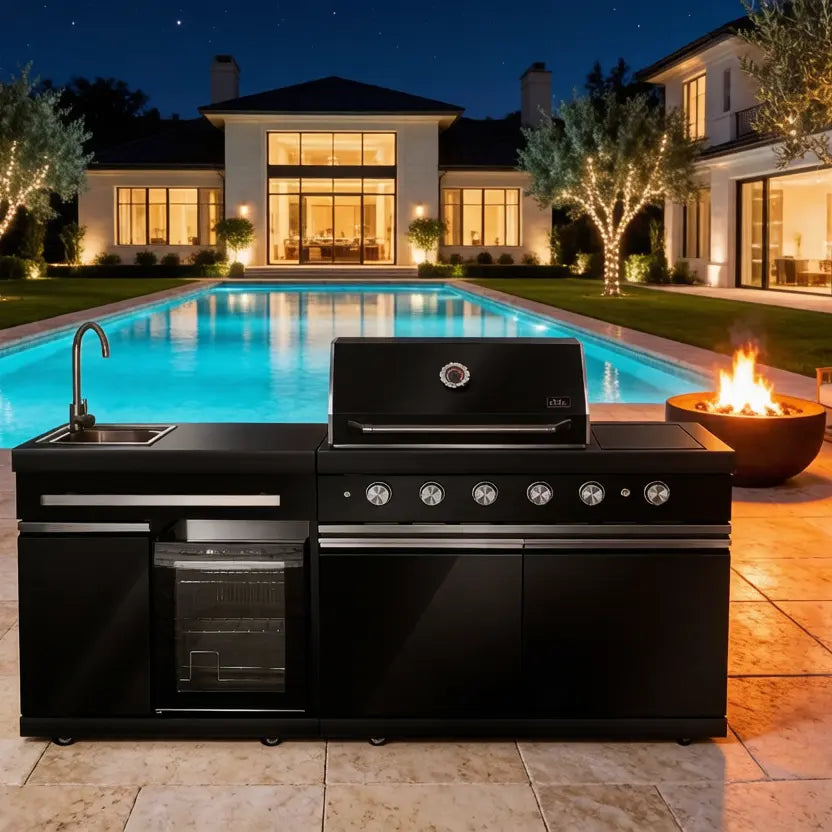
The short answer: a built-in grill wins when you want a permanent outdoor kitchen with maximum cooking power and prep space, and a portable or freestanding grill wins when you want flexibility, a lower starting cost, and the ability to move or change your setup. Big Horn’s lineup spans both — from a freestanding stainless steel island grill with 98,600 BTU of burners down to portable tabletop and camping grills — so the honest comparison is about your space, budget, and how you actually cook. This guide compares the two honestly: heat and capacity, cost and installation, longevity, and the questions to answer before you commit.
This is a brand-owned comparison; Big Horn specifications are traceable to the official product listings, and the current price belongs at checkout.
The real differences that matter
Four differences decide the comparison more than any spec sheet: permanence, cooking power, cost, and flexibility. A built-in grill is constructed into a permanent outdoor kitchen — masonry, cabinetry, and counters built around the grill — with the highest cost, the longest timeline, and the most permanent footprint. A freestanding island or portable grill is delivered ready to use, placed on a prepared spot, and can move when the patio changes. The trade is power and permanence against flexibility and cost.
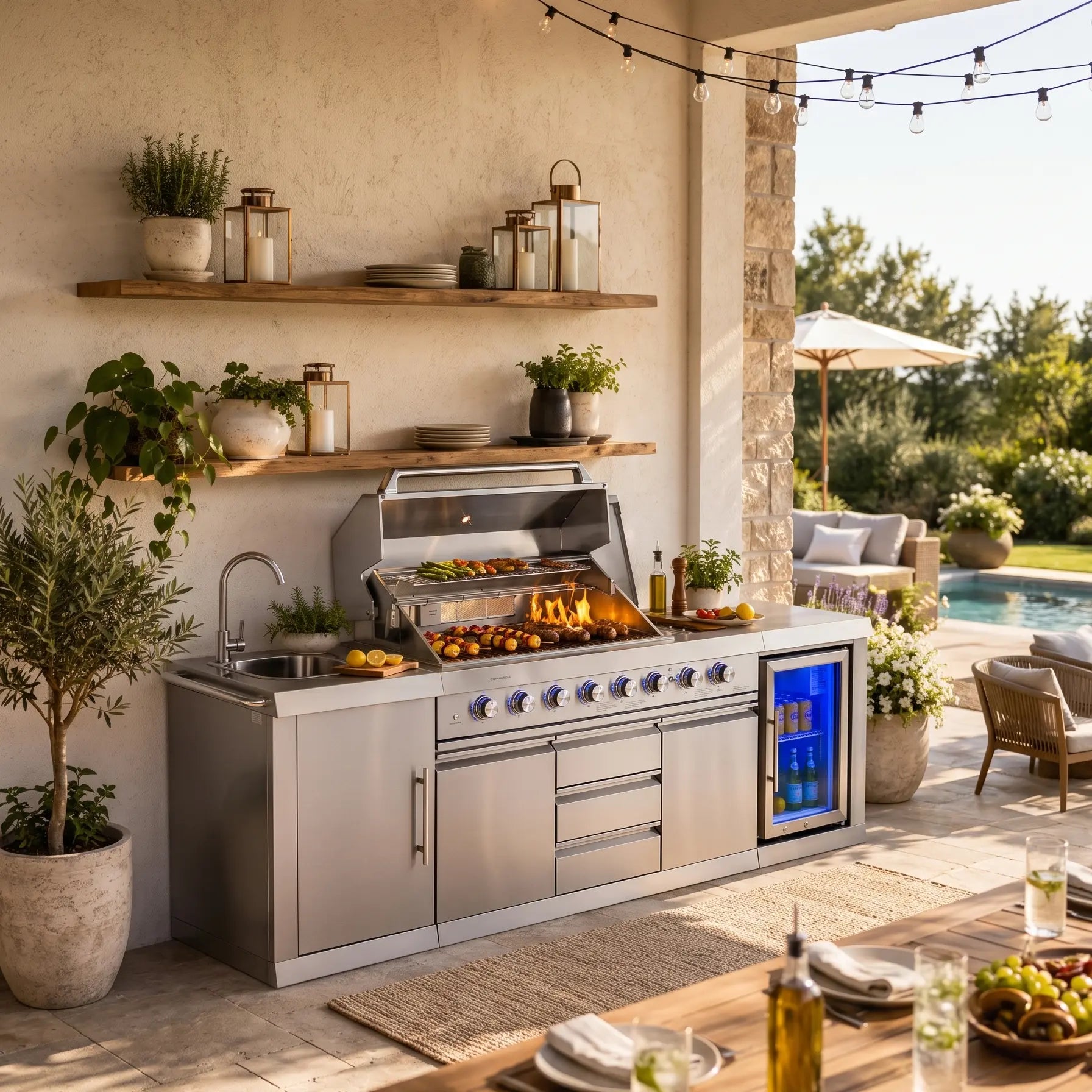
The middle option matters too: a factory-built island like Big Horn’s stainless steel outdoor kitchen island delivers most of the built-in experience — burners, cabinetry, counter space, and extras — without a construction project. Many buyers who think they want a built-in actually want a freestanding island, because it gives the same cooking station at a fraction of the installation cost.
Understanding BTU before you decide
BTU is a measure of heat input, and in the built-in-versus-portable debate it explains the capacity gap. A full-size island grill like Big Horn’s six-burner deluxe model totals 98,600 BTU across its burners, which gives the power for multiple zones: a hot direct zone, a low indirect zone for smoking or holding, and an infrared side burner for searing. A portable tabletop grill runs far fewer burners and cooks a smaller surface. The practical takeaway: BTU sets the cooking area and the number of zones you can run at once, not just how hot one spot gets.
More BTU is not automatically better. A grill you can barely reach across or one that burns through propane faster than you cook is a mismatch in the other direction. Match the burner count and total output to the meals you actually cook: a couple of burgers does not need 98,600 BTU; a party with a steak, veggies, and a rotisserie chicken does.
Head-to-head: heat, convenience, and cost
| Factor | Built-in grill | Portable / freestanding |
|---|---|---|
| Permanence | Permanent outdoor kitchen; construction required | Place down, move anytime |
| Cooking power | Multiple burners; often 60,000–100,000 BTU total; infrared side burner; rotisserie | Fewer burners; smaller cooking area |
| Upfront cost | Highest (grill + construction + countertop) | Lowest (grill only) |
| Installation | Site prep, gas/propane line, permits | None — plug in the tank |
| Prep and storage | Counters, drawers, often a fridge or sink | None built in; cart or table needed |
| Resale / change | Hard to move; anchored to the patio | Move with you; easy to upgrade |
Read the table as structure, not a scoreboard: the built-in wins on power and permanence, the portable wins on cost and flexibility, and the freestanding island is the bridge that gives most buyers the built-in feel without the build.
What each option does best
- Built-in does permanence and power. A constructed outdoor kitchen gives multiple burners, prep space, storage, and often a refrigerator or sink — a complete cooking station that is part of the yard.
- Freestanding island does the middle. Big Horn’s stainless steel island grill brings burners, counter space, and extras like an infrared side burner or rotisserie kit in a factory-built unit that sits on a prepared spot.
- Portable does flexibility. A tabletop or camping grill starts small, moves to the patio or the campsite, and costs the least — the right first purchase for a yard still being figured out.
Where most comparisons go wrong
Most comparisons treat “built-in” and “freestanding” as opposites and skip the middle. The common mistake is comparing a full built-in kitchen to a bare tabletop portable — those are different products for different stages. The honest comparison is between a built-in kitchen, a freestanding island, and a portable grill, with your space and budget as the tiebreaker. The second mistake is ignoring the true cost: a built-in includes construction, countertops, and possibly a gas line; a freestanding island includes the unit itself and a prepared pad; a portable is the grill alone. Compare delivered costs, not sticker prices.
How to match the choice to your cooking style
- You host regularly and want a permanent cooking station. A built-in or freestanding island with multiple burners, counters, and storage fits the way you cook.
- You grill whole meals for a family. A multi-burner unit with zones — high direct, low indirect, infrared sear — beats a single small grate.
- Your yard is still changing. A portable or freestanding grill lets you start small and move as the patio evolves.
- You camp, tailgate, or have a small patio. A portable tabletop grill is the honest answer.
Cost and longevity perspective
Built-in grills cost more for a reason: permanent construction, materials, and installation. Freestanding islands sit between — the unit is the main cost, and a factory-built stainless steel island with burners and counters is the fastest route to a serious outdoor kitchen without construction. Portable grills cost the least and last well if stored correctly, but they trade durability and power. Longevity across all three depends on care: clean grates and burners, manage grease, cover or shelter what you can, and check the gas system before each season.
The decision rule in one paragraph
Choose a built-in grill when you have the space, budget, and patience for a permanent outdoor kitchen and you cook for crowds on multiple burners. Choose a freestanding island — like a multi-burner stainless steel island grill — when you want the built-in experience without construction. Choose a portable grill when flexibility, moving, or a small space matters more than cooking power. Match the format to the way you actually cook, and the answer stops being a marketing debate.

FAQ
Why do built-in grills cost more?
Built-in grills cost more because the price includes the permanent installation: the grill itself, masonry or cabinetry, countertops, and often a gas line or permits. Freestanding islands and portable grills skip the construction, which is why their price is mostly the unit itself. Compare delivered cost, not just the sticker.
Can I use my freestanding grill as a built-in grill?
Some freestanding grills can be converted to built-in if the model is rated for it and the manufacturer provides a built-in trim or installation kit that allows proper airflow and clearance. Not all units are safe to enclose; check the manual and the manufacturer’s installation guidance before building around any grill. If a conversion is not supported, the safe options are a freestanding placement or a purpose-built built-in model.
Are portable grills good?
Yes, for what they do: portability, low cost, and flexibility for small patios, camping, and tailgates. They trade cooking power, capacity, and often heat control for that flexibility. A portable grill is a good purchase when it matches the cooking, not when it is trying to replace a multi-burner island.
What is the healthiest type of grill to use?
Using any grill safely — cooking food to the right internal temperature and managing drips and flare-ups — matters more than the fuel type. Gas and infrared grills burn cleanly, and infrared designs reduce flare-ups by keeping the flame off the food. The healthiest setup is one you use correctly: proper preheat, clean grates, and food cooked to temperature.