
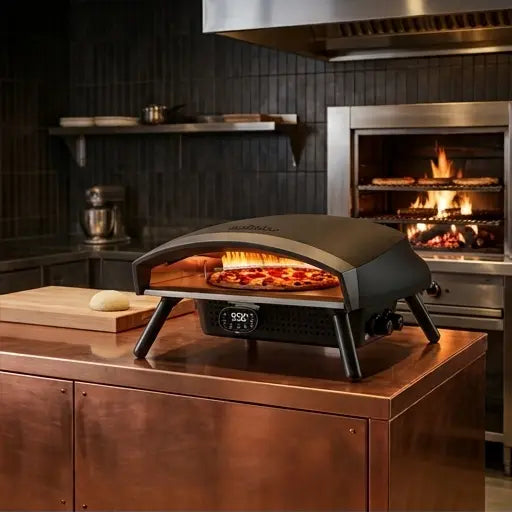

Electric pizza oven wattage tells you how fast the oven can heat and what circuit it needs: a higher-wattage oven preheats faster and recovers heat better, but it draws more from your outlet. Countertop electric pizza ovens typically run in the 1,000–1,800-watt range — Big Horn’s 14-inch countertop model runs 1,500 watts on a standard household circuit with PID temperature control — which is enough to preheat in about 15 minutes and bake a pizza in minutes. This guide covers what wattage means, the outlet math, and how to match an oven to your kitchen.
These are general electric pizza oven power guidelines; check your oven’s label and your circuit before buying.
What actually matters for this decision
- Wattage. Sets preheat speed and heat recovery — higher watts, faster and steadier.
- Circuit. A 1,500-watt oven needs a standard household circuit and draws about 12.5 amps.
- Preheat and recovery. Wattage drives both; a steady oven recovers between pies.
- Temperature control. PID control holds a set temperature more precisely than a simple thermostat.
Understanding wattage before you decide
Wattage is the rate at which the oven converts electricity into heat. A higher-wattage oven heats its stone and air faster and holds temperature better through back-to-back bakes, but it draws more current from your outlet. For a countertop electric pizza oven, the practical range is about 1,000–1,800 watts: enough to reach a high baking temperature without needing a dedicated circuit. Match the wattage to your circuit and your bake frequency, not to the highest number.
The outlet math before you buy
Wattage and voltage give the amp draw: divide watts by volts (in the US, about 120 volts) to estimate amps. A 1,500-watt oven draws roughly 12.5 amps, which a standard household circuit handles; higher-wattage ovens approach the 15-amp limit and may trip a shared circuit. Before you buy, check whether the oven will share a circuit with other appliances and confirm the outlet is rated for the draw. Big Horn’s 14-inch model at 1,500 watts runs on a standard outlet.
The key factors, ranked
| Factor | Why it matters | What to compare |
|---|---|---|
| Wattage | Sets preheat and recovery | 1,000–1,800 W typical for countertop |
| Circuit draw | Fits your outlet | ~12.5 A for 1,500 W on 120 V |
| Preheat | Weeknight convenience | About 15 min for a 1,500 W model |
| Control | Even bake | PID vs simple thermostat |
| Footprint | Fits the counter | 14-in countertop size |
Matching the choice to your situation
For a standard kitchen outlet and weekly baking, a 1,200–1,500-watt countertop oven is the practical choice — it preheats in about 15 minutes and bakes consistently without overloading the circuit. If you bake often and want faster recovery between pies, a higher-wattage oven helps, provided your circuit handles it. If your kitchen has limited counter or circuit capacity, match the wattage and footprint to what the space and outlet can support.
What the experts look for
Reviewers look at wattage through the lens of real baking: preheat time, stone recovery, and temperature stability, not just the peak number. A 1,500-watt oven with PID control holds a set temperature and recovers between pies, which is what produces consistent bakes. They also confirm the circuit before buying — a high-wattage oven on a shared circuit can trip mid-bake.
Common mistakes and how to avoid them
- Buying on wattage alone. Compare preheat, recovery, and control, not just the watts.
- Ignoring the circuit. A high-wattage oven on a shared circuit can trip; check the outlet and draw.
- Forgetting recovery. Wattage drives recovery between pies, which matters for parties.
- Overestimating the heat ceiling. An electric countertop oven bakes reliably but cannot reach a fuel-fired oven’s peak; match expectations.
- Skipping the manual’s circuit note. Follow the oven’s electrical guidance for the outlet and breaker.
Realistic expectations and results
An electric pizza oven with enough wattage preheats in about 15 minutes, bakes a 14-inch pizza in minutes, and recovers between pies when the wattage and control are right. The limits are the electrical ceiling: an electric countertop oven cannot reach a fuel-fired oven’s peak heat, so it suits standard and home-style bakes rather than the highest-heat Neapolitan style. Match the wattage to your circuit and your bake frequency, and the oven performs reliably.
The takeaway in one paragraph
Electric pizza oven wattage sets how fast and steadily the oven heats, and the practical countertop range is about 1,000–1,800 watts — Big Horn’s 14-inch model runs 1,500 watts on a standard outlet with PID control. Match the wattage to your circuit (about 12.5 amps at 1,500 watts) and your bake frequency, and compare preheat, recovery, and control rather than the watts alone. The right wattage is the one your kitchen supports and your baking uses.
See the countertop electric pizza ovens. electric pizza oven collection
FAQ
How many watts does a pizza oven take?
Countertop electric pizza ovens typically take about 1,000–1,800 watts. Big Horn’s 14-inch model runs 1,500 watts, which preheats in about 15 minutes and bakes a pizza in minutes on a standard household circuit.
Are electric ovens 30 or 50 amp?
Those amp figures are for large built-in kitchen ovens or ranges on dedicated circuits; a countertop electric pizza oven is different. A 1,500-watt countertop oven draws about 12.5 amps on a 120-volt household circuit and does not need a dedicated 30- or 50-amp line.
How many watts does it take to run an electric oven?
A full-size electric oven or range can draw 2,000–5,000 watts on a dedicated circuit; a countertop pizza oven draws far less, about 1,000–1,800 watts. Choose the size that matches your circuit and counter space.
How many watts does a Ninja pizza oven use?
Ninja’s pizza oven wattage varies by model — check the label of the specific unit. As a comparison point, Big Horn’s 14-inch countertop pizza oven runs 1,500 watts on a standard outlet; compare preheat time and recovery, not just the wattage.