
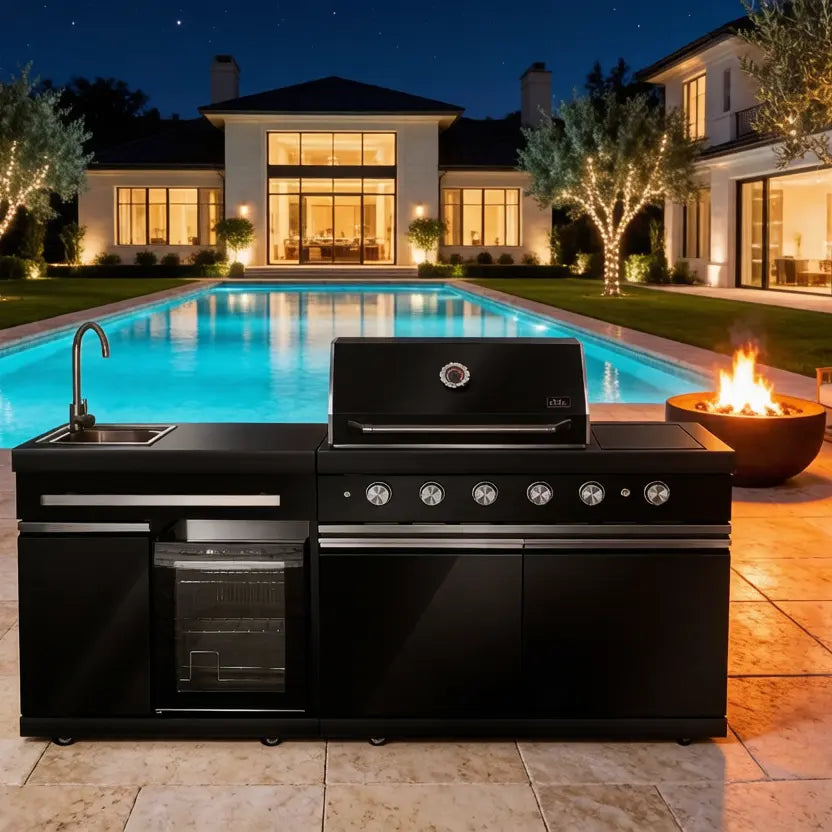
The short answer: an outdoor fireplace gives the most heat and smokestack warmth for a permanent patio anchor, a fire pit gives 360-degree group heat around an open flame, and a chiminea gives directed warmth with a chimney in a compact decorative package. Each is a real choice — the difference is warmth, smoke, permanence, and how many people gather. This comparison covers heat, smoke, and fit so you can match the fire feature to your yard.
This is a general comparison of outdoor fire features; follow fire safety and local burn rules.
The real differences that matter
Three differences decide the comparison: heat direction, smoke behavior, and permanence. A fireplace is a built unit that radiates and vents heat through a chimney — the most warmth and the most permanent. A fire pit is an open bowl that radiates heat all around for a group. A chiminea is a tall, enclosed unit that funnels smoke up a chimney for a small, directed zone. Match the warmth, the smoke, and the build to your patio and your group.
Understanding safety before you decide
All three are open-fuel features with the same core rules: use them outdoors on a level, fire-safe surface with clearance, never under a low or unventilated cover, and follow local burn rules. A fireplace needs a proper base and clearances; a fire pit’s open flame needs the most surrounding clearance; a chiminea’s firebox is enclosed but still hot. The safest feature is the one correctly placed and used, whatever its shape.
Head-to-head: heat, smoke, and convenience
| Factor | Fireplace | Fire pit | Chiminea |
|---|---|---|---|
| Heat | Most, wide | 360 degrees around | Forward, directed |
| Smoke | Chimney vented | Drifts with wind | Chimney funneled |
| Permanence | Built-in, permanent | Portable to built | Portable, compact |
| Best for | Permanent patio anchor | Larger groups | Small zones, patios |
What each option does best
- Fireplace does warmth and permanence. The most heat and a chimney-vinted burn in a permanent outdoor anchor.
- Fire pit does group heat. An open flame that radiates all around makes it the social focus for larger gatherings.
- Chiminea does directed warmth. A compact, decorative unit that funnels smoke and warms a small zone.
Where most comparisons go wrong
Most comparisons rank the three instead of matching them to the yard and group. A fireplace is not “better” than a fire pit — it is more permanent and more warmth, but a fire pit suits a bigger group and a chiminea suits a small smoke-sensitive patio. The second error is ignoring build: a fireplace is a construction project, a fire pit can be portable, a chiminea is compact. Match the warmth, the smoke, and the permanence to your space.
How to match the choice to your situation
- Permanent patio feature with the most warmth. Choose an outdoor fireplace.
- Larger groups around an open flame. Choose a fire pit.
- Small, smoke-sensitive zone. Choose a chiminea.
- Windy or smoke-restricted sites. Check burn rules first; a propane fire feature may be the allowed option.
Cost and longevity perspective
Cost climbs with permanence: a built fireplace is the most expensive and lasting, a fire pit ranges from portable metal to permanent stone, and a chiminea is the most affordable and compact. Longevity depends on material and care: steel, stone, and concrete fire pits last with covers and dry storage; clay chimineas can crack in weather. Match the material to your climate and the permanence to your patio plan.
The decision rule in one paragraph
Choose an outdoor fireplace for the most warmth and a permanent anchor, a fire pit for 360-degree group heat around an open flame, and a chiminea for directed warmth with controlled smoke in a compact patio footprint. Match the warmth, smoke, and permanence to your yard and your group, and follow fire safety and local rules. The right outdoor fire is the one that fits how you gather — and the build you are ready for.
See the fire features for your patio. fire and grill collection
FAQ
Why is a chiminea better than a fire pit?
A chiminea is better for a small, smoke-sensitive patio: its chimney funnels smoke up and away and concentrates heat forward into a small zone. A fire pit is better for a larger group because it radiates heat all around; “better” depends on the gathering.
What are the pros and cons of a chiminea?
Pros: chimney smoke control, directed heat for a small zone, compact decorative design. Cons: less heat for a group, a small opening, and clay versions can crack with weather and thermal shock.
Is an outdoor fireplace better than a fire pit?
An outdoor fireplace gives more warmth and a chimney-vinted burn in a permanent anchor, while a fire pit radiates group heat all around an open flame. A fireplace is better for a permanent, warming anchor; a fire pit is better and simpler for a larger gathering.
Why put a lid on a chiminea?
A lid on a chiminea serves several jobs: it shields the firebox from rain, keeps sparks and debris in, and protects the unit when not in use. Use it for storage and weather; keep it off or open while the fire is burning as the manual directs.