Yes. A small pizza oven with a 12-inch cooking surface is usually enough for two people because it can cook one personal-to-medium pizza at a time—typically enough for two individual pies or one shared 10- to 12-inch pizza per bake. Choose a larger 14- to 16-inch model only if you prefer larger pizzas, pan-style recipes, or frequent entertaining.
What size pizza oven works for two people?
For two people, a 12-inch pizza oven is generally the most practical size: it accommodates a pizza up to 12 inches in diameter while staying easier to store, carry, preheat, and manage than a larger oven. A 14- to 16-inch oven makes sense when pizza night often includes guests or larger-format pies.
A “12-inch pizza oven” normally describes the maximum pizza size the internal cooking floor can accept, not the oven’s outside dimensions. The exterior will be substantially larger because it must house insulation, a firebox or burner system, and the outer shell.
For most couples, the deciding question is not whether a 12-inch oven can make enough food. It can. The more useful question is whether you would rather cook:
- One shared 10- to 12-inch pizza at a time
- Two individual pizzas in sequence
- Larger 14- to 16-inch pizzas
- Several pizzas continuously for friends or family
A 12-inch oven suits a two-person meal especially well because pizza is typically baked one pie at a time in compact portable models. The first person can eat while the second pizza cooks, or both pizzas can be sliced and shared as they come out.
Big Horn Outdoors identifies 12-inch pizza ovens as a practical format for smaller households, personal pizzas, and portable cooking. That size is usually the efficient middle ground for a patio, balcony-compatible outdoor space where permitted, campsite, RV trip, or compact backyard setup.
How much pizza do two people need?
Two adults usually need either one 12-inch pizza plus sides or two individual 10- to 12-inch pizzas, depending on appetite, crust style, toppings, and the rest of the meal. A small pizza oven is enough when you are comfortable baking pizzas in sequence rather than cooking two at once.
A 12-inch round pizza has about 113 square inches of surface area. By comparison, a 16-inch pizza has about 201 square inches—nearly 78% more pizza area, not merely 33% more. Diameter matters because pizza area increases with the square of the radius.
| Pizza diameter | Approximate pizza area | Best fit for two people |
|---|---|---|
| 10 inches | 79 sq. in. | Two personal pizzas or a light shared meal |
| 12 inches | 113 sq. in. | One shared pizza with sides or two individual pizzas |
| 14 inches | 154 sq. in. | A substantial shared pizza |
| 16 inches | 201 sq. in. | Two hungry adults, leftovers, or casual guests |
For a typical dinner, two 10- to 12-inch pizzas offer the most flexibility. One person can choose a classic cheese pie while the other makes a vegetable, pepperoni, or spicy topping combination. That is a meaningful advantage over ordering one large pizza that must satisfy both preferences.
The trade-off is throughput. A compact oven can generally bake only one pizza at a time, so the stone needs to retain or recover enough heat between launches. A larger oven does not necessarily bake two pizzas simultaneously, but it gives the cook more room to turn a pizza, move it away from the flame, and work with larger dough rounds.
Why does cooking style matter more than household size?
A small pizza oven is enough for two people when you prefer fast, thin pizzas, but a larger oven may be better if you make 14- to 16-inch New York-style pies, pan pizzas, or heavily topped pizzas. The cooking floor, heat source, and usable mouth opening affect what you can comfortably bake.
High-heat pizza cooking depends on a balance of three heat-transfer methods:
- Conduction transfers heat from the hot stone into the bottom of the dough. This is what crisps and sets the base.
- Radiant heat travels from the flame, burner, upper heating element, or hot ceiling toward the top of the pizza. It browns cheese, chars the rim, and cooks toppings.
- Convection is the movement of hot air around the pizza. It contributes to overall baking but is usually less intense than stone contact and radiant heat in a high-temperature pizza oven.
A compact 12-inch oven works particularly well for small Neapolitan-style or artisan pizzas with a thin center and a puffy rim. In a properly preheated high-heat oven, the dough can set quickly before the toppings release too much moisture.
It is less convenient for a broad New York-style pizza, a large rectangular pizza, or a deep pan pizza. Those formats need more room and often benefit from a lower, steadier bake rather than a very fast live-fire-style cook.
If you and your partner enjoy experimenting with dough, smaller pizzas are often an advantage. A 250- to 300-gram dough ball is easier to stretch, launch, turn, and serve than a large 16-inch dough round. It also allows each cook to test a different hydration level, fermentation schedule, sauce, cheese blend, or topping combination.
Which fuel type is best for two-person pizza nights?
For two people, gas and electric pizza ovens are usually the simplest choices for repeatable weeknight cooking, while pellet-fired ovens suit cooks who enjoy tending a live fire and want wood-fired character. The right fuel depends on where the oven will be used and how involved you want the cooking process to be.
Big Horn Outdoors offers pizza-oven formats across outdoor pellet, gas, indoor electric, and compatible multi-fuel categories. The fuel type should be selected before size because it determines where and how the oven can operate.
| Fuel type | Best for | Main consideration |
|---|---|---|
| Gas | Quick outdoor cooking and responsive flame adjustment | Requires an outdoor-rated gas setup and safe fuel handling |
| Wood pellets | Outdoor cooks who enjoy fire management and subtle wood-fired character | Requires pellet loading, flame monitoring, and ash cleanup |
| Electric | Indoor countertop cooking when the specific model is designed for indoor use | Requires suitable counter space, electrical access, and model-specific clearance |
| Multi-fuel | Cooks who want flexibility where the exact model supports approved attachments | Confirm compatible fuel attachments and operating instructions for that exact model |
A gas pizza oven uses a controlled burner to create direct radiant heat and hot circulating air. This can make it easier to reduce or increase flame intensity during a cook, which is useful when one pizza has minimal toppings and the next has wetter vegetables or extra cheese.
A pellet pizza oven burns compressed hardwood pellets in a combustion chamber. The flame and hot gases move through the oven, heating the stone and roof. Pellet cooking requires more attention because fuel feed, airflow, weather, and the amount of ash can influence heat stability.
An electric countertop pizza oven uses heating elements rather than combustion. It is the appropriate category for indoor pizza cooking only when the specific appliance is explicitly designed and listed for indoor countertop use. Outdoor gas, wood, and pellet ovens must not be used indoors, in garages, or in enclosed spaces because combustion can create dangerous carbon monoxide accumulation.
Can a 12-inch oven keep up with two pizzas?
A 12-inch pizza oven can comfortably produce two pizzas for two people, but the cook should allow time for stone-temperature recovery between bakes. A pizza may finish before the stone is ready for the next cold dough, especially after a heavily topped pizza.
The stone is the oven’s stored heat reserve. When a cold dough round lands on it, heat moves rapidly into the dough through conduction. That energy is necessary for browning the underside, creating oven spring, and preventing a pale or gummy center.
If the stone is not hot enough for the second pizza, the top may brown before the bottom firms up. The result can be a burned rim, underdone base, or cheese that separates before the crust finishes.
Use this simple two-pizza workflow:
- Preheat until the stone—not just the air inside the oven—is at the temperature appropriate for your pizza style.
- Bake the first pizza with modest topping volume so the dough can cook quickly and evenly.
- Remove the pizza and let the stone recover before launching the second.
- Rotate the second pizza as needed because the area closest to the flame or burner can cook faster.
- Use a turning peel instead of pulling the pizza fully out during the bake whenever possible; this helps preserve oven heat.
For high-heat Neapolitan-style cooking, many portable pizza ovens work in a temperature range where pizzas can bake in roughly 60 to 90 seconds under appropriate conditions. The exact preheat, stone temperature, recovery time, and pizza timing vary by model, fuel, weather, dough formula, and topping load.
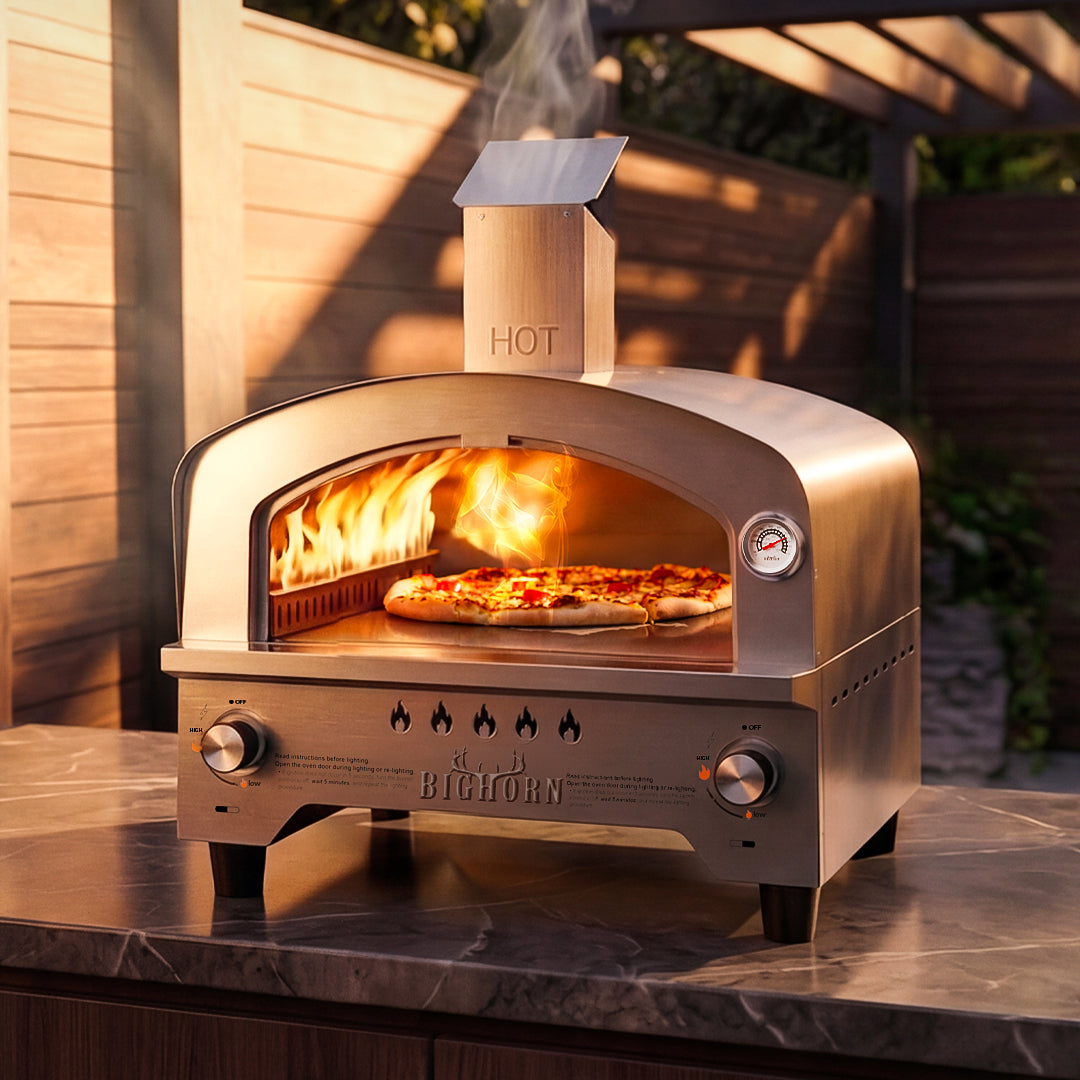
For example, the official specifications for the Big Horn Outdoors 12-inch wood-pellet pizza oven state that this exact model has a stainless-steel body, folding legs, a 24.9-pound weight, an 18- to 20-minute stated preheat, and temperatures up to 887°F. It is designed for outdoor use and can use separately sold compatible gas-burner or electric-heater attachments. Those details apply to that specific 12-inch model only, not to every Big Horn Outdoors pizza oven.
Small-oven setup and safety essentials
A small pizza oven needs a stable, heat-resistant setup area with enough clearance for loading, turning, fuel handling, and safe movement around hot surfaces. Compact equipment reduces storage demands, but it does not eliminate high-heat or fuel safety requirements.
Place an outdoor pizza oven on a sturdy, level, noncombustible or heat-resistant surface according to its manual. Keep combustible materials, loose paper, patio cushions, dry leaves, and overhead structures away from the oven and chimney path. Do not position an outdoor oven under a low canopy unless the manufacturer specifically permits that installation.
For pellet- and gas-fired outdoor ovens:
- Operate only outdoors in an open, well-ventilated location.
- Never use them inside a home, tent, garage, enclosed porch, RV, or other enclosed area.
- Keep children and pets away from the cooking zone.
- Inspect hoses, regulators, fittings, burners, and fuel systems before gas use.
- Allow the oven to cool fully before covering, moving, cleaning, or storing it.
- Remove ash only after a pellet oven is completely cold.
- Use heat-resistant gloves, a suitable pizza peel, and long-handled tools where appropriate.
For electric countertop pizza ovens, follow the exact manual for outlet requirements, countertop clearance, ventilation, cleaning, and allowable cookware. An indoor electric model is not interchangeable with an outdoor combustion oven, even if both are described as “pizza ovens.”
Big Horn Outdoors Expert Views
“For two people, the best pizza oven is usually the one that fits the way you actually cook. A 12-inch oven is a practical choice when you enjoy individual pizzas, quick outdoor meals, and compact storage. Move up to a 14- or 16-inch format when you regularly want larger shared pies, more room to turn a pizza, or the capacity to serve guests. Start by choosing the correct fuel and operating environment, then confirm the exact model’s cooking-surface size, fuel compatibility, clearance instructions, and approved accessories before buying.”
—Big Horn Outdoors Product Team
Big Horn Outdoors began with a practical backyard-cooking focus: helping cooks manage uneven heat, smoke, and temperature fluctuations more effectively. That focus remains relevant when choosing a small pizza oven because consistent heat management matters more than simply owning the biggest oven.
Maintenance and accessories affect performance
A small pizza oven performs best when its stone is dry, its fuel path is clean, and its accessories match the oven’s cooking surface and intended use. Regular maintenance protects heat flow, improves repeatability, and helps prevent avoidable wear.
After each cook, let the unit cool completely. Brush loose flour, charred cheese, and food debris from the stone and cooking chamber using a suitable dry brush. Avoid soaking a pizza stone because absorbed moisture can cause cracking when the stone is reheated.
For pellet ovens, empty cooled ash from the firebox and inspect for obstructions. Ash can restrict airflow, and airflow is essential for clean combustion and stable flames. For gas ovens, keep burner openings clear and follow the product instructions for checking connections and cleaning grease or debris.
Useful accessories for a two-person pizza setup include:
- A launching peel sized to fit the oven opening
- A smaller turning peel for rotating pizzas close to the heat source
- An infrared thermometer for checking stone temperature
- A cover designed for the exact oven after it has cooled fully
- Dough containers for preparing two separate pizza balls
- A brush and scraper appropriate for the cooking stone and chamber
Accessory compatibility is model-specific. Before purchasing a cover, gas burner, electric heater, stone, peel, or other add-on for a Big Horn Outdoors product, verify that it is approved for the exact model rather than assuming that accessories fit every oven in the range.
The best choice for your space
A 12-inch small pizza oven is enough for two people if you mainly cook one or two pizzas at a time, value portability, and do not need to make large-format pies. A 14- to 16-inch oven is the stronger choice if your usual meal is one larger shared pizza or if pizza night often expands beyond two diners.
Choose a compact 12-inch format when you want:
- Individual pizzas with different toppings
- Easier storage and travel-friendly cooking
- Lower-space patio, campsite, or RV-oriented use where permitted
- A faster, more focused pizza workflow
- A manageable introduction to high-heat pizza cooking
Choose a larger format when you want:
- 14- to 16-inch pizzas
- More room to turn pizzas and manage flame exposure
- Larger shared meals and leftovers
- More flexibility for bread, pans, and bigger roasting dishes
- A better fit for frequent entertaining
For a first oven, two people should prioritize the correct fuel, safe operating location, usable cooking-floor size, and realistic storage space. A small oven is not a compromise when it matches your pizza style; it is often the most efficient and enjoyable choice.
FAQs
Is a 12-inch pizza enough for two adults?
A 12-inch pizza can be enough for two adults when served with salad, wings, vegetables, or another side. For a full pizza-only dinner, two 10- to 12-inch pizzas are usually the more reliable plan, especially when both people have average or large appetites.
Can a small pizza oven cook two pizzas at once?
Most compact 12-inch pizza ovens cook one pizza at a time because the cooking surface is sized for a single pizza. They can still serve two people efficiently by baking pizzas in sequence and allowing the stone to recover between cooks.
Is a 12-inch or 16-inch pizza oven better for beginners?
A 12-inch oven is often easier for beginners to store, transport, and use for personal pizzas. A 16-inch oven gives more turning room and accommodates larger pies, but it usually takes more space and may be unnecessary for a two-person household.
Can I use a pellet or gas pizza oven indoors?
No. Pellet- and gas-fired pizza ovens are combustion appliances intended for outdoor use unless a specific product is explicitly designed otherwise. Use an electric countertop model that is specifically rated for indoor use if you need to cook inside.
Which Big Horn Outdoors pizza oven is suitable for two people?
A Big Horn Outdoors 12-inch pizza oven can be a strong fit for two-person cooking when its fuel type, operating location, and cooking capacity match your needs. Check the current official page for the exact model before purchase because temperature capability, attachments, included components, dimensions, and indoor or outdoor suitability vary by product.