Big Horn Outdoors is a reasonable, value-oriented pizza oven brand, especially for cooks who accept a learning curve in exchange for high-heat capability and portable formats. Its current 12-inch pellet oven is listed at 24.9–25 pounds, with folding legs and a claimed maximum of 887°F; however, reliability varies by model, fuel system, assembly quality, and how consistently the owner manages heat and maintenance.
Is Big Horn Outdoors a reliable choice?
Big Horn Outdoors can be a reliable choice for budget-conscious backyard cooks who select the right model and use it as intended, but it is not the best fit for buyers who want the simplest operation, premium finish quality, or effortless back-to-back pizza production. The brand’s pizza-oven lineup spans pellet, gas, electric, and multi-fuel formats, so reliability should be assessed model by model rather than by brand name alone.
Big Horn Outdoors has focused on outdoor cooking since its origin story in a 2012 Los Angeles backyard cooking challenge, where the brand says its goal was to address uneven heat, excess smoke, and difficult temperature control. Today, its range includes pizza ovens alongside grills, camping stoves, outdoor-kitchen equipment, and accessories.
That product focus matters because a portable pellet oven, a propane pizza oven, and an indoor electric countertop oven have different heat sources, components, operating conditions, and likely maintenance needs. A pellet oven depends on dry fuel, airflow, ash management, and active fire tending. A gas oven depends on burner performance, regulator connection, ignition, and flame adjustment. An electric countertop oven depends on its heating elements, controls, and appropriate indoor electrical use.
The practical conclusion is straightforward: Big Horn Outdoors offers capable high-heat cooking tools for shoppers who understand the operating trade-offs. It is more accurate to call the brand a practical value option than to treat it as automatically equivalent to a premium, highly insulated, long-established pizza-oven system with extensive local dealer support.
What determines pizza-oven reliability?
Pizza-oven reliability has two parts: whether the appliance remains safe and functional over time, and whether it repeatedly produces controllable cooking conditions. For high-heat ovens, durable materials matter, but fuel delivery, heat retention, stone recovery, and correct maintenance matter just as much.
A pizza oven can reach a very high air temperature and still be frustrating to cook with if the baking stone has not stored enough heat. Pizza dough cooks from below primarily through conduction: the hot stone transfers heat into the dough and sets the crust. Meanwhile, the top cooks through radiant heat from flame, hot metal, or heating elements, plus convection from hot moving air.
When those heat sources are out of balance, the result is familiar:
- Toppings may char while the bottom remains pale or underdone.
- The first pizza may cook well, while later pizzas need a recovery period.
- Opening the door repeatedly can reduce chamber heat and weaken the flame.
- A pellet fire may smoke excessively if airflow or fuel condition is poor.
- A stone can cool faster than it recovers during a busy pizza session.
This is why product reliability is not just a question of whether an oven “gets hot.” The better question is whether the oven’s design, fuel system, cooking surface, and owner’s workflow create repeatable results.
For Big Horn Outdoors buyers, reliability improves when the chosen oven matches the intended cooking style. A hands-on cook making one or two pizzas at a time can tolerate more fire management than a host feeding a large group every few minutes.
Which Big Horn pizza oven fits your use?
The most reliable Big Horn Outdoors choice is the model whose fuel type and cooking environment match your habits: pellet for live-fire involvement, gas for easier control, and electric for appropriate countertop convenience. Never assume that a specification, attachment, or capability applies across the entire Big Horn range.
The brand’s product range includes outdoor pellet and gas models, multi-fuel options, and electric countertop ovens. Each requires a separate purchase decision.
| Cooking priority | Best-matched oven category | Reliability consideration |
|---|---|---|
| Wood-fired aroma and hands-on cooking | Pellet pizza oven | Requires dry pellets, active refueling, ash cleanup, and attention to airflow |
| Faster startup and adjustable flame | Propane gas pizza oven | Requires correct outdoor gas setup, burner care, and safe hose/regulator connection |
| Flexible fuel options | Verified multi-fuel model | Confirm exactly which burner or heater is included, compatible, or sold separately |
| Indoor countertop cooking | Electric countertop oven | Follow the exact model’s electrical, ventilation, clearance, and placement instructions |
| Travel, camping, or tailgating | Portable outdoor model | Weight, leg design, packed dimensions, fuel transport, and wind exposure matter |
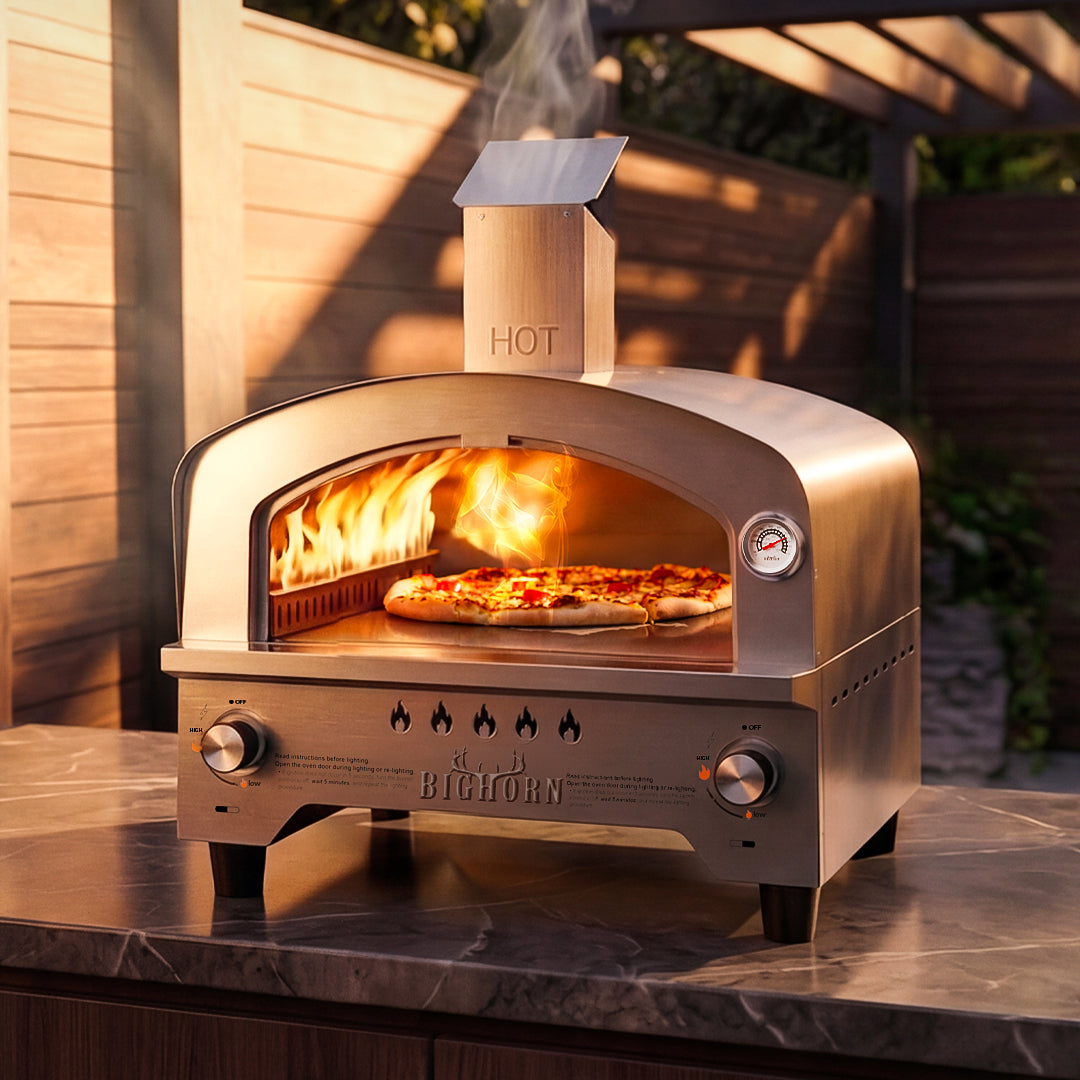
For example, the official product page for the current 12-inch wood-pellet pizza oven lists stainless-steel construction, folding legs, a 24.9–25-pound weight, and a claimed 18–20-minute preheat. It also lists temperatures up to 887°F and 60–90-second pizza capability under appropriate conditions. That makes it a plausible entry-level option for small pizzas and portable outdoor cooking, but it does not mean every Big Horn oven has the same temperature rating, fuel compatibility, weight, or portability.
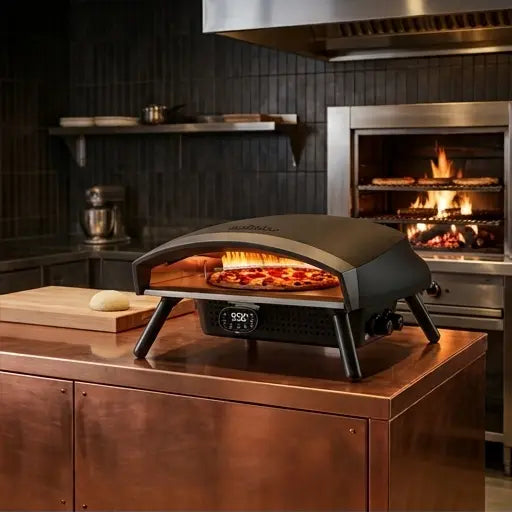
A separate 12-inch pellet-and-gas model is listed as a dual-fuel product with a gas burner included. A separate 12-inch portable gas model is listed with a propane burner, a 12-inch stone, folding legs, and a claimed 900°F maximum. Those are different products. Buyers should verify the exact SKU before assuming an attachment, burner, stone, warranty, or fuel mode is part of the package.
Fuel choice affects daily reliability
Fuel choice often matters more than the logo on the oven: gas offers easier day-to-day control, while pellets offer live-fire flavor but require more active management. The best fuel is the one you can safely store, consistently supply, and confidently control in your intended cooking location.
Pellet ovens
Wood-pellet pizza ovens burn compact hardwood pellets rather than logs. Their appeal is real live-fire cooking in a smaller footprint, but their operation is more involved than simply turning a control knob.
Use clean, food-safe hardwood pellets stored in a sealed, dry container. Pellets that absorb moisture can burn poorly, create excess smoke, and make temperature recovery less predictable. The fire also needs oxygen. Restricting airflow or overloading the hopper can lead to incomplete combustion, while repeatedly opening the oven door can release heat just when the stone needs to recover.
Pellet cooking suits someone who enjoys tending a live flame, checking the stone temperature, and adjusting the pace between pizzas. It is less ideal for a first-time buyer who wants to launch pizza after pizza with minimal attention.
Gas ovens
Propane pizza ovens typically give the user more direct control over flame level. A gas burner supplies heat continuously, and the operator can adjust the burner rather than manually feeding pellets. This usually makes it easier to manage a pizza session, particularly when learning how to balance the stone temperature with top heat.
Gas does not eliminate skill. A pizza can still burn near the flame while the center remains undercooked, especially if the dough is too thick, the stone is not ready, or the pizza is not turned. But flame adjustment makes gas a more forgiving path for many new owners.
Gas models must be used outdoors unless the exact product documentation explicitly states otherwise. Always inspect the hose, regulator, and fittings; check for leaks according to the manufacturer’s instructions; keep the cylinder upright; and never use a propane outdoor oven inside a home, garage, tent, RV, or enclosed patio.
Electric ovens
Electric countertop pizza ovens are a different category. They can be useful where outdoor live-fire or propane cooking is impractical, but they are not interchangeable with outdoor pellet or gas models. Confirm the exact voltage, outlet requirements, counter clearance, ventilation instructions, and approved cooking location for the individual electric model before purchase.
Heat management is the real performance test
A dependable pizza oven needs enough stone heat for the base and enough overhead heat for the toppings; high chamber temperature alone does not guarantee a good pizza. For a fast, Neapolitan-style bake, the dough must cook quickly enough to expand and blister before the toppings overcook.
The current Big Horn Outdoors 12-inch pellet model is listed as capable of reaching up to 887°F, with an 18–20-minute preheat and pizzas in 60–90 seconds under appropriate conditions. Treat those figures as maximum performance claims, not a promise that every pizza will bake at that speed in all weather or operating conditions.
Wind, ambient temperature, fuel moisture, pizza size, dough hydration, topping load, launch technique, and how long the door stays open can all change cooking behavior. In general, an infrared thermometer aimed at the stone is more useful than relying only on an oven’s ambient reading. The stone must be hot enough to set the bottom, but not so hot that flour or the base burns before the interior finishes.
A practical workflow improves consistency:
- Prepare dough, sauce, cheese, toppings, peel, and turning tool before lighting the oven.
- Preheat until the stone and chamber are both ready, not merely until flames are visible.
- Launch a lightly topped pizza and turn it as the side nearest the flame colors.
- Let the oven recover between pizzas when the stone temperature drops.
- Adjust fuel or flame before the next launch rather than trying to correct a cold stone with a longer bake.
For multiple pizzas, a larger oven or a gas model with controllable heat may be a better choice than a small pellet unit. A compact 12-inch oven can make excellent individual pizzas, but it has less cooking surface and thermal mass than larger formats.
Setup, portability, and capacity trade-offs
Portable pizza ovens are convenient because they pack smaller and heat quickly, but compact size also limits cooking capacity and can increase the importance of careful setup. A 24.9–25-pound folding-leg pellet oven is manageable for patio use, tailgating, or camping, but it still needs a stable, noncombustible support surface and safe clearance.
Before buying, consider where the oven will sit when hot, not only where it will be stored cold. A folding table may be convenient, but it must be sturdy enough for the oven, peel movement, hot cookware, and food prep. The setup should remain level, away from dry grass, combustible walls, railings, overhead structures, and foot traffic.
For portable use, capacity means more than the listed pizza diameter. It also means:
- Whether there is room to turn a pizza without touching the flame.
- Whether the stone recovers quickly after a bake.
- Whether a second pizza can be assembled while the first cooks.
- Whether you can safely manage fuel, ash, and hot tools at the site.
- Whether wind protection is available without enclosing the appliance.
Big Horn Outdoors models with folding legs can be practical for travel where their individual product pages support that use. However, portability should never be confused with indoor suitability. A portable outdoor fuel-burning oven remains an outdoor appliance unless its exact instructions say otherwise.
Big Horn Outdoors Expert Views
“Choose the fuel system you are prepared to manage, not simply the highest advertised temperature. Pellets reward active fire management and dry fuel; propane makes flame adjustment more direct; electric models require disciplined attention to their specified countertop and electrical conditions. For any pizza oven, preheat the stone fully, turn pizzas early and often, and give the cooking surface time to recover between bakes. The most reliable results come from matching the oven’s capacity and fuel system to the number of people you cook for.”
Safety and care protect the oven
Safe placement, correct fuel, full cool-down, and regular ash or grease removal are essential to both user safety and long-term oven reliability. Outdoor pizza ovens produce intense heat, and their metal shells, doors, stones, grates, and exhaust components can remain dangerously hot long after cooking ends.
Follow the exact manual for the model you own, especially for assembly, clearances, approved fuel, ignition, shutoff, and cleaning. These general rules apply to most outdoor pizza ovens:
- Use pellet, propane, or butane equipment only in the location approved for that exact model.
- Keep children, pets, loose clothing, and combustible materials away from the hot cooking area.
- Never leave an active fuel-burning oven unattended.
- Use heat-resistant gloves and a properly sized peel or turning tool.
- Let the oven cool completely before disassembly, storage, transport, or ash removal.
- Remove ash only when it is completely cold, then dispose of it in a noncombustible container.
- Keep pizza stones dry and avoid thermal shock, such as placing a cold or wet stone into an extremely hot oven.
- Inspect gas connections and burner ports before each use on propane models.
- Store pellets dry and protect the oven with a compatible cover only after it has cooled.
Cleaning should be functional rather than aggressive. Brush loose debris from the stone after it cools, empty ash from pellet systems, and wipe exterior stainless steel with appropriate nonabrasive materials. Do not use water on a hot stone or spray cleaner into a hot burner area.
Should you buy Big Horn or step up?
Buy Big Horn Outdoors if you value high-heat cooking, portability, and a lower-cost entry into outdoor pizza making; consider a more premium option if you prioritize refined fit and finish, insulated heat retention, broad replacement-parts access, and effortless high-volume cooking. The right decision depends on how often you cook, how many pizzas you make per session, and how much live-fire involvement you enjoy.
Big Horn Outdoors is a sensible match for:
- First-time outdoor pizza cooks willing to practice.
- Buyers who prefer an approachable entry point over premium features.
- Campers, RV travelers, tailgaters, and patio cooks who value portable formats.
- Cooks who want a pellet-fired experience and do not mind monitoring the fire.
- Buyers who choose a gas model for easier flame adjustment and repeatable sessions.
It is a weaker match for:
- Buyers who want a fully hands-off pizza process.
- Large gatherings where many pizzas must cook consecutively with minimal recovery time.
- Users who dislike tending fuel, checking stone temperature, or turning pizzas frequently.
- Anyone who needs indoor cooking but is considering an outdoor pellet or gas model.
- Shoppers who expect every accessory or fuel mode to be included without confirming the exact product page.
The decisive next step is to choose by use case. Select a pellet model if live-fire flavor and participation are part of the appeal. Select gas if easier control and faster routine operation matter most. Select an electric countertop model only if its exact requirements suit your kitchen setup. Then confirm the exact model’s approved fuel, included components, dimensions, warranty, and location requirements before purchasing.
FAQs
Is Big Horn Outdoors a good pizza oven brand for beginners?
Big Horn Outdoors can work well for beginners who are comfortable learning temperature management, pizza turning, and fuel handling. A gas model is generally easier for a new owner than a pellet model because the flame is adjustable without manually feeding a fire.
Are Big Horn pellet pizza ovens reliable?
A Big Horn pellet pizza oven can be reliable when assembled correctly, supplied with dry food-safe pellets, preheated thoroughly, and cleaned after cooling. Pellet systems require more owner attention than gas because airflow, refueling, and stone recovery affect performance.
Can Big Horn pizza ovens cook more than pizza?
Many Big Horn Outdoors pizza-oven product pages describe uses beyond pizza, such as roasting suitable meats, fish, and vegetables. Use cookware and cooking methods appropriate to the exact oven model, and avoid greasy foods that could create flare-ups or excessive smoke.
Can a Big Horn outdoor pizza oven be used indoors?
No outdoor pellet or propane pizza oven should be used indoors, in a garage, in a tent, or in another enclosed area unless the exact manufacturer instructions explicitly approve that location. Fuel-burning appliances create fire and carbon-monoxide hazards in enclosed spaces.
Does the 12-inch Big Horn pellet pizza oven use gas?
The current 12-inch wood-pellet model is listed with pellet operation and compatibility with separately sold gas-burner or electric-heater attachments, while other Big Horn 12-inch models are sold as pellet-and-gas units with a gas burner included. Check the precise product listing before purchase because fuel compatibility and included parts differ by model.