Big Horn pizza ovens are worth the money for cooks who want an affordable route into high-heat pizza and accept a more hands-on workflow. The current range includes pellet, gas, electric, and multi-fuel formats; the verified 12-inch pellet model weighs 24.9 pounds, preheats in 18–20 minutes, and is listed to reach 887°F for 60–90-second pizzas under suitable conditions. The key is choosing the right fuel and size for how you actually cook.[bighornoutdoor]
What Does “Worth It” Mean for a Pizza Oven?
A Big Horn Outdoors pizza oven is a sensible value when its fuel type, cooking capacity, and operating style match your needs—not simply because it has a lower initial price than premium competitors. For a first outdoor oven, the best value is usually the model you can safely use, maintain, and cook on regularly.
“Worth it” has different meanings for different cooks:
- A beginner may value a gas or electric model because predictable heat reduces the learning curve.
- A wood-pellet enthusiast may value live-fire flavor and portability enough to accept ash cleanup and active fire management.
- A family that makes several pizzas in succession may value a larger cooking floor and steadier heat recovery more than the lowest purchase price.
- A camper or RV traveler may prioritize folded dimensions, carry weight, and setup time.
- A backyard cook may prioritize maximum pizza size, weather resistance, and fuel availability.
Big Horn Outdoors began from a 2012 backyard-cooking challenge centered on uneven heat, smoke, and unstable cooking temperatures. That product focus matters because a pizza oven is not just a small grill: it must heat the cooking surface, the air inside the chamber, and the top of the pizza in balance.
The important distinction is between an oven that can produce a great pizza and an oven that makes repeatable pizza easy. A lower-cost pellet oven can deliver crisp, blistered crust when the stone is sufficiently hot and the fire is managed well. It may not, however, offer the same heat retention, control system, finish quality, or support ecosystem as a more expensive model. Independent reviewers of earlier 12-inch pellet units have commonly identified active fuel management, recovery between pizzas, and compact cooking space as the central trade-offs.[palapizza][myhouseofpizza]
Which Big Horn Oven Fits Your Cooking Style?
Big Horn Outdoors makes pizza ovens across pellet, gas, electric, and multi-fuel categories, so “Big Horn pizza oven” is not one product. Choose the fuel system first, then confirm the exact model’s official cooking area, intended environment, temperature range, included components, and compatible accessories before buying.[bighornoutdoor]
The table below identifies the practical differences among the main pizza-oven fuel categories. It is a selection guide, not a claim that every model in a category has identical features.
| Oven type | Best for | Primary advantage | Main trade-off |
|---|---|---|---|
| Wood-pellet outdoor oven | Cooks who enjoy fire management and subtle wood-fired character | High-heat live-fire cooking in a portable format | Requires pellet tending, ash removal, and outdoor use |
| Gas outdoor oven | Beginners, frequent pizza nights, and repeatable cooking | Fast ignition and adjustable flame control | Requires compatible gas fuel and outdoor clearance |
| Electric countertop oven | Apartment kitchens, year-round indoor use, and controlled baking | Plug-in convenience and preset or adjustable cooking modes | Does not duplicate the workflow of a live-fire outdoor oven |
| Multi-fuel oven | Cooks who want flexibility between live fire and gas | Fuel choice can suit the recipe, weather, and skill level | Verify exactly which fuel attachments are included or sold separately |
A wood-pellet pizza oven burns compact hardwood pellets to create a live flame. Pellet combustion produces radiant heat from the flame and hot chamber surfaces, while the pizza stone transfers heat by conduction into the dough.
A gas pizza oven uses a burner to create a controllable flame. This generally simplifies ignition and heat adjustment, which helps when learning to balance browned toppings with a fully baked crust.
An electric countertop pizza oven uses electrically powered heating elements and is designed for controlled indoor cooking only when the specific model is expressly rated for that setting. Never assume that an outdoor pellet, wood, or gas oven can be used indoors.
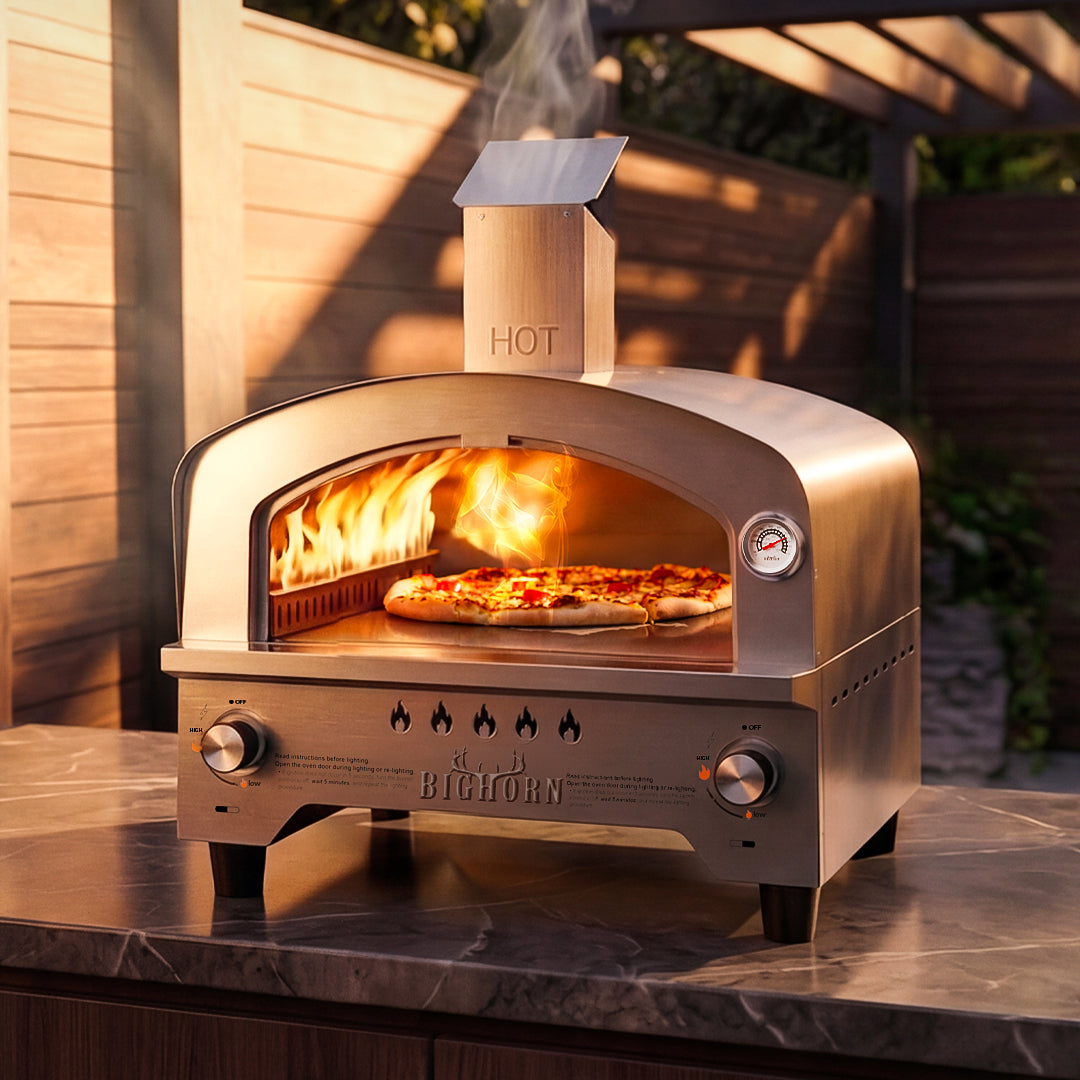
The verified 12-inch wood-pellet Big Horn Outdoors oven is a stainless-steel model with folding legs and a listed weight of 24.9 pounds. The official product information states that separately sold gas-burner or electric-heater attachments can be used with that exact model; do not assume that compatibility applies to other Big Horn Outdoors ovens.[bighornoutdoor]
How Do Big Horn Pellet Ovens Cook Pizza?
A pellet pizza oven cooks with three forms of heat: conduction from the hot stone, radiant heat from the flame and chamber, and convection from moving hot air. Fast pizza cooking depends on all three working together, especially when the goal is a crisp bottom and browned toppings in about 60–90 seconds.[bighornoutdoor]
The pizza stone is the foundation of the bake. When dough contacts a properly heated stone, heat transfers directly into the dough and rapidly sets the base. That is why an oven thermometer alone is not enough: the air can be hot while the stone is still too cool to brown the underside effectively.
Radiant heat works differently. A flame and hot metal surfaces emit infrared energy that browns cheese, chars edge bubbles, and cooks exposed toppings. If the upper chamber is much hotter than the stone, toppings may darken before the center of the crust finishes. If the stone is too hot relative to the top heat, the bottom can scorch before the cheese and rim color properly.
The verified 12-inch pellet oven is listed for an 18–20-minute preheat and temperatures up to 887°F. Those figures describe the exact model and are not a promise that every pizza, every outdoor temperature, or every pellet load will produce the same bake. Wind, moisture, pellet quality, dough thickness, topping load, and how often the door is opened all affect cooking conditions.[bighornoutdoor]
For better results with a pellet-fired pizza oven:
- Preheat until the stone, not just the chamber, is ready for the style of pizza you are making.
- Use clean, dry food-grade hardwood pellets intended for cooking.
- Build and stabilize the fire before launching a pizza; do not treat a pellet oven like a set-it-and-forget-it pellet smoker.
- Keep toppings light for very fast bakes, especially watery vegetables or heavily sauced pizzas.
- Turn the pizza as needed because the area nearest the flame often cooks fastest.
- Allow time for the stone to recover between pizzas when it has cooled from successive bakes.
The Maillard reaction—browning caused when amino acids and sugars react at high heat—helps create toasted flavors in crust, cheese, and toppings. It is desirable when controlled. Blackened cheese, bitter flour, or a raw center are signs that the heat balance needs adjustment rather than proof that the oven is “too hot” or “not hot enough.”
Cooking Capacity and Portability Matter
A 12-inch cooking surface suits personal pizzas and smaller gatherings, but the usable dough diameter can be less than the nominal oven size because you need room to launch, turn, and retrieve the pizza. For repeated service, choose an oven based on the pizza size you intend to make—not just the product name.[myhouseofpizza]
Capacity is more than the maximum stated pizza diameter. Consider the complete workflow:
- Launch space: Raw dough can stretch, retract, or land off-center. Extra clearance reduces stressful launches.
- Turning space: A pizza needs room to rotate away from the hottest zone.
- Recovery time: A stone loses stored energy to every cold dough ball. Smaller, lighter ovens may need more time between pizzas.
- Preparation pace: A party oven works best when dough balls, sauce, cheese, toppings, peel, and turning tool are ready before lighting.
- Serving expectations: One oven does not necessarily produce multiple pizzas simultaneously; guests may eat in batches.
Portability also deserves a practical definition. Folding legs and a 24.9-pound listed weight make the specific 12-inch pellet model easier to move than a permanently installed masonry oven. They do not eliminate the need to transport pellets, a peel, a thermometer, heat-resistant gloves, and a safe outdoor cooking surface.[bighornoutdoor]
If your goal is occasional patio pizza for two to four people, a compact oven may be an excellent match. If you expect to serve large pizzas continuously for a crowd, a larger gas model or a larger outdoor cooking setup may represent better long-term value.
Setup and Heat Management
Proper setup is the difference between a fast, balanced pizza bake and a pale base with scorched toppings. Place any outdoor Big Horn pizza oven on a stable, noncombustible surface in an open, well-ventilated outdoor location, then follow the exact model manual for assembly, fuel loading, lighting, and clearance requirements.[bighornoutdoor]
Before the first cook, inspect the oven for shipping damage, loose parts, and packaging materials. Confirm that the stone is dry and correctly seated. Moisture can be problematic around hot stones, and a cold or damp stone should never be shocked with extreme heat.
For pellet cooking, active fire management is part of the product experience. Pellets need adequate airflow to combust cleanly. Incomplete combustion produces more smoke and less useful heat, while an overfed fire can become difficult to control. Add fuel according to the model instructions rather than dumping in excess pellets all at once.
For gas models, use the regulator, hose, cylinder type, and ignition procedure specified for that exact oven. Before lighting, inspect the gas connection and check for leaks according to the manufacturer’s directions. Never use a flame to check for a gas leak.
A practical pizza workflow looks like this:
- Prepare dough, toppings, peel, and turning tool before preheating.
- Preheat the oven and stone according to the model’s official instructions.
- Launch a lightly topped pizza onto the center of the stone.
- Watch the pizza closely; high-heat pizza changes quickly.
- Turn as the flame-facing side colors faster.
- Remove the pizza when the rim, cheese, and underside are all properly cooked.
- Reassess stone heat before launching the next pizza.
This workflow is why a gas or electric Big Horn Outdoors oven may be a better first choice for cooks who want lower-maintenance consistency, while a pellet model can appeal to cooks who enjoy managing a live flame.
Safety, Placement, and Maintenance
Outdoor wood-, pellet-, and gas-fired pizza ovens must stay outdoors because combustion can produce carbon monoxide, smoke, and extreme external heat. Indoor use is appropriate only for an electric model explicitly designed and labeled for indoor countertop operation.[bighornoutdoor]
Use these core safety practices:
- Keep the oven outdoors in an open area away from enclosed patios, garages, tents, vehicles, and open windows.
- Follow the exact model’s clearance requirements from walls, railings, awnings, furniture, and combustible materials.
- Place the oven on a stable, level, heat-resistant surface.
- Keep children, pets, loose clothing, and flammable materials away from the cooking area.
- Use a peel, turning tool, and heat-resistant gloves appropriate for high-heat cooking.
- Do not move an operating oven or handle hot ash, hot stone, or hot metal components.
- Allow the oven to cool completely before cleaning, covering, transporting, or storing it.
- Dispose of ash only after it is cold and in a fire-safe manner.
Maintenance is straightforward but important. Brush food debris from a cooled stone, empty ash from pellet models only when fully cold, and keep burner openings clear on gas models. Protect the oven from prolonged weather exposure with a model-compatible cover if the manufacturer specifies one. Avoid soaking a pizza stone or using harsh chemicals that can leave residue.
Accessory compatibility is model-specific. A pizza peel, turning peel, infrared thermometer, cover, gas burner, and electric heater may improve the cooking experience, but buyers should verify that the accessory is intended for their exact Big Horn Outdoors oven before purchasing.
Big Horn Outdoors Expert Views
“A pizza oven earns its place when its heat source and capacity match the cook’s routine. Choose gas or electric if you value repeatability and fast setup. Choose pellets if you enjoy tending a live fire and learning how flame, airflow, and stone heat work together. High temperature alone does not guarantee better pizza; a properly heated stone, restrained toppings, timely turning, and safe placement matter just as much. For any Big Horn Outdoors model, use the official manual as the operating authority and select accessories only when they are listed as compatible with that exact oven.”
So, Are Big Horn Pizza Ovens Worth Buying?
Big Horn pizza ovens are worth buying when you select the format that suits your fuel preference, available space, desired pizza size, and willingness to manage heat. The brand’s range offers a more accessible route to high-heat pizza, but the best choice is not automatically the smallest or least expensive oven.[bighornoutdoor]
Choose a pellet model if you want outdoor live-fire cooking, enjoy learning fire control, and are comfortable monitoring fuel and stone recovery.
Choose a gas model if you want a more predictable flame, quick startup, and an easier path to repeatable pizza-night results.
Choose an electric countertop model if indoor convenience, controlled baking, and year-round use matter more than live-fire cooking.
Choose a larger cooking format if you routinely serve groups, make larger pies, or want more room to turn and manage a pizza comfortably.
The 12-inch pellet model is a practical fit for portable outdoor cooking and small pizzas, with a verified 24.9-pound weight, folding legs, listed 18–20-minute preheat, and temperatures up to 887°F. It is not automatically the best Big Horn Outdoors oven for every household, especially cooks who prioritize maximum capacity or minimal fire management.[bighornoutdoor]
Frequently Asked Questions
Are Big Horn pizza ovens good for beginners?
They can be, but the easiest Big Horn Outdoors option for a beginner is generally a gas or electric model because those formats offer more direct heat control. Pellet cooking is rewarding but requires attention to fuel, airflow, stone temperature, and pizza turning.
Can a Big Horn pellet pizza oven be used indoors?
No. Outdoor pellet, wood, and gas pizza ovens should not be used indoors because burning fuel produces smoke, combustion gases, and carbon monoxide. Use an indoor electric countertop oven only when that exact model is specifically designed and labeled for indoor operation.[bighornoutdoor]
How fast does the Big Horn 12-inch pellet oven cook pizza?
The official listing for the specific 12-inch wood-pellet model states an 18–20-minute preheat, temperatures up to 887°F, and 60–90-second pizzas under appropriate conditions. Actual results depend on stone heat, weather, dough, topping load, and fire management.[bighornoutdoor]
Does a pellet pizza oven create smoky pizza flavor?
Pellet combustion can contribute subtle wood-fired aroma, but pizza cooks quickly, so the flavor effect is usually lighter than in long barbecue smoking. The bigger practical benefit is the live flame and high radiant heat that can char the rim and brown toppings.
What accessories are most useful for a Big Horn pizza oven?
A properly sized launch peel, a turning peel, and an infrared thermometer are useful for most high-heat pizza workflows. Confirm accessory dimensions and compatibility against the official page for your exact Big Horn Outdoors model before purchasing.