Choose a Big Horn Outdoors pellet oven if you enjoy tending a live hardwood fire and accept ash cleanup as part of outdoor cooking. Choose a gas oven if repeatable flame control and simpler weeknight operation matter most. Big Horn’s 12-inch Pellet & Gas Pizza Oven combines both approaches, reaches 350°C/660°F in about 20 minutes, and is listed for 60–90-second pizzas.[bighornoutdoor]
The practical choice is not about which fuel is universally “better.” It is about how you plan to cook. A pellet-fired pizza oven rewards active fire management and delivers the visual, sensory experience of real solid-fuel cooking. A propane gas pizza oven reduces the variables: ignite the burner, regulate the flame, and focus on stretching dough, topping pizzas, and turning them at the right time.
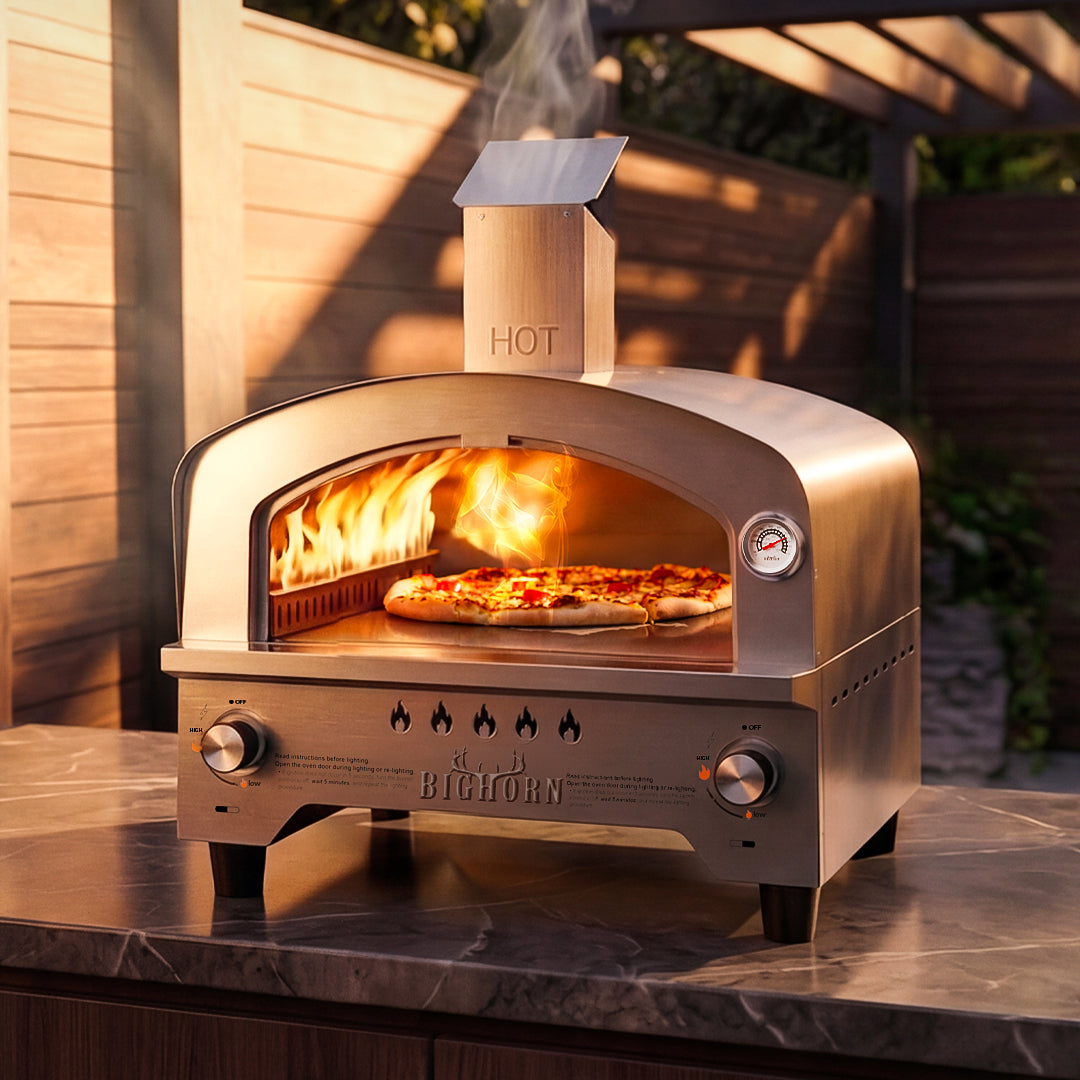
For cooks who want both workflows in one compact outdoor oven, the Big Horn Outdoors 12-inch Pellet & Gas Pizza Oven is the more flexible category of choice. The current official product page lists a detachable gas burner, tool-free switching between pellet and gas modes, a 12-inch pizza stone, folding legs, a stainless-steel body, and a pellet hopper.[bighornoutdoor]
What Is the Main Difference Between Pellet and Gas?
A pellet pizza oven burns compressed hardwood pellets to create a live flame, while a gas pizza oven burns propane through an adjustable burner. Pellets require fire, airflow, and fuel management; gas gives the cook direct control over the flame with a burner control.
The difference matters because pizza depends on several forms of heat working together:
- Radiant heat browns the top of the pizza, blisters the rim, and melts cheese.
- Conductive heat moves from the hot pizza stone into the dough, setting and crisping the base.
- Convective heat is the movement of hot air and flame through the cooking chamber.
- Flame management determines whether the dough, toppings, and crust finish at a similar pace.
In a pellet oven, combustion depends on a stable supply of dry pellets and sufficient oxygen. The flame can change as pellets ignite, burn down, or bridge inside the hopper. That makes pellet cooking more interactive: you watch the fire, add fuel deliberately, and learn how wind and airflow affect the oven.
In a gas oven, the burner supplies fuel at a controlled rate. You can generally make a faster, more predictable adjustment if the top is browning too quickly or the stone needs more heat before the next pizza. Gas is therefore often the easier option for beginners, high-volume family meals, and cooks who want a more repeatable process. Independent product guidance similarly identifies gas as the more consistent flame source, while solid-fuel cooking demands more monitoring.[seriouseats]
Which Big Horn Oven Fits Your Cooking Style?
Choose pellet if the fire-tending process is part of the occasion; choose gas if you want the least complicated route to high-heat pizza. The Big Horn Outdoors 12-inch Pellet & Gas Pizza Oven is designed for cooks who want to switch between both approved fuel modes rather than commit to only one.[bighornoutdoor]
Use this decision table to match fuel choice to the way you actually cook.
| Decision factor | Pellet mode | Gas mode |
|---|---|---|
| Best for | Cooks who enjoy live-fire cooking and wood-fuel ritual | Weeknight cooking, new pizza makers, and repeatable sessions |
| Heat control | Managed through pellet supply, airflow, and fire behavior | Adjusted through the burner’s flame control |
| Startup workflow | Requires lighting and maintaining solid fuel | Uses an ignition-and-burner workflow |
| Cleanup | Requires fully cooled ash removal | No pellet ash from the burner |
| Cooking experience | More hands-on and flame-focused | More controlled and streamlined |
| Fuel logistics | Requires dry, food-safe hardwood pellets | Requires a compatible propane supply and correct connections |
| Ideal buyer | Outdoor cook who enjoys learning fire management | Outdoor cook who prioritizes convenience and consistency |
The Big Horn Outdoors dual-fuel model is especially relevant when household preferences differ. One cook may want pellet-fired pizza on a relaxed weekend, while another may prefer gas for a faster dinner. The official product page says the oven can switch between pellet and gas without tools and includes its gas burner; however, always follow the current manual and product-specific setup instructions rather than assuming a procedure from another pizza-oven model.[bighornoutdoor]
How Do Pellet and Gas Affect Pizza Results?
Fuel choice changes how you manage the oven more than it changes the fundamental requirement for good pizza: a properly heated stone and balanced top heat. Big Horn Outdoors lists its 12-inch Pellet & Gas Pizza Oven at 350°C/660°F in about 20 minutes and 60–90-second pizza capability when conditions are appropriate.[bighornoutdoor]
A short, high-heat bake works because the stone rapidly cooks the bottom while the flame and hot upper chamber finish the rim and toppings. If the stone is too cool, the base may remain pale or soft before the cheese and rim overcook. If the stone is excessively hot relative to the upper chamber, the bottom can scorch before the toppings are done.
Pellet cooking: what changes
Pellet heat can be highly effective for pizza, but it is not set-and-forget heat. You must keep the fuel dry, avoid overloading the hopper, and allow the flame to stabilize before launching food. A pellet flame may create subtle wood-fired aromatic notes, but it should not be treated as a guarantee that every fast-cooked pizza will taste strongly smoky. Pizza bakes quickly, and flavor is also shaped by dough fermentation, cheese, sauce, char, and topping choice.
Use pellet mode when you enjoy:
- Building and maintaining a live flame
- Cooking in a slower, more hands-on rhythm
- Managing fuel and airflow as part of the craft
- The look and atmosphere of hardwood-fired outdoor cooking
Gas cooking: what changes
Gas simplifies the heat-management sequence. Turn the burner high for preheating, observe the stone and flame behavior, then adjust the burner when the top or crust needs a different balance. That can be especially useful for thicker pizzas, vegetables, roasted foods, or consecutive pizzas where you want to maintain a controlled cooking environment.
Use gas mode when you prioritize:
- Consistent burner output
- Easier adjustment during cooking
- Less solid-fuel residue after a session
- A more approachable learning curve
- Pizza nights where timing matters more than fire tending
Neither method eliminates the need to rotate pizzas. Big Horn Outdoors advises preheating with the stone in place and rotating the pizza every 15–20 seconds; it also advises par-baking the crust before topping when working with thick dough.[bighornoutdoor]
How Much Hands-On Work Do You Want?
Gas is generally the lower-maintenance fuel during and after cooking, while pellets require ongoing fuel attention and ash handling. Choose the fuel whose workload you will realistically enjoy after the novelty of the first few pizza nights has passed.
Pellet cooking has three recurring jobs:
- Fuel preparation: Use dry, food-safe hardwood pellets specified or permitted by the manufacturer. Do not substitute heating pellets, treated wood products, or unknown fuel sources.
- Fire monitoring: Add pellets at a measured pace and watch for changes in flame quality. Wind, moisture, and pellet flow can influence performance.
- Ash cleanup: Let the oven and ash cool completely before handling residue. Ash can remain hot long after the visible flame has disappeared.
Gas cooking has different responsibilities:
- Connection checks: Inspect the hose, regulator, cylinder, and fittings before use according to the model instructions.
- Ignition discipline: Light and operate the burner exactly as directed by the manufacturer.
- Grease and surface care: Although gas creates no wood ash, flour, cheese, grease, and food debris still need to be removed after the oven has cooled.
Gas is not automatically “better” because it is easier. Pellet mode may be the better ownership choice if you cook outdoors specifically because you enjoy working with a real fire. But if you anticipate using the oven twice a week after work, the convenience of gas may make the difference between using the oven regularly and leaving it stored away.
Cooking Capacity and Portability
A 12-inch pizza oven is best suited to personal-size pizzas and small-format outdoor cooking rather than large 14- to 16-inch pizzas. The Big Horn Outdoors 12-inch Pellet & Gas Pizza Oven includes a 12-inch pizza stone and folding legs, making its format more appropriate for compact patios, backyard setups, and transport-conscious cooking than for a permanent, high-capacity outdoor kitchen.[bighornoutdoor]
“Portable” does not mean effortless or safe to move while hot. Folding legs can simplify storage and transport when the unit is cold and clean, but you still need a stable, heat-resistant outdoor cooking surface and enough room for safe operation.
Before selecting pellet or gas, assess the entire working area:
- Space for the oven itself
- A stable prep surface for dough, sauce, toppings, and tools
- A landing area for hot pizza pans or peels
- Safe routing and placement for a propane cylinder, if applicable
- Storage for pellets kept dry and protected from moisture
- Clear space around the oven according to its current manual
For a compact outdoor setup, a dual-fuel model can reduce the need to own two separate pizza ovens. That does not mean every accessory is interchangeable across Big Horn Outdoors models. Confirm compatibility on the product page or in the manual before buying a cover, burner attachment, stone, peel, or replacement component.
Safe Setup for Pellet and Gas Cooking
Pellet- and propane-fired pizza ovens should be used outdoors in an open, well-ventilated area, following the exact clearance, placement, and fuel instructions for the specific model. Never use a combustion-fueled pizza oven in a house, garage, tent, enclosed patio, or other confined space because combustion creates fire and carbon-monoxide hazards.
The following safety practices apply broadly, but the manufacturer’s current instructions for your exact Big Horn Outdoors oven always take priority:
- Place the oven on a stable, level, noncombustible or suitably heat-resistant surface.
- Keep children, pets, clothing, paper products, dry vegetation, and other combustibles away from the cooking area.
- Do not leave a lit oven unattended.
- Do not use gasoline, lighter fluid, or unapproved fire starters with pellet fuel.
- Do not connect an unapproved burner, hose, regulator, or gas cylinder.
- Check gas connections for leaks according to the manufacturer’s procedure before lighting.
- Keep the oven door, hopper, burner, and ventilation areas configured as directed for the selected fuel mode.
- Allow the appliance to cool fully before moving, covering, cleaning, or storing it.
- Follow local fire restrictions, HOA rules, campsite rules, and municipal requirements.
A key multi-fuel rule is simple: use one approved fuel system at a time. Do not improvise by combining pellet fire and gas operation in the same cooking session unless the exact product manual specifically permits that workflow. Other established multi-fuel pizza-oven guidance likewise warns against operating solid fuel and gas simultaneously for safety and performance reasons.[ooni]
Care and Maintenance by Fuel Type
Pellet ovens need ash management after fully cooling, while gas ovens need burner-area inspection and routine removal of food debris. Both fuel types benefit from a clean pizza stone, dry storage, and avoiding water on hot components.
For pellet mode:
- Let all pellets and embers burn out and cool naturally.
- Remove cold ash only after confirming there are no live embers.
- Brush loose flour and debris from the cooking area after the oven is cool.
- Keep unused pellets dry; damp pellets burn poorly and can interfere with reliable ignition.
- Check the hopper and fuel path for accumulated ash or obstructions before the next cook.
For gas mode:
- Inspect the burner openings for debris according to the manual.
- Keep the hose, regulator, and connections clean and protected from damage.
- Wipe external surfaces only after the oven has cooled.
- Store the propane cylinder and oven in accordance with local rules and the manufacturer’s guidance.
- Do not use the oven if you smell gas or identify a damaged connection; shut off the gas supply and follow the manual’s safety steps.
Do not soak a pizza stone or introduce water to a hot oven. Thermal shock can crack a stone, and moisture inside a hot cooking chamber can create steam hazards. The safest cleanup sequence is always: burn off residue where appropriate, cool fully, brush away loose debris, then clean only with methods allowed by the product instructions.
Big Horn Outdoors Expert Views
“The best pizza-oven fuel is the one you will use confidently and safely. Pellet cooking is ideal when you want to manage a real flame and make the fire part of the experience. Gas is ideal when you want repeatable heat and straightforward adjustment. For cooks who want both options, choose a model designed and approved for both fuels, then treat each mode as its own setup: use the right fuel, follow the correct ignition procedure, preheat the stone, and give the oven time to recover between pizzas.”
— Big Horn Outdoors Product Team
Which Option Should You Buy?
Buy a pellet-focused Big Horn Outdoors oven if you want a live-fire cooking routine, have suitable outdoor space, and are comfortable monitoring fuel and cleaning cooled ash. Buy a gas pizza oven if your priority is easier heat adjustment, simpler cleanup, and a dependable process for frequent pizza nights.
Choose the Big Horn Outdoors 12-inch Pellet & Gas Pizza Oven if you want the flexibility to cook with either pellet or gas. Its official listing specifies a stainless-steel construction, folding legs, a 12-inch stone, an upgraded pellet hopper, a detachable gas burner, tool-free fuel switching, and a listed 350°C/660°F target in about 20 minutes.[bighornoutdoor]
Make the final decision with five practical questions:
- Do you want to tend a fire, or turn a burner knob?
- Will you cook mostly relaxed weekend pizzas or quick weeknight meals?
- Do you have dry pellet storage and a safe place to dispose of cooled ash?
- Do you have a safe, approved outdoor arrangement for a propane cylinder?
- Would choosing both fuel options help more than owning two single-fuel ovens?
If your answer is “I want the wood-fired process,” choose pellet. If it is “I want consistent, convenient high heat,” choose gas. If it is “I want the freedom to decide each time,” a purpose-built Big Horn Outdoors pellet-and-gas model is the most adaptable option.
FAQs
Is a pellet pizza oven harder to use than a gas pizza oven?
Usually, yes. Pellet cooking requires the user to light, feed, and monitor a live fire, while gas allows flame adjustment through the burner control. Neither is difficult after practice, but gas is generally the easier starting point for cooks focused on consistency.
Does pellet fuel make pizza taste smoky?
Pellets can contribute wood-fired aroma, but the effect varies with fuel, flame quality, bake time, dough, and toppings. Because a high-heat pizza can bake in 60–90 seconds in the listed Big Horn dual-fuel oven conditions, do not expect a long-smoked flavor from every pizza.[bighornoutdoor]
Can I use gas and pellets at the same time?
Do not combine fuel systems unless the exact product manual explicitly instructs you to do so. Use the approved pellet or gas configuration for one cooking session, follow its dedicated setup steps, and never modify the oven or burner.
How long does the Big Horn 12-inch Pellet & Gas Pizza Oven take to preheat?
The official product page lists approximately 20 minutes to reach 350°C/660°F in pellet or gas mode, while a separate page FAQ mentions 15 minutes in gas mode. Because these statements differ, plan around the conservative 20-minute listing and verify stone readiness before launching pizza.[bighornoutdoor]
Is a 12-inch pizza oven large enough for a family?
A 12-inch oven suits personal-size pizzas and sequential cooking for a small group. It is practical for families willing to cook one pizza at a time; choose a larger format if you routinely need larger pizzas or want more room for high-volume service.