
Choosing a pizza oven comes down to four decisions that interact more than most buyers expect: where you will use it, what fuel you are willing to manage, how large a pizza you actually cook, and what your budget allows you to upgrade later. The right order is to answer the questions about use and space first, because they eliminate more options than any spec sheet. This guide is the starting point for that decision; the fuel-specific and model-specific details live in the guides it links to.
Answer these questions first
Before comparing ovens, write down answers to five questions:
- Where will it live? Indoors on a counter, outdoors on a table, or on a permanent patio spot? That answer immediately separates indoor-rated electric models from outdoor propane, pellet and multi-fuel units.
- Who cooks, and how often? A twice-a-month hobby cook and a weekly pizza-night family want different levels of convenience.
- What style of pizza do you want? Neapolitan-style pies with blistered rims need high heat; New York-style and sheet-pan pizzas are more forgiving and can work in ovens that reach lower peaks.
- How many people at once? Feeding six means baking back-to-back; a stone that holds heat and an oven that recovers quickly matter as much as diameter.
- What are the constraints? Balcony rules, storage space, wind exposure and whether you can store fuel all change the recommendation.
Most buyers who skip these questions end up choosing between two ovens that both fit the wrong scenario.
Fuel: gas, pellet, electric, multi
Fuel is the biggest lifestyle decision, not just a heat-source decision. Each option changes how you start the oven, how long it takes to preheat, what you store, and where the oven can legally run.
| Fuel | Best for | Main trade-off |
|---|---|---|
| Gas (propane) | Fast starts, consistent heat, frequent outdoor cooking | No wood-fired flavor; tank storage rules apply |
| Pellet (wood) | Wood-fired flavor with dialed-in outdoor sessions | You feed and manage the fire; pellets must stay dry |
| Electric | Indoor countertop cooking and apartment kitchens | Heat profile differs from live fire; outlet and circuit matter |
| Multi-fuel | Trying wood/charcoal now with a gas option later | More parts and decisions per cook |
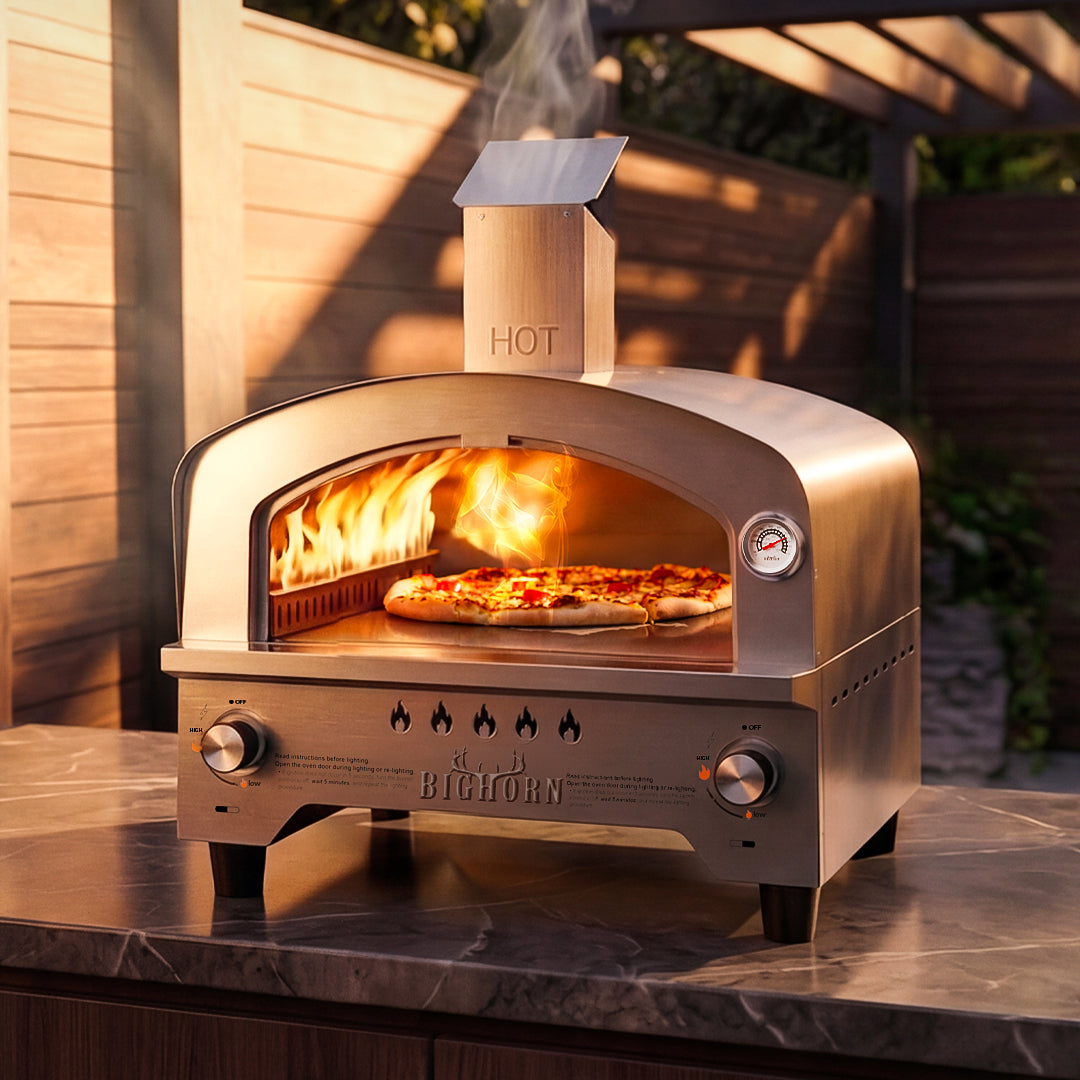
Big Horn organizes its current range the same way you should think about it: the electric pizza oven collection for countertop and indoor use, the gas pizza oven collection for fast outdoor cooks, and the pellet pizza oven collection for wood-fired flavor outdoors. The full pizza oven collection shows the range together.


A closer look at the fuel trade-offs
Each fuel rewards a different kind of cook, and the differences show up in the routine as much as the crust. Gas is the convenience pick: you turn a dial, preheat for a set amount of time, and cook at a stable temperature. It suits cooks who want pizza often and predictably, and it pairs well with a propane tank or natural-gas connection if your patio supports one. Pellet ovens trade a little convenience for wood-fired character — you fill a hopper, light the fire and manage it during the cook, and the reward is smoky, blistered crust that gas cannot fully mimic.
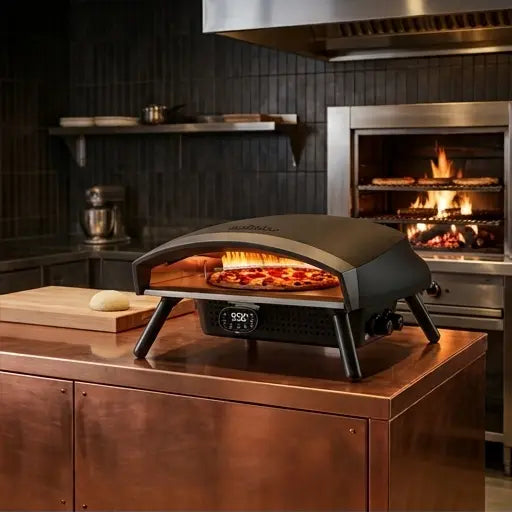
Electric ovens are the indoor answer: they plug into a wall outlet, need no fuel storage, and produce no combustion exhaust, which is why they are the realistic choice for apartments and countertop kitchens. Their heat profile is not identical to live fire, but a good electric oven with a hot stone can still turn out properly charred Neapolitan-style pies. Multi-fuel ovens let you start with wood or charcoal and add a gas burner later, or switch by mood — useful if you are not sure which fuel you will prefer, at the cost of more parts to store and more decisions per cook.
There is no best fuel in the abstract. There is only the fuel that matches where you cook, how often, and how much fire management you enjoy.
Size: what fits your cooking
Oven size is usually described by the largest pizza that fits, but the number that matters more is the one you cook most often. A 12-inch oven fits most Neapolitan-style pies and many home batches; a 14- or 16-inch deck gives you room to stretch larger pies and to maneuver with a peel without crowding the stone. If you mostly cook 12-inch pizzas, a bigger deck mainly buys recovery time between bakes rather than room for a single pie.
Size also means footprint. Measure the table, cart or counter where the oven will sit, including the space you need beside it for a peel and a landing board. An oven that fits the surface but leaves no room to load and turn pizzas will frustrate you on every cook.
Think about pizza sizes you actually serve, not the biggest pizza you have ever eaten. If your household eats 12-inch pizzas, a 12-inch oven is not undersized; if you regularly make 16-inch pies for a crowd, a 12-inch deck will force you to downsize every batch. Also consider stone thickness and recovery: a heavier stone holds heat between pizzas, which matters for back-to-back bakes even when the diameter is the same. When a product page lists a pizza size, check whether that is the stone diameter or the largest dough that fits — the two are not always the same number.
Indoor vs outdoor placement
Placement is a safety decision before it is a convenience decision. Electric ovens designed for countertop use can run indoors; propane, pellet and charcoal-burning ovens produce exhaust and belong outdoors with clearance from walls, overhangs and anything that can burn. Apartment and balcony rules can override what the oven physically allows, so check your lease and local fire rules before buying an outdoor model. If you are unsure where a given fuel can be used, the placement guide for your grill type is the better read before you compare prices.
Storage is part of placement. An outdoor oven still needs a dry place for its cover or a sheltered corner in wet seasons, and a pellet oven adds fuel storage to the list — pellets need to stay dry. An electric countertop oven needs counter space near an outlet that can handle its load. Think about the full footprint of the system, not just the oven body, before you commit to a spot.
Budget and upgrade path
Instead of asking "how much should I spend," ask what each price tier must include for your use. A useful way to think about it: the oven, the fuel it needs, a peel, and a place to put it are the minimum system; a cover and a thermometer are the next additions that protect the investment. Set the budget for the system, not the oven alone, and leave room to upgrade the weak link later — many cooks discover their first upgrade is a better peel or stone, not a bigger oven.
Three buyer profiles show how the questions work in practice. A renter who wants pizza on weeknights in a small kitchen lands on an electric countertop oven, because placement and fuel rules eliminate outdoor models before price is discussed. A family with a patio and a regular pizza night usually lands on gas for the routine, with a pellet oven as the choice when wood-fired flavor is the point of the purchase. A hobbyist who wants to try live-fire cooking without committing to one fuel is the natural candidate for a multi-fuel oven. Match yourself to the closest profile, then let the model guides narrow the list.
Where each guide fits in this cluster
This page is the decision framework. Once you know your fuel, size and placement, the deeper reads are the ones that compare within a fuel type: best-of lists for gas, electric and pellet, heat-up and cleaning guides for the fuel you chose, and setup articles for the specific model. The Pizza Calculator is also worth bookmarking now — it answers the dough math for whatever oven you end up with.
A pizza oven is a long-lived purchase that rewards an honest answer to the first five questions. Work through them once, and the fuel, size and budget choices stop feeling like guesswork.
A quick way to shortlist once your answers are written: eliminate anything that fails your placement rule first, then compare only ovens in your fuel column, then drop anything whose stone or deck cannot handle your regular pizza size. Most buyers are left with two or three realistic models after those three filters — which is exactly the point of a framework. From there, the fuel-specific guides and product pages do the close comparison, and the Pizza Calculator settles the dough math for whichever oven you pick.
Product details and prices in this guide were verified against official Big Horn Outdoors listings during the September 5, 2026 review; re-check prices and availability at checkout.
Explore more in the Pizza Oven Comparisons.