
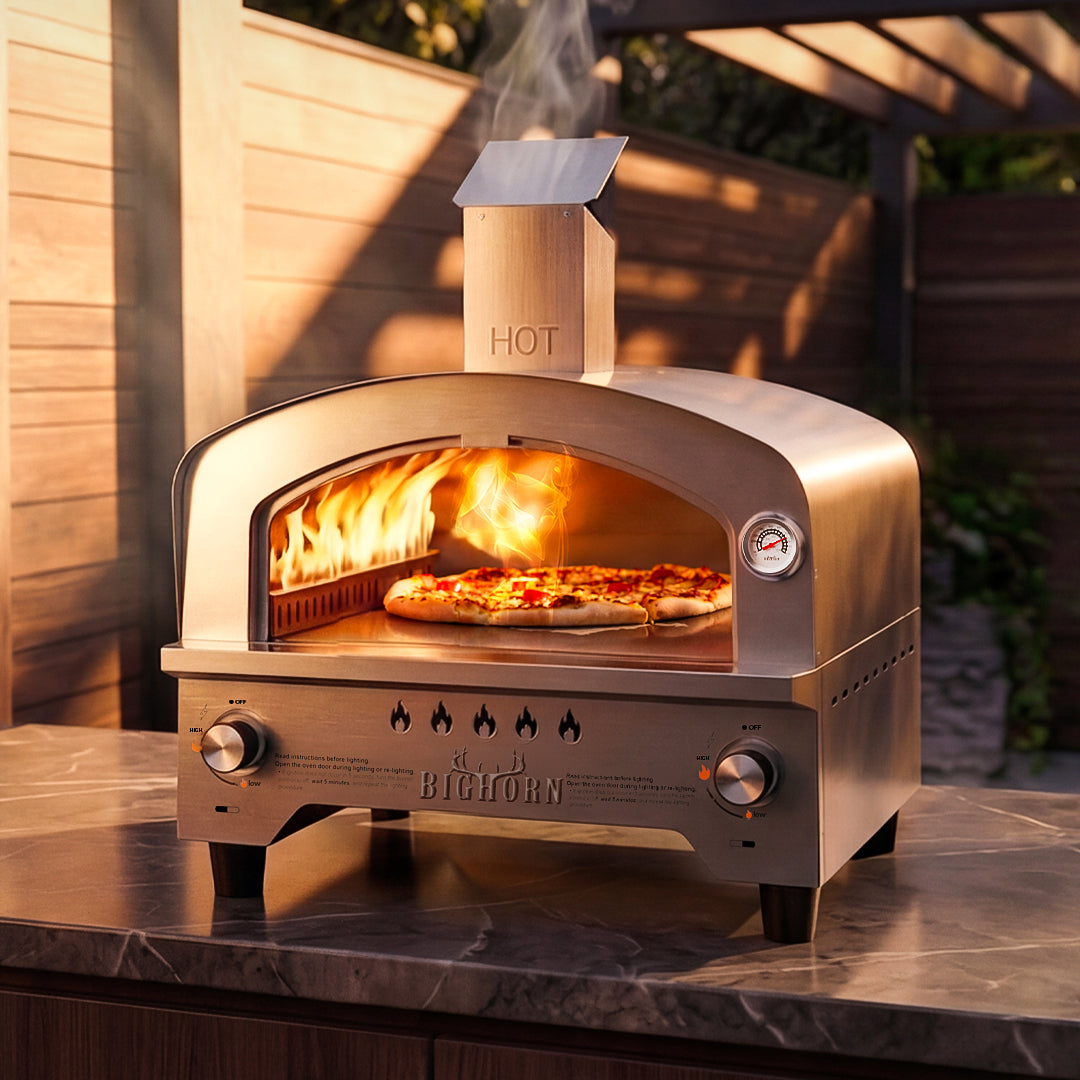
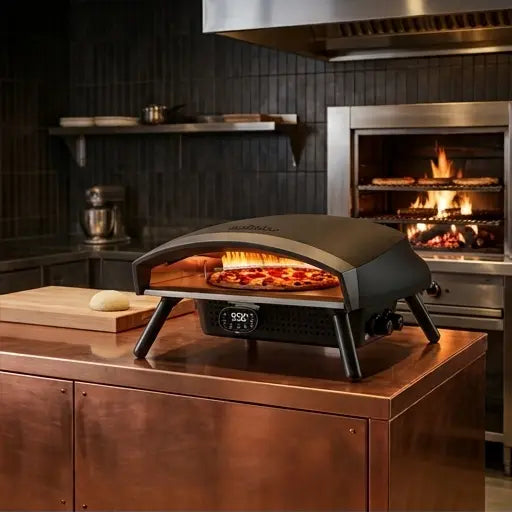
An indoor pizza oven is worth buying when an indoor-rated electric countertop model fits your kitchen: enough clearance, a proper circuit, and a workflow that does not crowd the counter. The 14-inch countertop models from Big Horn Outdoors are designed for kitchen use, and the kitchen-fit check comes before the model comparison.
What This Guide Answers
This guide decides one thing: whether your kitchen can support an indoor countertop pizza oven. It covers the countertop measurement, the electrical setup, the workflow space, and the storage position. It does not cover fuel-fired outdoor ovens or multi-fuel attachments, because an indoor oven is an electric appliance with its own requirements.
The fit check is pass-fail: if the kitchen cannot meet the clearance and electrical rules, the oven is out regardless of features. Work the checks in order, and the fit question answers itself.
Measure the Countertop in Both Positions
Measure the countertop where the oven will cook, then measure again where it will be stored. A 14-inch countertop oven occupies a compact footprint, but the manual's clearance requirements around and above it are the working minimum, not a suggestion. The stored position matters too, especially for a model that flips up to reduce depth after cooling.
The cooking position needs the oven away from walls, heat-sensitive surfaces, and blocked vents. The stored position needs to be reachable, stable, and clear of heat sources, and the oven should return to the same spot every session so the routine stays simple.
The two electric countertop models from Big Horn Outdoors, the stainless steel preset model and the black manual model, share the same footprint class. The fit check is identical for both; the control choice comes after the fit.
Check the Electrical Setup Before the Purchase
The electrical requirements come from the rating label and the manual. Connect the oven directly to an appropriate grounded outlet, and avoid overloaded circuits or extension cords unless the manufacturer expressly permits them. The power cord should reach without crossing a hot surface or creating a trip hazard.
Check what else shares the circuit. A countertop oven draws real power, and a circuit already loaded by other kitchen appliances may not support it reliably. The manual and the rating label define the requirements, and the kitchen wiring should meet them.
If the outlet location does not suit the oven's position, the fix is electrical, not improvised: reposition the oven or arrange a proper outlet through qualified work. A long extension cord draped across the kitchen is not part of the setup.
Plan the Workflow Around the Oven
The oven needs more than a footprint; it needs a working zone. The peel path, the dough station, and the landing board should sit near the oven without crowding the countertop. An oven that fits in isolation but blocks the kitchen flow will frustrate every session.
Plan the order the food moves: prepare the dough and toppings at the prep side, build the pizza on the peel, launch it into the oven, and land the finished pie on a clean board. The zone should let the cook move in one direction without crossing the heat or the raw food.
Keep the tools within reach: a peel, a cutter, a stone brush, and a board. The zone is organized when the session starts without hunting and ends with a clean counter.
Choose the Model by Control, Then Confirm the Fit
The two 14-inch models answer the fit question with different controls. The stainless steel model reaches up to 850°F with six pizza presets, a manual mode, and PID-assisted temperature regulation; the black model covers a 220–800°F range with manual knob control. Both fit pizzas up to 14 inches and use upper and lower elements with a removable stone.
Choose presets for guided, repeatable bakes or manual control for direct adjustment. The control choice is separate from the fit: whichever model you prefer, the kitchen must meet the same clearance and electrical rules. Compare the current electric pizza oven collection for the models available today.
Before You Buy: The Kitchen-Fit Checklist
Four checks close the fit question:
- Countertop: the cooking and stored positions meet the manual's clearances.
- Electrical: a proper grounded outlet on a circuit that can support the oven.
- Workflow: the peel path, prep area, and landing board fit around the oven.
- Storage: the stored position is reachable, stable, and clear of heat sources.
The checklist is the same for every countertop electric oven, and it protects the purchase from the most common failure: an oven that does not fit the kitchen. If any check fails, the oven is not the right model for the kitchen.
Big Horn Outdoors Expert Views
The kitchen fit is the first spec for an indoor electric pizza oven, and it is a measurement exercise, not a preference. The manual's clearances are the working minimum, the circuit must support the draw, and the workflow needs room for the peel and the board. The two 14-inch countertop models share the same fit requirements and differ in control, so the fit check comes first and the control choice second. A flip-up design reduces stored depth, but operating clearances and stored dimensions are not the same, and the stored position still needs its own space. Buyers who measure the countertop, confirm the outlet, and plan the zone before ordering rarely return the oven.
The Fit-First Purchase Order
The most reliable indoor pizza oven purchase follows a fit-first order, and the order protects the household from the most common regret: an oven that does not work in the kitchen. Start with the countertop measurement in the cooking position, add the manual's clearance on every side, and write the numbers down before comparing any models. Then measure the stored position, because a flip-up model that saves depth in storage still needs its own reachable, stable spot when the kitchen is rearranged, and the measurement is the only way to know the truth.
The second step is the electrical check, and it deserves the same measurement discipline as the countertop. Confirm the outlet location against the rating label, note what else shares the circuit, and decide whether the wiring supports the oven before the purchase. A household that discovers the circuit problem on paper avoids the post-purchase scramble of moving the oven, changing the outlet, or running an improvised cord across the kitchen, and the paper check is the cheapest fix available.
The third step is the workflow test, and it is the step most buyers skip. Place a cardboard outline of the oven's footprint on the counter for a week, and live with it: open the drawers, use the peel, and land a board beside it. The cardboard test reveals the drawer that cannot open, the cabinet that blocks the flip-up, and the cord that cannot reach, all before the purchase, and it costs nothing but a week of living with an outline.
The fourth step is the model choice, and it comes last because the fit narrows the field before the controls matter. A preset model and a manual model share the same footprint, so a kitchen that fits one fits the other, and the control decision follows the cook rather than the space. The fit-first order turns the purchase from a feature comparison into a measured decision, and the measured decision is the one the household keeps instead of storing.
The final part of the fit-first order is the first session itself, and it doubles as the verification. Run the preheat, watch the stone, and confirm the kitchen behaves as planned: the clearances hold, the circuit does not complain, and the workflow flows. If the first session matches the plan, the purchase is confirmed; if it does not, the household learns it in the first hour rather than the first year, and that knowledge is worth the price of the appliance.
FAQ
How much countertop clearance does an indoor pizza oven need?
The clearance requirements come from the manual for the exact model. Keep the oven away from walls and heat-sensitive surfaces, keep vents unobstructed, and measure both the cooking and stored positions.
Does an indoor electric pizza oven need a special outlet?
Check the rating label and manual. Connect the oven directly to an appropriate grounded outlet and avoid overloaded circuits or extension cords unless the manufacturer permits them.
Can I use an outdoor pizza oven indoors if I open a window?
No. Pellet, wood, and gas ovens must be used outdoors in open, ventilated space. For kitchen use, choose an indoor-rated electric countertop model.
What is the difference between the two 14-inch models?
The stainless steel model reaches up to 850°F with six presets plus manual mode and PID regulation; the black model covers 220–800°F with manual knob control. Both fit pizzas up to 14 inches.
How do I know if the countertop fits?
Measure the cooking and stored positions against the manual's clearances, and test the workflow with the peel path and landing board. If the oven crowds the counter or the circuit, the kitchen does not fit.
Conclusion
An indoor pizza oven is the right tool when an indoor-rated electric countertop model fits the kitchen: clearance, circuit, workflow, and storage all pass. The 14-inch models from Big Horn Outdoors answer the fit with different controls, so choose the control first, then confirm the fit with the four-check list. See the current electric pizza oven collection to compare models, and confirm the manual's requirements before ordering. The kitchen fit decides whether the oven becomes a weekly appliance or a stored one.