







Accessories & Tools
A pizza launches cleanly when the dough is ready, the peel is dusted with just enough flour or semolina, and the motion is one committed slide. This is a peel-and-motion guide, not a clone of existing sticking pages. Do not treat a 55 rule as official launch advice.
Flour vs semolina vs holes
Flour, semolina, and a perforated blade are three different release tools, and none of them will save a wet, under-relaxed dough. A light dusting of flour or semolina under the round reduces contact. Too much dust tastes gritty and can burn on a hot stone. A perforated peel sheds extra dust through the holes, which can help, but the holes do not replace a dry, mobile round.
The current 12-inch perforated pizza peel with a foldable handle is the perforated example in this guide. The current stainless-steel pizza peel with a fordable handle is the solid metal path; the live URL uses that spelling, and the listing has published blade-size notes to recheck. Neither peel is a launch guarantee. For a dedicated dust comparison, keep semolina vs flour for launching pizza nearby, and use perforated pizza peel flour management when the question is how a holed blade sheds extra dust. This page will not redo those tests.

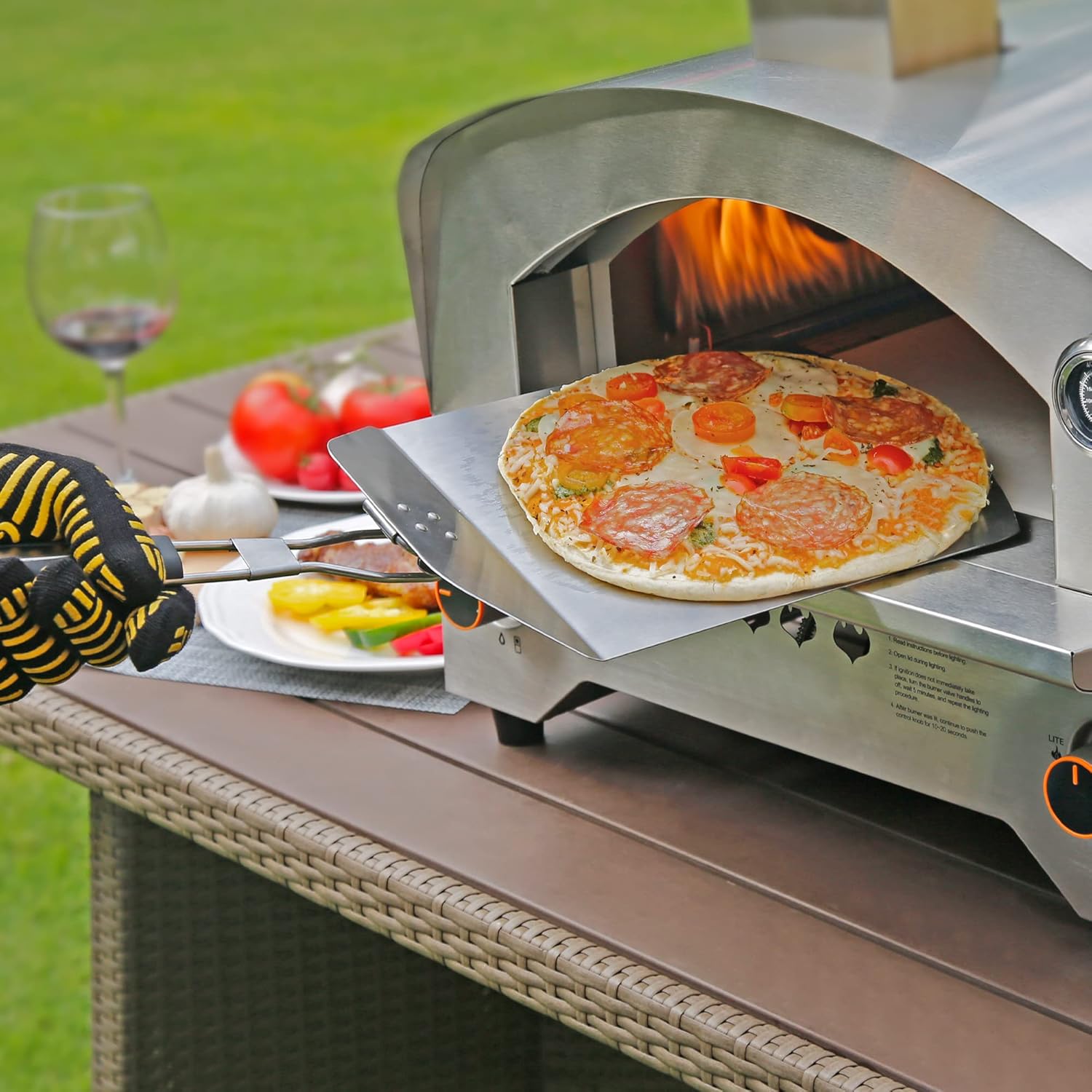
Motion technique
Build the pie on the peel only when you are ready to launch, then check that it still slides with a little shake. If it does not slide on the peel, it will not slide into the oven. The motion itself is a committed, slightly forward slide, not a timid toss and not a long pause at the oven mouth. Hesitation is when the rim fuses to the blade.
A peel that is too small for the pie, or a pie that hangs over the edge, will catch. Match the blade to the pizza and the oven you actually have, and browse the pizza oven collection only if the chamber, not the peel, is still the open question. Keep the oven fully outdoors if it burns fuel. NFPA grilling safety and U.S. Fire Administration cooking-fire prevention still apply around a hot chamber, and National Weather Service wind safety can cool a stone and make a delayed launch worse.
Hydration interaction
A wetter dough needs a drier, more confident launch, and often a little more dust or a perforated blade, but it also needs to be relaxed enough to open. A dry, tight dough can still stick if it sits too long on the peel and sweats. The fix is usually less time on the peel, a light even dust, and a dough that is actually ready, not a heavier coat of flour that turns into paste.
People ask about a 55 rule for pizza. This article will not treat a 55 rule as official launch guidance. If someone is using that phrase as a hydration or rest shorthand, follow the dough you actually mixed and a readiness feel, not a catchy number. How long dough should rest before it is stretched depends on the mix and the room; there is no universal official rest clock on this page.
Rescue mid-stick
If the pie grabs on the peel before you launch, stop. Lift the stuck edge with a scraper or a floured hand, dust a little more underneath, and test the slide again. If a topping leak is gluing the dough down, scoop the leak, dust, and decide whether the pie is still launchable. A pie that is already a puddle on the peel is often better rebuilt than forced into a torn mess on the stone.
If it grabs at the oven mouth, do not yank the peel out from under a folding rim. Support the pie, ease it off, and accept a slightly misshapen bake rather than a folded calzone you did not want. A broader "stop the stick" walk-through already lives at stop pizza sticking to the peel; use that page for the general sticking problem, and use this one for the perforated-and-motion habits.
The table below is a launch check, not a flour recipe.
| Tool or habit | What it helps | What it will not do |
|---|---|---|
| Light flour or semolina | Reduce contact under a ready round | Rescue a wet dough that sat too long, or replace official food handling later |
| Perforated peel | Shed extra dust through the holes | Launch a sticky pie by itself; confirm the live size notes |
| A committed slide | Get a mobile pie onto the deck before it fuses | Fix a peel that was already stuck before you reached the oven |
| A mid-stick rescue | Lift, dust, and retest, or rebuild if the pie has collapsed | Turn a 55 rule into official guidance |
What flour to dust is a smaller question than it looks. Use a modest coat of the flour you already bake with, or a little semolina if that is the dust you prefer, and avoid a thick cornmeal pile unless you already like that crunch and have tested it in your oven. The goal is a film that lets the pie move, not a sandy bed that burns on the stone. If you change dust, change one variable at a time so you can tell whether the peel, the dough, or the motion was the real problem.
Peel guides this page will not redo
Keep the existing launch-dust and perforated-peel pages for those tests, and keep the broader stop-sticking walk-through for the general grab problem. This page stays with motion, a mid-stick rescue, and the choice between a perforated blade and a solid metal peel. Confirm the live peel listings rather than assuming one blade solves every dough.
A first launch drill
Practice once with a plain round and almost no topping, just to feel the slide. Dust the peel, confirm movement, open the door or mouth, and commit. Then build a simple pie and do it again. Official leftover and topping temperatures still come from FDA safe food handling and FDA food safety in your kitchen if you add meat, and leftovers follow Ready.gov home fire guidance and Ready.gov food guidance rather than a warm sit on the peel.
Key takeaways
- Dust lightly, keep the pie moving, and launch with one committed slide; a perforated peel helps shed dust, but it is not a cure-all.
- Do not treat a 55 rule as official launch advice; use a readiness feel and the dough you actually mixed.
- If the pie sticks on the peel, stop, lift, and retest rather than forcing a tear.
- Confirm live peel sizes and handle notes, including the fordable-handle spelling on the metal listing.
Confirm the current 12-inch perforated pizza peel or stainless-steel pizza peel with a fordable handle listing, and keep stop pizza sticking to the peel nearby for the broader sticking walk-through this page does not redo.
FAQ
How do I stop pizza from sticking to the peel?
Dust the peel lightly, keep the pie on the peel only briefly, confirm that it still slides, and launch with one committed motion. If it grabs, stop, lift, dust, and retest, or rebuild a collapsed pie rather than forcing a tear.
What is the 55 rule for pizza?
This article will not treat a 55 rule as official launch guidance. If someone uses that phrase as a hydration or rest shorthand, follow the dough you actually mixed and a readiness feel, not a catchy number.
How long should pizza dough rest before being stretched?
It depends on the mix and the room. This article will not invent a universal official rest clock. Stretch the dough when it is relaxed enough to open without snapping back or tearing.
What flour should I use to dust pizza dough?
Use a modest coat of the flour you already bake with, or a little semolina if that is the dust you prefer. The goal is a film that lets the pie move, not a thick sandy bed that burns on the stone.
More to Read
Leftover Holiday Turkey on the Grill or in the Pizza Oven: Sandwiches, Tostadas and a White Pie
Give leftover turkey a second heat, not another roast: grill sandwiches or tostadas, or bake a white pie, after a safe leftover inventory the night...
Parrilla Taco Night: Carne, Salsas and Grate Space for a Crowd
Run taco night on a parrilla as a grate-space plan: carne, a second protein, a salsa station, and tortillas held soft, without one crowded fire.
Bone-In Lamb Leg or Shoulder on a Santa Maria or Gas Grill
Grill a bone-in lamb leg or shoulder as a roast: Santa Maria height or a gas two-zone fire, a USDA safety floor, and a probe that does not touch bone.
