

Preheat your pizza stone for 45 to 60 minutes at your oven’s highest setting (typically 500–550°F). The oven’s “preheat” beep only means the air is hot; the stone itself needs that extra time to reach core temperature and deliver a crisp, evenly browned crust.
By the Big Horn Outdoors Product Team
Published: September 16, 2026
Why Pizza Stones Need a Long Preheat
A pizza stone must preheat for 45–60 minutes at 500–550°F to act as a true heat reservoir; skipping this is the leading cause of pale, undercooked bottoms. This time allows heat to penetrate the stone’s full thickness, not just its surface.
Home ovens heat air quickly but transfer that heat slowly into dense materials like cordierite, ceramic, or firebrick. When you slide dough onto a fully saturated stone, it instantly draws moisture from the crust while delivering steady radiant and conductive heat. That rapid heat transfer triggers the Maillard reaction—the browning process that creates complex flavor and a crisp exterior—without overcooking the toppings.
If the stone is under-heated, the crust steams instead of sears, resulting in a gummy or soggy base even if the cheese and toppings look done.
How Long to Preheat Based on Stone Type and Thickness
Preheat time depends primarily on material and thickness: thin stones (½ inch or less) need 30–45 minutes, standard cordierite or ceramic stones (¾ to 1 inch) require 45–60 minutes, and thick or double-stacked stones (1½ inches or more) benefit from 60–90 minutes.
| Stone Type | Typical Thickness | Recommended Preheat Time at 500–550°F |
|---|---|---|
| Thin ceramic/terracotta | ½ inch or less | 30–45 minutes |
| Standard cordierite | ¾–1 inch | 45–60 minutes |
| Thick cordierite/stacked | 1½ inches or more | 60–90 minutes |
| Baking steel | ¼–⅜ inch | 40–45 minutes |
Cordierite—the most common pizza stone material—has high thermal mass but relatively low conductivity, meaning it stores heat well but takes longer to warm through. Ceramic and terracotta behave similarly but are more prone to thermal shock. Baking steel, while not a stone, heats faster due to metal’s superior conductivity but still requires 40+ minutes to stabilize.
Always start with a cold oven and place the stone inside before turning the heat on. This prevents thermal shock, which can cause cracking.
What Temperature Should Your Pizza Stone Reach?
For most home ovens, aim for a stone surface temperature of 475–525°F when the oven dial reads 500–550°F. The stone typically runs 25–50°F cooler than the oven’s air temperature due to heat loss and material properties.
Neapolitan-style pizza traditionally bakes at 700–900°F in wood-fired ovens, but home ovens max out lower. At 500–550°F dial settings, a properly preheated stone can still produce excellent New York–style or hybrid crusts with good char and structure. If your oven has a broiler element, some cooks finish the top minute under the broiler to boost top heat without raising stone temperature further.
Use an infrared thermometer to check surface temperature if you want precision. Point it at the center of the stone after the full preheat window; readings within 25°F of your oven setting indicate good saturation.
Common Preheating Mistakes That Ruin Crust
The most frequent error is launching pizza as soon as the oven beeps “preheat complete,” which only reflects air temperature, not stone readiness. This leads to undercooked bottoms and uneven browning.
Other critical mistakes include:
- Placing the stone in a hot oven: Always start cold to avoid thermal shock and cracking.
- Using the wrong rack position: Place the stone on the lower-middle or middle rack for balanced top-to-bottom heat. Too high risks burnt tops before the base cooks; too low can over-char the bottom.
- Opening the oven repeatedly: Each door opening drops internal temperature by 25–50°F, extending recovery time.
- Skipping parchment or a floured peel: Without a proper launch tool, dough can stick or tear, disrupting even contact with the stone.
Big Horn Outdoors designs its pizza stones and accessories—like its stainless steel peels and cordierite baking surfaces—to work within these thermal realities, ensuring consistent results across home ovens, grills, and dedicated pizza ovens.
How to Tell If Your Pizza Stone Is Fully Preheated
Your pizza stone is fully preheated when it has heated for 45–60 minutes at maximum oven temperature and shows no visible steam or moisture when lightly misted. Visual and tactile cues matter more than the oven timer.
Beyond timing, watch for these signs:
- No condensation: Lightly flick a few drops of water onto the stone. If they sizzle and vanish instantly without steaming, the surface is hot enough.
- Even color: A properly heated stone often darkens slightly and uniformly.
- Consistent bake: The first pizza may still reveal cold spots; rotate it halfway through baking to test heat distribution.
For serious home bakers, an infrared thermometer provides objective data. After 45 minutes at 500°F, a well-saturated stone should read 475°F or higher at the center.
Preheating Pizza Stones in Grills and Outdoor Ovens
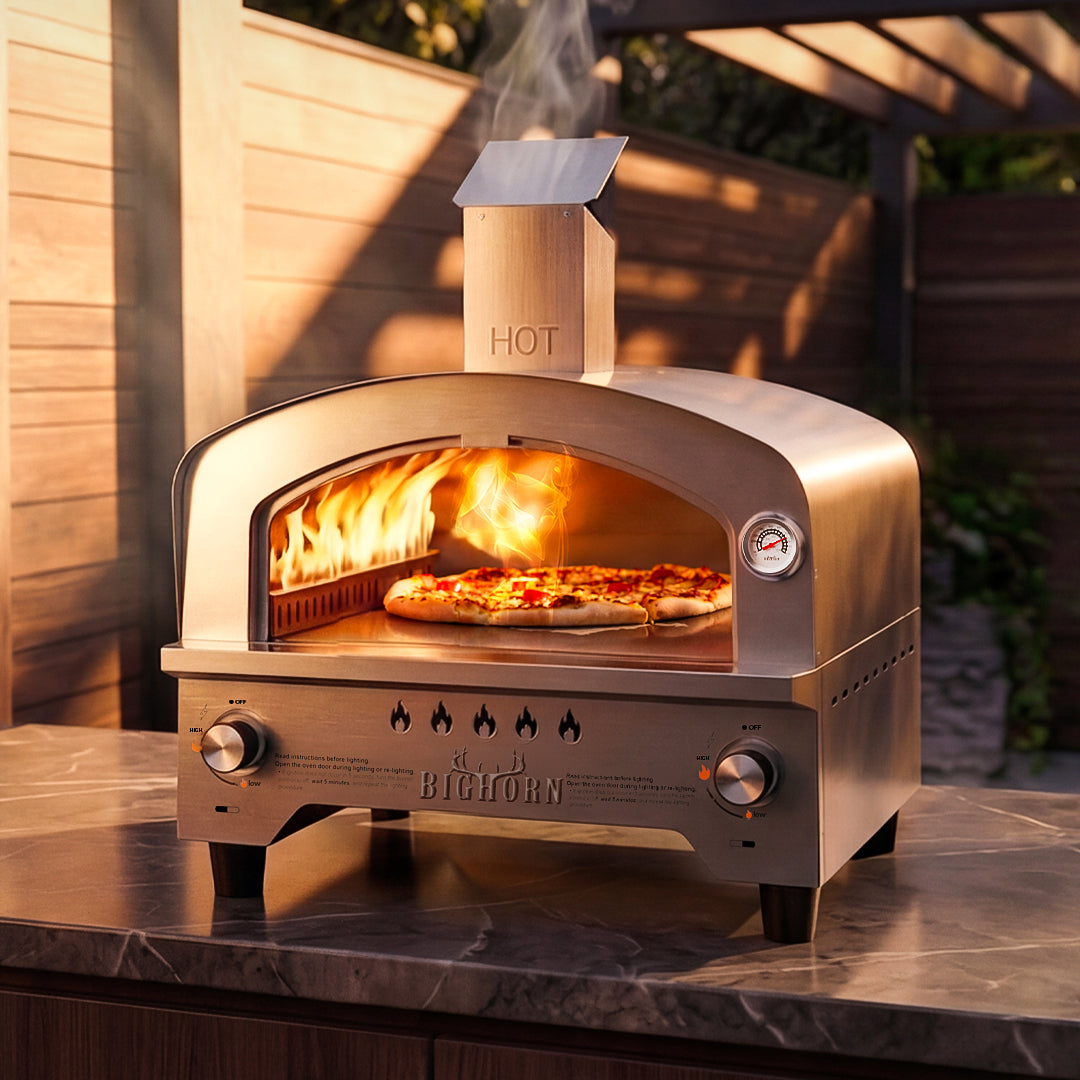
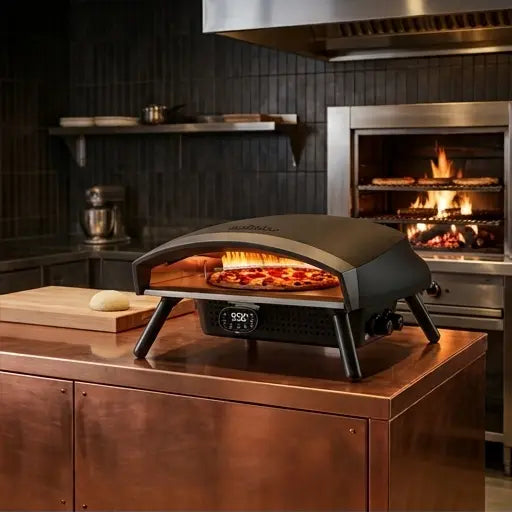
In outdoor setups like gas grills or Big Horn Outdoors pizza ovens, preheat times vary by fuel type and insulation. Pellet and gas pizza ovens often reach target stone temperatures faster than home ovens due to concentrated radiant heat and better heat retention.
For example, Big Horn Outdoors’ 12-inch wood-pellet pizza oven lists an 18–20 minute preheat to reach up to 887°F, significantly faster than a home oven’s 45–60 minutes. This is possible because the burner radiates heat directly onto the stone in a compact, insulated chamber.
On a standard gas grill with a pizza stone insert:
- Preheat all burners on high for 15 minutes.
- Add the stone and continue heating for another 30–45 minutes.
- Use an infrared thermometer to confirm 475°F+ surface temperature.
Always follow your specific oven or grill manual. Outdoor units can exceed 700°F, so monitor closely to avoid burning.
Big Horn Outdoors Expert Views
At Big Horn Outdoors, we design our pizza stones and ovens around one principle: consistent, high-heat performance that mimics professional results. Our 12-inch pellet pizza oven, for instance, uses a food-grade cordierite stone paired with a focused radiant burner to achieve 887°F in under 20 minutes—far faster than a home oven. But the rule remains the same: the stone must be fully saturated before baking. Whether you’re using a home oven at 500°F for 45–60 minutes or our pellet oven at 800°F+ for 18–20 minutes, never skip the preheat. That waiting period is what transforms dough into a crisp, blistered crust with authentic char and structure. — Big Horn Outdoors Product Team
Care and Maintenance to Extend Stone Life
Proper preheating isn’t just about performance—it protects your stone from cracking and extends its lifespan. Thermal shock from rapid temperature changes is the top cause of failure.
Key care practices:
- Never wash with soap or water: Pizza stones are porous. Soap absorbs and taints future bakes; water causes steam cracks. Scrape off debris with a stiff brush or plastic scraper.
- Cool completely before handling: Let the stone cool inside the turned-off oven to avoid stress fractures.
- Store in a dry place: Moisture absorption weakens structural integrity over time.
- Avoid extreme temperature swings: Don’t move a hot stone to a cold surface or vice versa.
With proper care, a quality cordierite stone can last a decade or more, delivering consistent results bake after bake.
Conclusion
For best results, preheat your pizza stone for 45 to 60 minutes at your oven’s highest setting (500–550°F). Thinner stones may need only 30–45 minutes; thicker or stacked stones benefit from 60–90 minutes. Always start cold, use the middle or lower-middle rack, and verify readiness with timing, visual cues, or an infrared thermometer. Whether you’re using a home oven, grill, or a dedicated Big Horn Outdoors pizza oven, respecting thermal mass and preheat time is the single most important step to achieving a crisp, evenly baked crust.
FAQs
Can I preheat a pizza stone for too long?
No—once fully saturated (after 60 minutes at 500–550°F), the stone stabilizes at oven temperature and won’t overheat. Extended preheating beyond 90 minutes offers no benefit but won’t damage a quality stone.
Do I need to preheat a pizza stone for frozen pizza?
Yes. Even frozen pizzas benefit from a hot stone. Preheat for at least 30–45 minutes to ensure the crust crisps instead of steaming, though you can reduce total time slightly compared to fresh dough.
Why does my pizza stone crack after preheating?
Cracking usually results from thermal shock: placing a cold stone in a hot oven, exposing it to moisture while hot, or moving it to a cold surface. Always start in a cold oven and let it cool gradually.
Can I use a pizza stone on a grill?
Yes, but preheat differently. On a gas grill, heat all burners on high for 15 minutes, add the stone, and continue for 30–45 more minutes. Use an infrared thermometer to confirm 475°F+ surface temperature before baking.
Is 30 minutes enough to preheat a pizza stone?
Only for very thin stones (½ inch or less). Standard ¾–1 inch cordierite stones require 45–60 minutes to reach core temperature. Under-preheating leads to soggy bottoms and uneven browning.