
Your first pizza oven should match where you cook, how much heat control you want, and how many people you feed. A propane pizza oven is a practical starting point for outdoor beginners, while an indoor-rated electric oven offers simpler kitchen cooking. Choose a wood-pellet oven if managing a live fire is part of the experience you want.
By the Big Horn Outdoors Product Team
Published: September 19, 2026
What Is the Best First Pizza Oven for a Beginner?
For most outdoor beginners, a gas pizza oven with adjustable heat and a 12- to 16-inch cooking surface offers a manageable introduction to homemade pizza. It removes the need to maintain a wood fire while allowing you to learn dough preparation, stone temperature, launching, and crust browning.
However, the easiest oven to operate is not necessarily the right oven for every first-time buyer.
Consider three different situations.
A homeowner who wants to make pizza outside every Friday may appreciate a propane oven. Someone living in an apartment without a suitable outdoor cooking area needs an indoor-rated electric model. A camper who enjoys tending a fire may prefer a portable wood-pellet oven despite its additional learning curve.
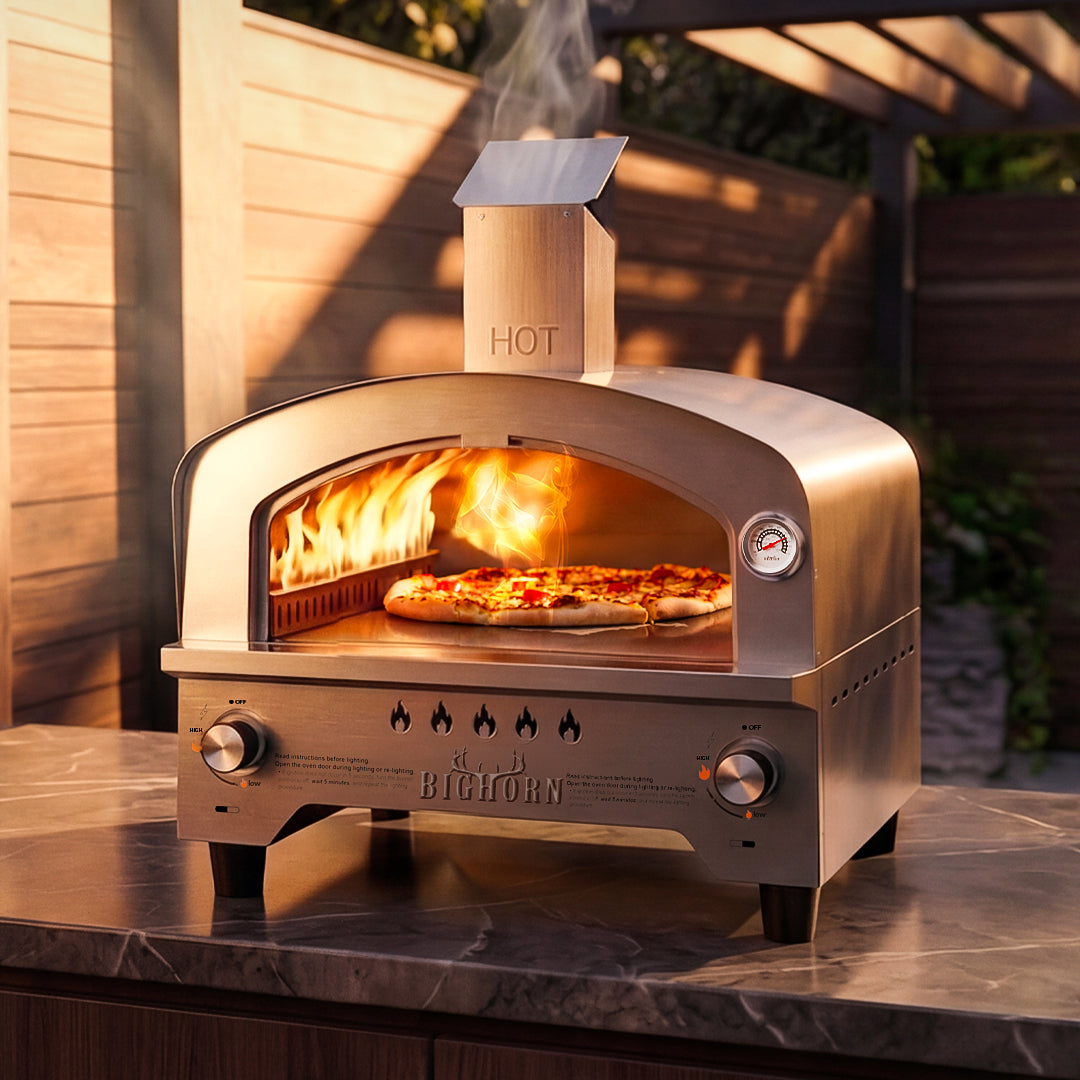
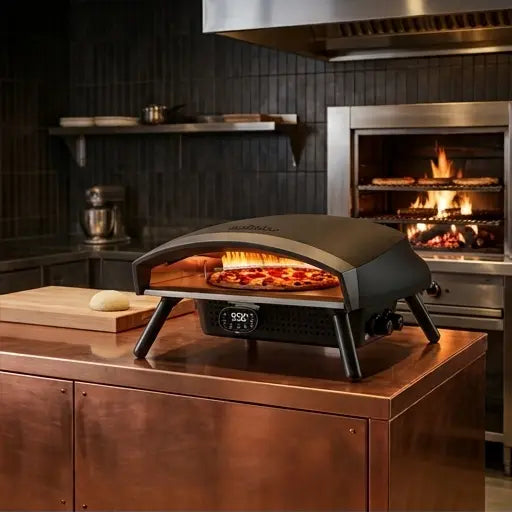
Big Horn Outdoors offers options across these categories, including portable pellet ovens, dual-burner gas models, indoor electric countertop ovens, and multi-fuel systems.
The important question is not simply which oven reaches the highest temperature. It is which oven you will enjoy setting up and using regularly.
A first pizza oven should help you develop your cooking skills rather than create unnecessary work every time you want dinner.
Which Pizza Oven Fuel Is Easiest to Use?
Electric pizza ovens generally require the least fuel management, followed by gas ovens. Wood-pellet ovens demand more attention because their combustion rate, fuel supply, and airflow affect cooking temperature.
Fuel selection influences almost every part of ownership, from where you can cook to how much cleanup follows.
Here is how the main options compare.
| Pizza Oven Type | Main Advantage | Main Trade-Off | Suitable First Buyer |
|---|---|---|---|
| Gas | Adjustable heat without feeding a fire | Requires propane and an approved outdoor location | Outdoor beginners |
| Wood pellet | Live-fire cooking experience | Requires active fuel and airflow management | Hands-on outdoor cooks |
| Indoor electric | Plug-in operation and controlled heating | Requires adequate countertop space and electrical capacity | Apartment and indoor cooks |
| Multi-fuel | Compatible heating methods in one oven | More components and configuration checks | Buyers seeking long-term flexibility |
Gas: A straightforward outdoor starting point
A propane pizza oven produces heat through a gas burner. Once the oven is operating, you can adjust the burner instead of continuously adding fuel.
This lets beginners concentrate on handling dough and monitoring the pizza.
For example, the Big Horn Outdoors 15-inch Dual Burner Gas Pizza Oven has two independently controlled side burners with a combined rated output of 23,000 BTU.
Its 14.7-inch cooking area accommodates pizzas up to approximately 14 inches, giving beginners room to practice with smaller pies before using more of the cooking surface.
Electric: Controlled cooking without an outdoor fire
An indoor electric pizza oven uses heating elements rather than combustion.
The Big Horn Outdoors 14-inch Indoor Electric Countertop Pizza Oven in stainless steel offers six preset cooking modes, manual control, and a listed temperature range of 220–850°F.
This makes it an option for someone who wants to prepare pizza in a kitchen without managing propane or wood pellets.
Always confirm that the exact electric model is rated for indoor use. An electric heating attachment does not automatically make an outdoor oven suitable for a kitchen.
Wood pellet: More involvement in the cooking process
A pellet pizza oven burns compressed wood pellets to produce the heat needed for cooking.
The Big Horn Outdoors 12-inch Wood Pellet Pizza Oven is designed for outdoor cooking and has a manufacturer-listed maximum temperature of 887°F.
It offers the live-fire character some buyers specifically want, but beginners must also learn to maintain steady combustion.
Pellet cooking is a good starting point when fire management is something you want to learn, rather than something you want to avoid.
Should Your First Pizza Oven Be 12, 14, or 16 Inches?
A 12-inch pizza oven suits smaller households and portable cooking, while a 14- to 16-inch cooking surface offers more flexibility for family meals and entertaining. The right size depends on usable cooking area, not just the dimensions advertised in the product name.
Pizza oven size affects more than the number of slices you can make.
It also determines how much space you have to launch dough, turn the pizza, and keep its edges away from the hottest areas.
Why start with a 12-inch oven?
A compact oven makes sense when you cook for one or two people, have limited storage, or plan to transport the equipment.
A smaller pizza also uses less dough and fewer toppings, which can make early attempts easier to manage.
The Big Horn Outdoors 12-inch Wood Pellet Pizza Oven weighs 24.9 pounds and has folding legs. These features make it a practical candidate for buyers who expect to move their oven between storage and an outdoor cooking surface.
The trade-off is capacity.
If four people each want a personal pizza, you will need to prepare multiple pies and allow the stone to recover between bakes.
When does a larger oven make sense?
A larger cooking surface is useful when you regularly feed a family or want to make pizzas bigger than 12 inches.
The Big Horn Outdoors 15-inch Dual Burner Gas Pizza Oven has a 14.7-inch cooking area.
That extra space gives you room to work with a 12-inch pizza without positioning its crust near the edge of the stone.
A 16-inch oven may be worth considering if larger pizzas and backyard gatherings are your main priorities.
However, larger ovens generally need more setup and storage space. Measure the intended location before assuming that extra cooking capacity is worthwhile.
How Hot Should a Beginner Pizza Oven Get?
A beginner pizza oven should reach temperatures appropriate for the pizza style you want to make, rather than simply advertise the highest possible heat. Neapolitan-style pizza commonly uses an oven environment around 800–900°F or higher, while New York-style and thicker pizzas can benefit from lower temperatures and longer baking times.
High heat changes how pizza cooks.
The pizza stone transfers energy into the dough through conduction, while the flame or upper heating elements provide radiant heat that cooks the toppings and browns the upper crust.
Both heat sources need to work together.
If the stone is too cool, the cheese may brown before the bottom crust becomes firm.
If the stone is excessively hot for your dough, the bottom may burn while the center remains undercooked.
Why stone temperature matters more than the display alone
An oven thermometer generally measures temperature at its sensor location. It does not necessarily tell you the temperature of the cooking stone.
This distinction becomes important when cooking several pizzas in succession.
The stone loses energy whenever cold dough is placed on it. Even if the air or chamber temperature remains high, the next pizza may develop a pale bottom if the stone has not recovered.
An infrared thermometer can help you monitor the stone surface when used according to its instructions.
For your first few cooking sessions, record the approximate stone temperature, dough weight, topping quantity, and baking result.
This gives you a repeatable starting point rather than requiring you to guess why one pizza cooked differently from another.
Which Big Horn Outdoors Pizza Oven Fits Your First Purchase?
Big Horn Outdoors offers several first-oven options for different cooking environments. The 12-inch wood-pellet model emphasizes portability and live-fire cooking, the 15-inch gas oven provides adjustable outdoor heat, and the 14-inch indoor electric oven prioritizes controlled countertop operation.
The following comparison focuses on the capabilities listed for these exact models.
| Big Horn Outdoors Model | Verified Product Details | Main Use Case |
|---|---|---|
| 12-inch Wood Pellet Pizza Oven | 24.9 lb; folding legs; up to 887°F; compatible gas and electric attachments sold separately | Compact outdoor cooking |
| 15-inch Dual Burner Gas Pizza Oven | 14.7-inch cooking area; two independent burners; 23,000 BTU combined output | Outdoor family pizza nights |
| 14-inch Indoor Electric Countertop Oven, Stainless Steel Preset Model | Up to 14-inch pizza; 220–850°F; six presets plus manual control | Indoor kitchen cooking |
These models are not interchangeable.
The pellet oven involves more fuel management. The gas oven requires a suitable outdoor location and propane supply. The countertop oven needs enough kitchen space and an appropriate electrical connection.
The 12-inch pellet oven for portable outdoor cooking
The 12-inch pellet model is worth considering if you enjoy wood-fired cooking or expect to take your pizza equipment on outdoor trips.
Big Horn Outdoors lists an 18–20-minute preheat and 60–90-second pizza cooking under appropriate conditions.
Actual performance depends on fuel condition, airflow, weather, stone temperature, and the pizza itself.
This model also supports separately sold compatible gas-burner and electric-heater accessories.
However, buyers should verify the exact configuration they are purchasing instead of assuming every heating option comes in the box.
The 15-inch gas oven for regular backyard meals
The 15-inch dual-burner oven is intended for outdoor cooks who want more control over heat distribution.
Its independently adjustable burners allow the user to modify heat from each side.
That capability can help manage uneven browning, although pizza rotation may still be necessary depending on the dough, toppings, wind, and temperature.
Its larger cooking area also accommodates family-size pizzas without requiring an oversized oven.
The 14-inch electric oven for indoor pizza nights
The stainless steel indoor electric model is suited to people who prefer cooking in their kitchen.
Its upper and lower heating elements support crust and topping browning, while its preset modes offer starting points for different pizza styles.
The manufacturer lists a maximum temperature of 850°F and a preheat time of approximately 15 minutes.
Before buying, measure the available countertop space and check the model's electrical requirements and operating clearances.
An oven that fits in storage still needs adequate room for safe operation.
Where Will You Actually Use Your Pizza Oven?
Your cooking location should determine the oven category before you compare temperature, accessories, or appearance. Gas and wood-pellet pizza ovens require suitable outdoor locations, while indoor-rated electric countertop models are designed for kitchen use.
A first-time buyer should decide where the oven will operate, where fuel will be stored, and where hot equipment will cool.
Outdoor patios and backyards
A patio or backyard can accommodate a gas or pellet pizza oven when the location satisfies the manufacturer's ventilation and clearance requirements.
You also need a stable, heat-resistant work surface.
Avoid placing the oven beneath combustible coverings or too close to walls, fences, furniture, and overhead materials.
Apartments and small kitchens
An indoor-rated electric oven may be the appropriate solution if you do not have an approved outdoor cooking location.
Do not assume a balcony is automatically suitable for a propane or pellet appliance. Building policies and local fire restrictions may limit open-flame equipment.
Also, never operate a combustion-fueled outdoor pizza oven inside a home, garage, tent, or enclosed porch. These appliances can produce carbon monoxide.
Camping and outdoor travel
Portable pellet and gas models can work for outdoor travel when the site permits their use.
Remember that portability involves more than oven weight.
You must also transport the required fuel, peel, dough, toppings, protective equipment, and any compatible heating attachments.
Check campsite fire restrictions before planning to use a wood-pellet oven.
What Accessories Should You Buy With Your First Pizza Oven?
A first pizza oven generally needs a suitable launching peel, a turning tool when manual rotation is required, and a safe method for handling hot equipment. An infrared thermometer is also useful for understanding stone temperature.
You do not need to purchase every accessory immediately.
Start with the equipment that solves practical problems.
A launching peel transfers uncooked pizza from your preparation surface into the oven. Choose one that fits the oven opening and the pizza size you intend to make.
A turning peel allows you to rotate pizza during cooking without pulling it completely out of the oven.
An infrared thermometer helps you monitor whether the stone has reached your intended cooking temperature.
Heat-resistant gloves provide protection when handling suitable hot tools or oven components, provided they meet the temperatures and handling conditions involved.
A pizza cover can protect a cooled oven during storage when the cover is compatible with the exact model.
Before buying, check which accessories are already included.
For multi-fuel ovens, confirm heating-element and burner compatibility directly. Do not assume accessories for one oven size will fit another.
How Can You Make Your First Pizza Without Burning It?
Start with a lightly topped 10- to 12-inch pizza, thoroughly preheat the stone, and monitor the crust throughout cooking. A smaller pizza gives beginners more space to practice launching and turning while reducing the risk of toppings spilling onto the stone.
Your first cooking session should help you understand the oven rather than test every recipe you have saved.
Begin with a basic cheese or Margherita-style pizza.
Use a moderate amount of sauce, fresh or low-moisture mozzarella as appropriate for the style, and dough formulated for the baking temperature.
Very high-hydration dough can be more difficult to stretch and launch, particularly for first-time cooks.
A practical first-pizza workflow
-
Position and preheat the oven according to its instructions.
-
Prepare a small pizza with an evenly stretched center.
-
Use a light dusting of suitable flour on the peel to reduce sticking.
-
Shake the peel gently before launching to confirm that the pizza moves freely.
-
Launch onto the preheated stone and monitor browning.
-
Rotate the pizza when necessary to balance cooking.
-
Remove it when the crust is cooked through and the toppings have reached the desired finish.
Do not leave stretched dough sitting on the peel for an extended period.
Moisture from the dough and toppings can increase sticking, making the pizza difficult to launch.
After each bake, check whether the stone needs more time to recover before cooking the next pizza.
At first, consistency matters more than speed.
What Maintenance Should a First-Time Owner Expect?
A gas pizza oven generally requires less combustion-residue cleanup than a pellet oven, while an electric model avoids fuel ash entirely. All pizza ovens still need appropriate stone care, exterior cleaning, safe cooling, and storage.
Consider maintenance before choosing an oven that you plan to use frequently.
A wood-pellet model requires cooled ash removal and attention to the fuel-loading and combustion areas.
A gas oven requires inspection of its burner, hose, regulator, and connections according to the manufacturer's instructions.
An electric oven needs cleaning around the cooking chamber and heating components without exposing electrical parts to water.
For pizza stones, avoid sudden temperature changes.
Do not pour cold water onto a hot stone or immerse it unless the exact manufacturer's instructions explicitly permit that cleaning method.
Allow the oven to cool completely before moving, covering, or storing it.
Big Horn Outdoors Expert Views
Your first pizza oven does not need to be the most powerful model in the catalog. It needs to fit your cooking environment and the way you want to prepare food.
Gas gives outdoor beginners adjustable heat without maintaining a wood fire. An indoor-rated electric oven makes kitchen pizza nights more accessible. A pellet oven adds the hands-on experience of managing live combustion.
Start with the fuel, confirm the usable cooking area, and check the space needed for safe operation. Then choose a simple pizza recipe and learn how your oven's stone and upper heat work together.
The most useful first purchase is an oven that matches the way you actually cook.
— Big Horn Outdoors Product Team
Which Pizza Oven Should You Buy First? Final Recommendation
Choose your first pizza oven according to cooking location, fuel preference, household size, and the amount of involvement you want during each session. A controllable oven that fits your routine will generally be more useful than an oversized model selected primarily for its advertised maximum temperature.
For a beginner who wants regular outdoor pizza nights with straightforward heat control, a propane oven is a practical choice.
For someone who enjoys camping, wood-fired cooking, and hands-on temperature management, a compact pellet oven may be more satisfying.
For someone who wants to make pizza inside a kitchen, an indoor-rated electric countertop oven is the appropriate category.
And for a buyer who wants to experiment with different heating methods, a compatible multi-fuel system offers flexibility, provided the required components and permitted operating environments are understood before purchase.
Big Horn Outdoors offers options across these cooking styles, including the 12-inch wood-pellet oven, the 15-inch dual-burner gas oven, and the 14-inch indoor electric countertop model.
Before purchasing, answer five questions:
-
Where will I cook most often?
-
Do I want to manage a live fire?
-
How many people will I usually feed?
-
Where will I store the oven and its fuel or accessories?
-
Am I buying for occasional weekend cooking or frequent pizza nights?
Once those answers are clear, choosing your first pizza oven becomes a much simpler decision.
Frequently Asked Questions
Is a gas or wood-fired pizza oven better for beginners?
A gas pizza oven is generally easier for beginners who want adjustable outdoor heat without tending a fire. A wood-pellet oven is suitable for someone who specifically enjoys live-fire cooking and is willing to learn fuel and airflow management.
Is a 12-inch pizza oven big enough for a family?
A 12-inch oven can serve a family by cooking several pizzas in succession. A larger cooking surface may be more convenient if you regularly prepare family-size pizzas or entertain guests.
Can I use an outdoor pizza oven in my kitchen?
No. Outdoor gas and wood-pellet pizza ovens must not be operated inside a home or other enclosed space. Choose an electric countertop model explicitly rated for indoor use and follow its ventilation, clearance, and electrical instructions.
Do I need a multi-fuel pizza oven for my first purchase?
No. A single-fuel oven is sufficient if you already know how you prefer to cook. Multi-fuel compatibility becomes more useful when you want to experiment with different approved heat sources without purchasing an entirely separate oven.
Can I use my first pizza oven for food other than pizza?
Many pizza ovens can cook suitable foods such as bread, vegetables, fish, and meat, depending on the model and its approved cooking methods. Use appropriate cookware, follow the manufacturer's instructions, and do not place fatty foods directly on a pizza stone when doing so could cause contamination, flare-ups, or damage.