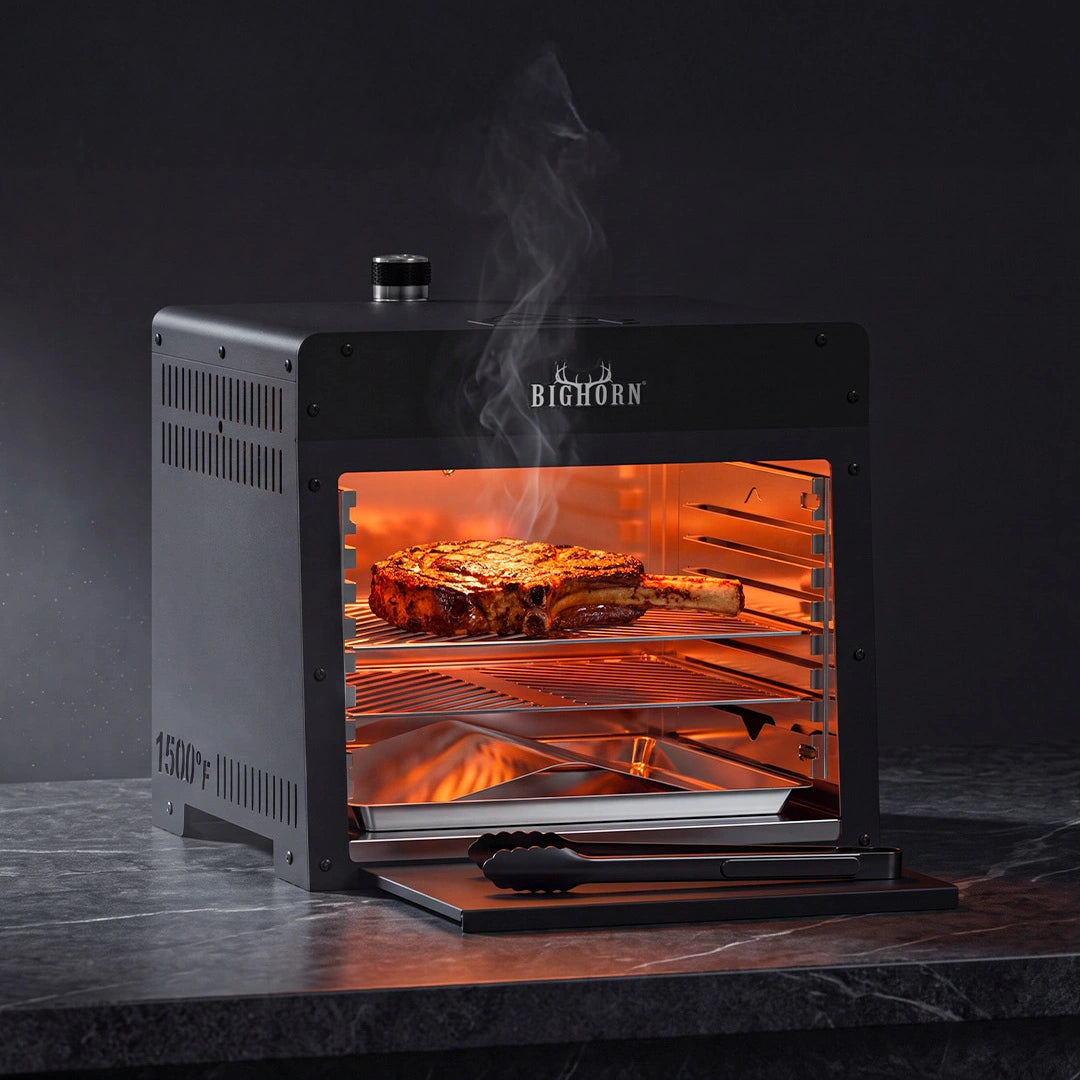
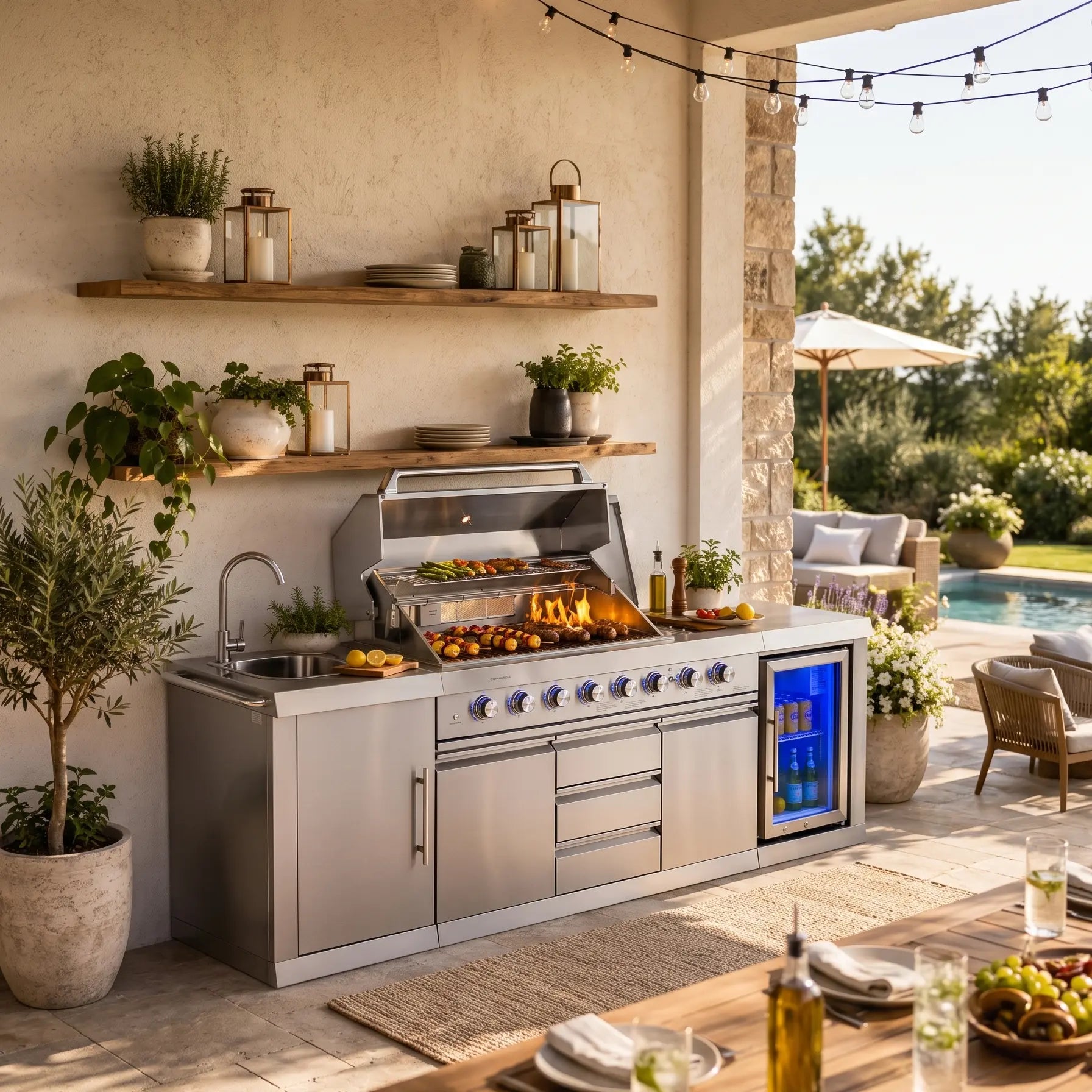
An infrared grill sears at extremely high temperatures — the Big Horn 16-inch portable broiler reaches about 1500°F (815°C) — so the temperature chart is less about a single number and more about the zone: sear close to the emitter for a crust, finish at a lower rack position to temperature. This chart covers the rack positions, the food temperatures, and the times that work on an infrared grill.
These are general infrared grilling temperature guidelines for a grill like the Big Horn 16-inch broiler; use a probe thermometer for doneness.
What actually matters for this chart
- Rack position. The 10 positions run from a maximum searing zone down to a gentler zone around 450°F (232°C).
- Food temperature. Pull at the target internal temperature; infrared heat is intense, so the probe decides.
- Sear time. The sear window is tens of seconds per side on the hot zone, not minutes.
- Finish lower. Move food to the lower rack to finish without burning the surface.
Understanding the zones before you decide
An infrared grill has a hot zone near the emitter and a cooler zone lower down. The upper rack positions deliver maximum radiant heat for a fast crust; the lower positions, around 450°F, finish or hold food gently. The chart below uses that two-zone reality: sear on the upper rack, then move to the lower rack to finish at the probe target. This is why the rack positions matter as much as the temperature.
Infrared grill temperature chart by cut
| Food | Sear zone | Sear time (per side) | Finish / pull temp |
|---|---|---|---|
| Ribeye / strip, 1–1.5 in | Upper racks | 60–90 s | 130–135°F (medium-rare) |
| Filet, 1.5–2 in | Upper racks | 60–90 s | 130–135°F (medium-rare) |
| Thin steak, under 1 in | Upper racks, brief | 30–60 s | Pull at doneness; watch closely |
| Chicken pieces | Sear, finish lower | Sear each side, then gentle | 165°F |
| Burgers | Upper racks | 60–90 s | 160°F (ground beef) |
| Fish / seafood | Middle racks | Short, careful | 145°F (fish) |
Matching the chart to your situation
For a thick steak, use the upper racks to sear a crust in 60–90 seconds per side, then move to the lower rack to finish to 130–135°F for medium-rare. For thin cuts, keep the sear brief and pull at doneness — they can overcook in seconds. For chicken, sear for color, move lower, and pull at 165°F. Match the rack position to the cut and the probe to the pull.
What the experts look for
Experienced infrared cooks use the rack positions and the probe, not a static timer: sear in bursts on the hot zone, rest between intervals so the heat penetrates, and finish at the lower rack to a probe target. They also adjust for thickness — a thin cut cooks entirely in the sear, while a thick cut needs the finish zone. The chart is a starting point; the probe is the referee.
Common mistakes and how to avoid them
- Ignoring the rack positions. Searing everything at maximum heat burns the surface; use the lower racks to finish.
- Trusting a timer. At 1500°F-class heat, the probe decides doneness, not the clock.
- Thin cuts left on the hot zone. They overcook in seconds; keep the sear brief or use the middle racks.
- Under-resting. The temperature climbs during rest; pull a few degrees early.
- Cleaning the emitter while hot. Let it cool, then brush gently.
Realistic expectations and results
An infrared grill produces a fast, deep crust on the hot zone and a controlled finish on the lower rack — the chart is a guide to that two-zone rhythm. Expect a thin steak to cook almost entirely in the sear, a thick steak to need the finish zone, and chicken to be pulled at 165°F. The temperatures are food-safety minimums and doneness targets; the probe is the authority.
The takeaway in one paragraph
An infrared grill cooks in two zones: sear on the upper racks for 60–90 seconds per side, then finish on the lower rack to the probe target — 130–135°F for medium-rare steaks, 165°F for chicken, 160°F for ground beef, 145°F for fish. The chart is a starting point; the rack position and the probe do the real work. Match the zone to the cut and pull at temperature, and infrared delivers the crust and the finish every time.
See the infrared grill and the steak chart resources. Big Horn portable infrared broiler · infrared grill collection
FAQ
What are the downsides of using an infrared grill?
The main downsides are the learning curve and specialization: intense heat overcooks thin cuts quickly, the format is not built for low-and-slow smoking, and a portable unit has a compact cooking area. The two-zone rack rhythm and a probe are how you manage the intense heat.
Can I cook hamburgers on an infrared grill?
Yes — burgers cook well on the upper racks, searing 60–90 seconds per side and pulling the ground beef to 160°F. Keep them together and flip once, and move to a lower rack if the surface finishes before the center.
How long to cook steak on an infrared grill?
After a full preheat, sear a 1–1.5 inch steak 60–90 seconds per side on the hot zone, then finish on the lower rack to 130–135°F for medium-rare. Thin steaks cook almost entirely in the sear; use the probe, not a timer.
Which infrared grill is best for steaks?
The best infrared grill for steak preheats fast, sears close to the emitter, and offers a lower finishing zone. The Big Horn 16-inch portable broiler fits with a 19,000 BTU burner, ten rack positions, and a lower zone around 450°F; the 21.2-inch dual-burner adds a wider zone.