A rotating pizza oven uses a motorized stone that turns the pizza while it bakes, so the crust blisters evenly without you opening the oven and turning the pie by hand. It is the convenience upgrade for cooks who want consistent rims without mastering a turning peel — and it is most worth it if you bake often or host parties. This guide covers what a rotating stone does, the trade-offs, and how to decide if the automation is worth the cost.
These are general rotating pizza oven guidelines; the mechanism and drive are covered by your oven’s manual and warranty.
What actually matters for this decision
- Even browning. The rotation blisters the rim evenly — the job a turning peel normally does by hand.
- Convenience. Less opening and turning means more consistent bakes and less heat loss.
- Mechanism to maintain. A motor and drive add parts that need care and warranty coverage.
- Cost. The automation is an upgrade over a manual-turn oven of the same size.
Understanding the rotating stone before you decide
In a stationary oven, the side nearest the burner gets more heat, so the cook rotates the pizza every 20–30 seconds to even out the blistering. A rotating stone automates that: a motor turns the stone steadily, so the pie passes through the hot and cooler zones without manual intervention. The result is more even rims, fewer opened-lid moments, and a simpler bake — at the cost of the motor, drive, and maintenance they bring.
The key factors, ranked
| Factor | Why it matters | What to compare |
|---|---|---|
| Even browning | The core benefit | Steady rotation vs manual turning |
| Convenience | Less hands-on | Automated turns, fewer lid openings |
| Maintenance | Mechanism longevity | Motor and drive care, warranty coverage |
| Cost | Budget fit | Automation premium over manual-turn model |
Matching the choice to your situation
If you bake often and want consistent rims without mastering a turning peel, a rotating stone is a strong upgrade — the automation removes most of the manual turning and keeps the lid closed, which preserves heat between bakes. If you bake rarely or enjoy the hands-on turning rhythm, a manual-turn oven is simpler, cheaper, and has no motor to maintain. For a host who runs several pies back-to-back, the rotating stone keeps the flow steady.
What the experts look for
Experienced cooks weigh the automation honestly: the rotating stone pays when even rims without a turning peel are worth the extra cost and the mechanism to maintain, and it matters less for occasional bakers. They also check the warranty and parts availability — the drive and motor are the parts to confirm are covered. If the rotation is uneven, the stone or the drive may have an issue, so a stable, steady turn is the sign of a healthy mechanism.
Common mistakes and how to avoid them
- Buying automation you will not use. If you bake rarely, the rotating stone adds cost and maintenance for little benefit.
- Ignoring the warranty. The motor and drive are moving parts; confirm they are covered.
- Forgetting stone recovery. Even with rotation, the stone must return to temperature between pies.
- Judging by peak heat alone. The rotation benefit is even browning, not a higher temperature; compare the whole package.
- Overloading the oven. Keep the pizza sized to the stone so the rotation runs clean.
Realistic expectations and results
A rotating pizza oven delivers even, blistered rims with less hands-on work — the automation handles the turning that a peel would do. Expect a smoother bake rhythm and fewer lid openings, with the trade of a motor to maintain and a higher price. For a frequent baker or host, the convenience is the point; for an occasional baker, the simplicity of a manual-turn oven may win.
The takeaway in one paragraph
A rotating pizza oven turns the pizza automatically for even rims, removing most of the manual turning and keeping the lid closed — the convenience upgrade for cooks who bake often or host. It is worth it when even bakes without a turning peel justify the cost and the motor to maintain; for occasional bakers, a manual-turn oven is simpler and cheaper. Match the automation to how often you bake, and the rotating stone pays for itself in the rhythm.
See the gas pizza ovens, including the rotating-stone model. 16-inch gas pizza oven · gas pizza oven collection
FAQ
Which rotating pizza oven is best?
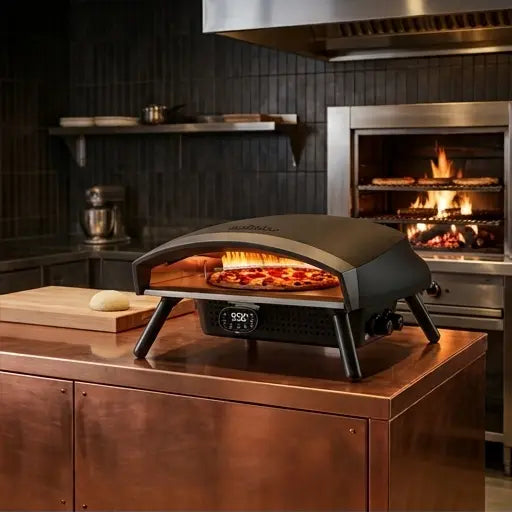
The best rotating pizza oven matches your deck size and baking: Big Horn’s 16-inch gas model combines an auto-rotating stone with a digital thermometer, covering the high-use home range. Compare even browning, stone recovery, and warranty, not just peak heat.
What kind of pizza oven has a rotating stone?
Gas pizza ovens with an auto-rotating stone use a motorized deck that turns the pizza during the bake — Big Horn’s 16-inch gas oven is one such model. The automation blisters the rim evenly without a turning peel.
What is a rotating pizza oven?
A rotating pizza oven has a motorized stone that turns the pizza while it bakes, evening out the heat across the crust so the rim blisters consistently — the job a cook normally does by hand with a turning peel.
How much is a Rotoflex pizza oven?
Rotoflex pricing varies by model and configuration, and it is a commercial-class brand; check current listings for an exact price. As a comparison point, Big Horn’s 16-inch gas pizza oven with an auto-rotating stone is a home-oriented option; verify the current price on the product page.