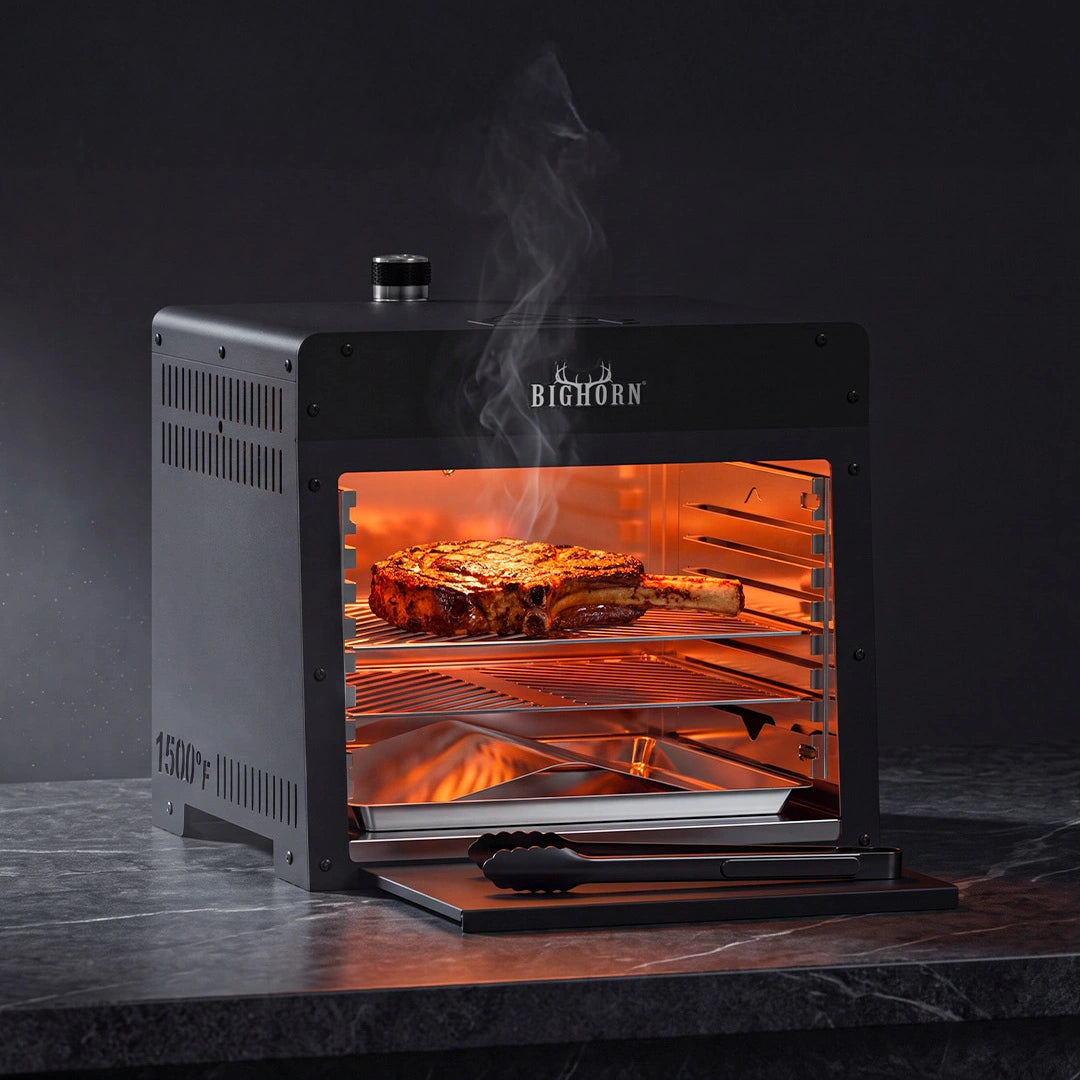
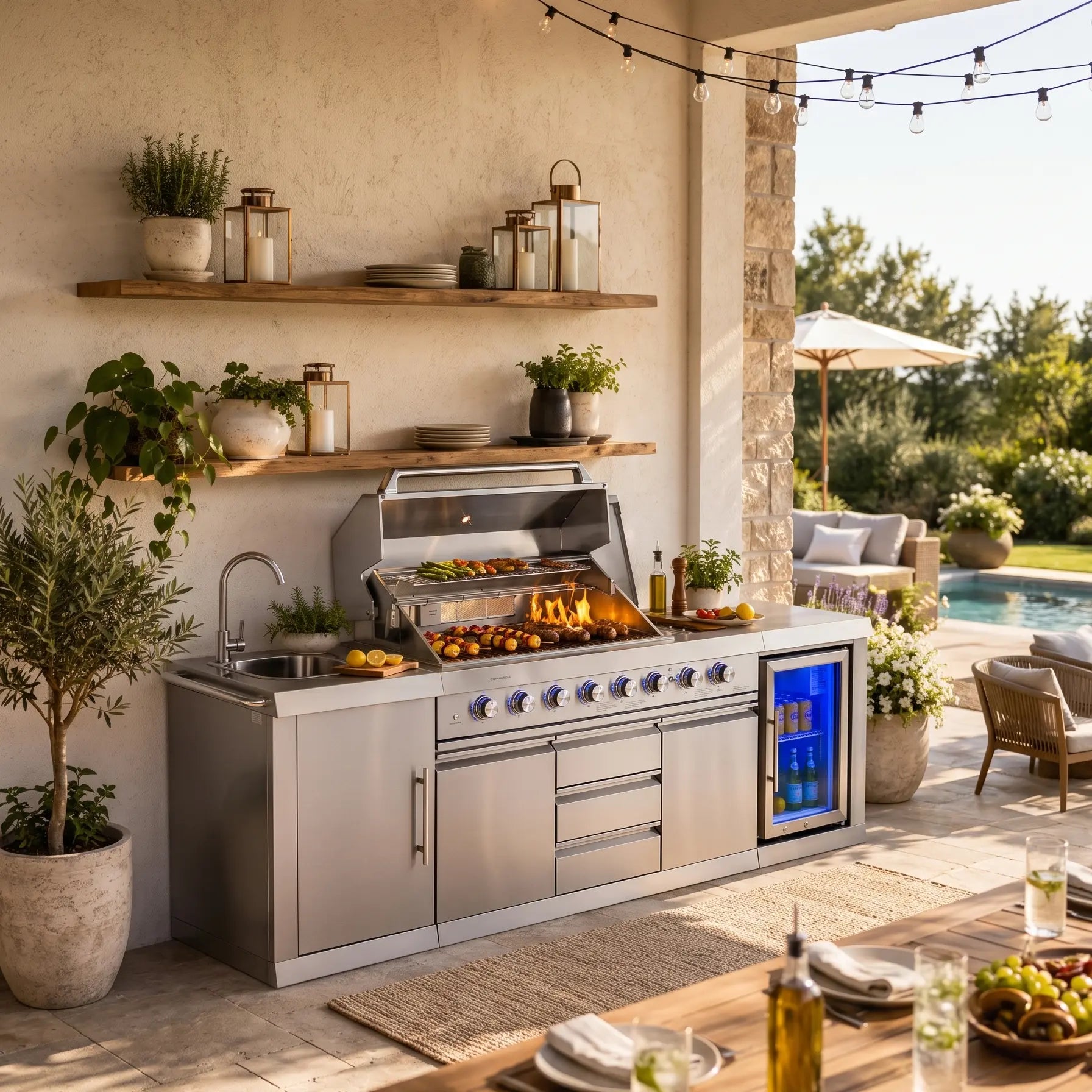
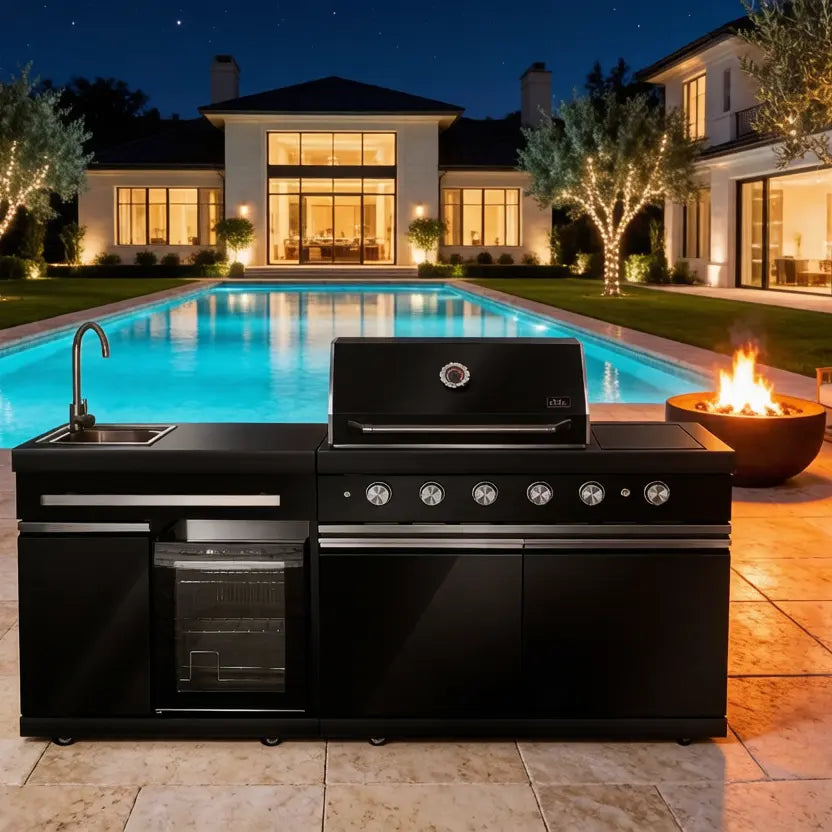
An infrared grill is a gas grill that converts fuel into radiant heat and beams it directly onto the food instead of warming the air around it. Because radiant energy travels straight to the surface, an infrared grill reaches far higher cooking temperatures than a conventional gas grill — the Big Horn 16-inch broiler reaches about 1500 °F in 3–5 minutes — and that is what lets it sear a steak in roughly five minutes while the center stays pink.
The key idea: radiant heat instead of hot air
A conventional gas grill heats the air inside the cooking chamber, and that hot air slowly transfers heat to the food. An infrared grill skips the air: the burner heats a ceramic or metal surface until it glows and emits infrared radiation, which travels in straight lines to whatever it hits. In the Big Horn design, that heat comes from above the food, like a restaurant salamander broiler, rather than from a flame below.
This direct path is the whole story. Less energy is lost to surrounding air, so the surface gets hotter faster, browning develops quickly, and flare-ups are reduced because the flame is shielded by the emitter.
How an infrared burner produces heat
The burner burns gas to heat a ceramic or metal plate until it glows. That glowing surface emits infrared radiation — the same kind of energy you feel when you put your hand near a hot object: it warms you directly rather than warming the air first. On the Big Horn 16-inch broiler, a 19,000 BTU burner feeds a ceramic emitter placed above the grate, so the radiant energy reaches the food almost instantly.
Top-down placement matters for the cooking style it enables. Because the heat comes from above, the unit functions as a broiler: it sears the top surface hard while the interior warms more gently, which suits steakhouse-style crusts and quick finishing.

How hot does an infrared grill get?
An infrared grill gets significantly hotter than a typical residential gas grill. The Big Horn line reaches about 1500 °F, while most home gas grills top out near 500–700 °F. That higher ceiling is the practical difference: browning, or the Maillard reaction, accelerates as the surface gets hotter and drier, so a steak’s surface browns in seconds at 1500 °F — long before the heat can reach the center and overcook it.
Rack position gives you control within that range. The Big Horn broiler has ten rack positions: close to the emitter for maximum sear, lower for a gentler cook around 450 °F. That spread is what makes one burner suitable for both hard sears and more moderate finishing.
Why infrared heat sears food faster
Infrared heat sears faster because radiant energy transfers directly to the surface instead of being carried slowly by hot air. Hot air is a poor conductor compared with direct radiation, which is why a conventional grill needs more time and often more flipping to brown a surface. Radiant energy does that browning almost immediately, which creates the fast, steakhouse-style crust and preserves a juicier interior on thick cuts.
This is also why infrared grills are best at high-heat searing rather than slow roasting: the same concentration that builds a crust in minutes would overcook something that needs gentle, prolonged heat.
Infrared grilling technique: the two-zone approach
The fastest way to learn an infrared grill is to treat its rack positions as two zones. A hard sear happens in the top position, where the radiant heat is most intense; finishing happens in a lower position, where the food browns more gently. For a thick steak, sear both faces in the top zone to build the crust, then move it down to finish at a lower temperature — the same rhythm a restaurant salamander uses, in a machine designed for it.
Because the heat is so direct, dry the surface of the food first. Moisture turns a sear into a steam and prevents browning; patting meat dry before it goes near the emitter is the single highest-leverage technique on this kind of grill.
Setting up an infrared grill safely
Place the grill outdoors on a stable, non-combustible surface with at least 3 feet of clearance from walls, overhangs, and flammable material. Connect the propane per the manual, check for leaks, and never operate it indoors or in an enclosed space. The stainless body handles weather well, but the unit should be covered or stored dry between uses, and the emitter should only be brushed when cool.
What you can cook on an infrared grill
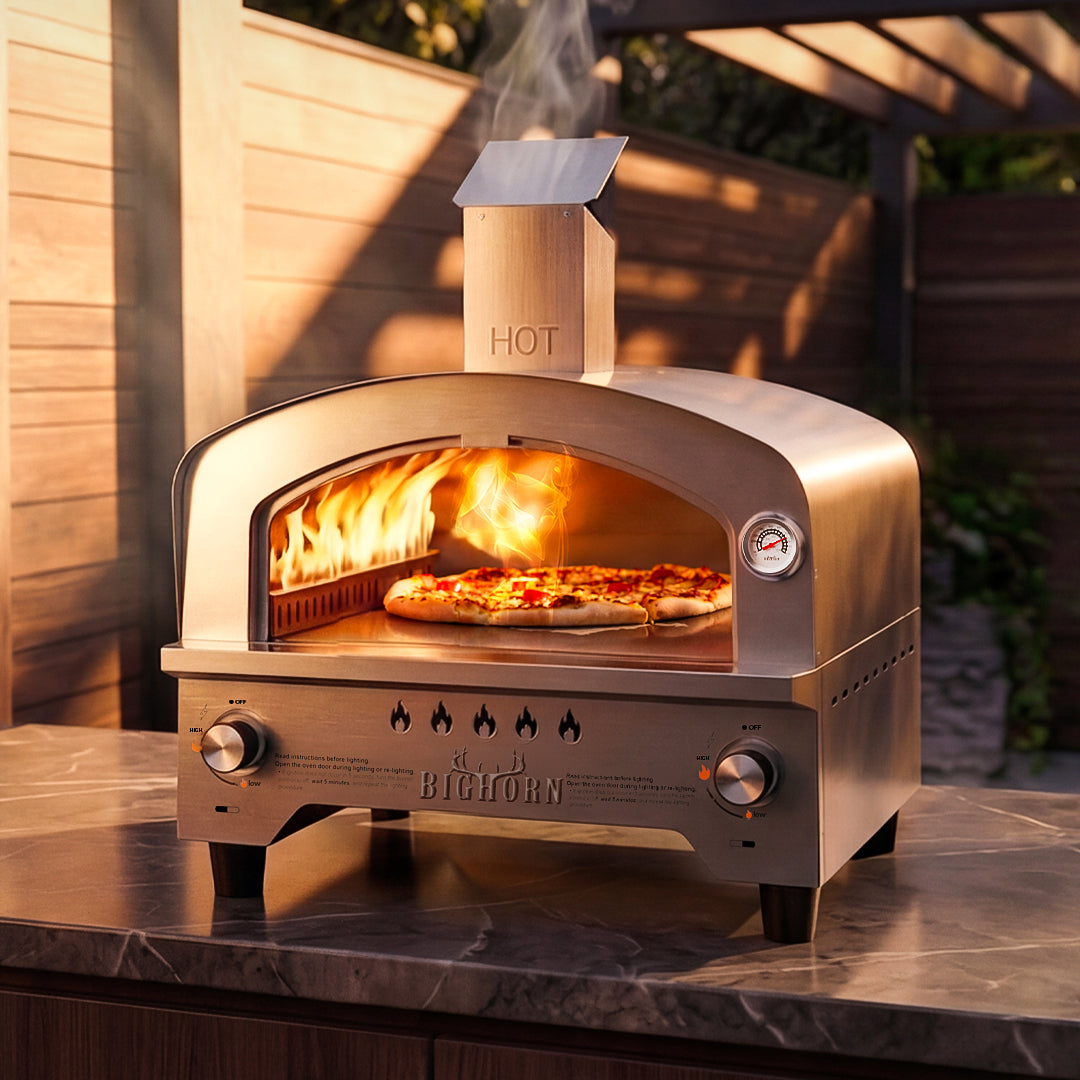
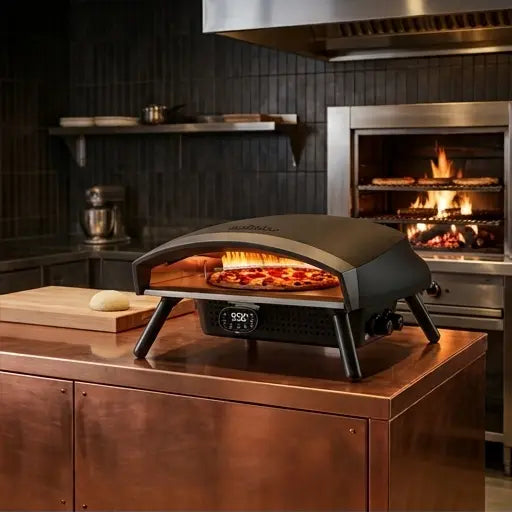
Steak and chops benefit most from intense, direct heat because they develop a deep crust quickly. Fish, seafood, and vegetables work well too, using a slightly lower rack position to brown without scorching. The Big Horn broiler also includes a pizza stone, which turns it into a high-heat pizza cooker for 60–90 second bakes — the adjustable rack is what makes the unit flexible rather than a single-purpose searing tool.
| Food | Rack position | Result |
|---|---|---|
| Thick steak | Top position | Deep crust, pink center |
| Chicken, pork | Mid position | Even browning, no scorch |
| Fish, vegetables | Lower position | Gentle char |
| Pizza | Pizza stone | 60–90 s Neapolitan-style bake |
Conventional gas grill vs infrared: quick comparison
| Factor | Conventional gas | Infrared |
|---|---|---|
| Heat transfer | Hot air (convection) | Direct radiant energy |
| Peak surface temp | ~500–700°F | Up to 1500°F |
| Preheat time | 10–15 min | 3–5 min |
| Flare-ups | More common | Reduced (shielded emitter) |
| Best for | Low-and-slow, general grilling | High-heat searing and broiling |
This is not a winner-takes-all comparison; it is a division of labor. If you already own a conventional grill and wish it seared harder, an infrared unit is a complement rather than a replacement.
What to look for when choosing one
When you shop for an infrared grill, the specs that matter are max temperature, preheat time, burner output, rack adjustability, and included accessories. A unit that only promises a high number but lacks rack control is harder to use. Look for a stainless body, a shielded ceramic emitter, and included extras such as a second grate and a pizza stone — the Big Horn 16-inch broiler checks those boxes with ten rack positions and two cooking plates.
Also check portability and fuel fit for your space: a propane-powered, compact broiler suits patios, RVs, and tailgates, while a larger integrated unit is meant for a fixed position. Match the format to where you cook, not just the marketing number.
Is an infrared grill worth adding to your setup?
An infrared grill earns its place when you cook foods that benefit from intense, dry surface heat — steaks, chops, seafood, and high-heat pizza. For cooks who already own a conventional grill and want a faster, harder sear, the addition genuinely changes results; for cooks who rarely sear, it is an expensive extra. The honest test is simple: if you wish your grill seared harder and faster, infrared is worth it; if you mostly smoke or slow-cook, keep your current setup.
Infrared grill FAQs
Is an infrared grill just a very hot gas grill?
Not quite — the heating mechanism differs. A gas grill relies on hot air; an infrared grill radiates heat directly from a glowing ceramic emitter. That difference is what gives infrared its speed and heat intensity.
Does infrared grilling use more fuel?
Not necessarily. It reaches temperature quickly and transfers heat efficiently, so short high-heat sessions can be fuel-comparable to a conventional grill for the same job.
Can I slow-cook on an infrared grill?
Not well. Infrared is designed for high-heat searing and broiling; for low-and-slow cooking you want a separate smoker or conventional grill.
Is infrared grilling safe on a balcony?
Only if local rules allow a propane appliance and you have proper ventilation and clearance. Never use it in a fully enclosed space, and check building rules for open-flame or propane restrictions.
Not well. Infrared is designed for high-heat searing and broiling; for low-and-slow cooking you want a separate smoker or conventional grill.
To see the specifications and included accessories, review the 16-inch Big Horn infrared broiler product page before deciding.