
Choose infrared for fast, intense searing with less flare-up; choose conventional gas for a larger cooking area and low-and-slow cooking. An infrared grill reaches up to 1,500°F, while a conventional gas grill typically tops out near 500°F to 700°F. The right choice depends on what and how much you cook.
What Is the Difference Between Infrared and Conventional Gas Grills?
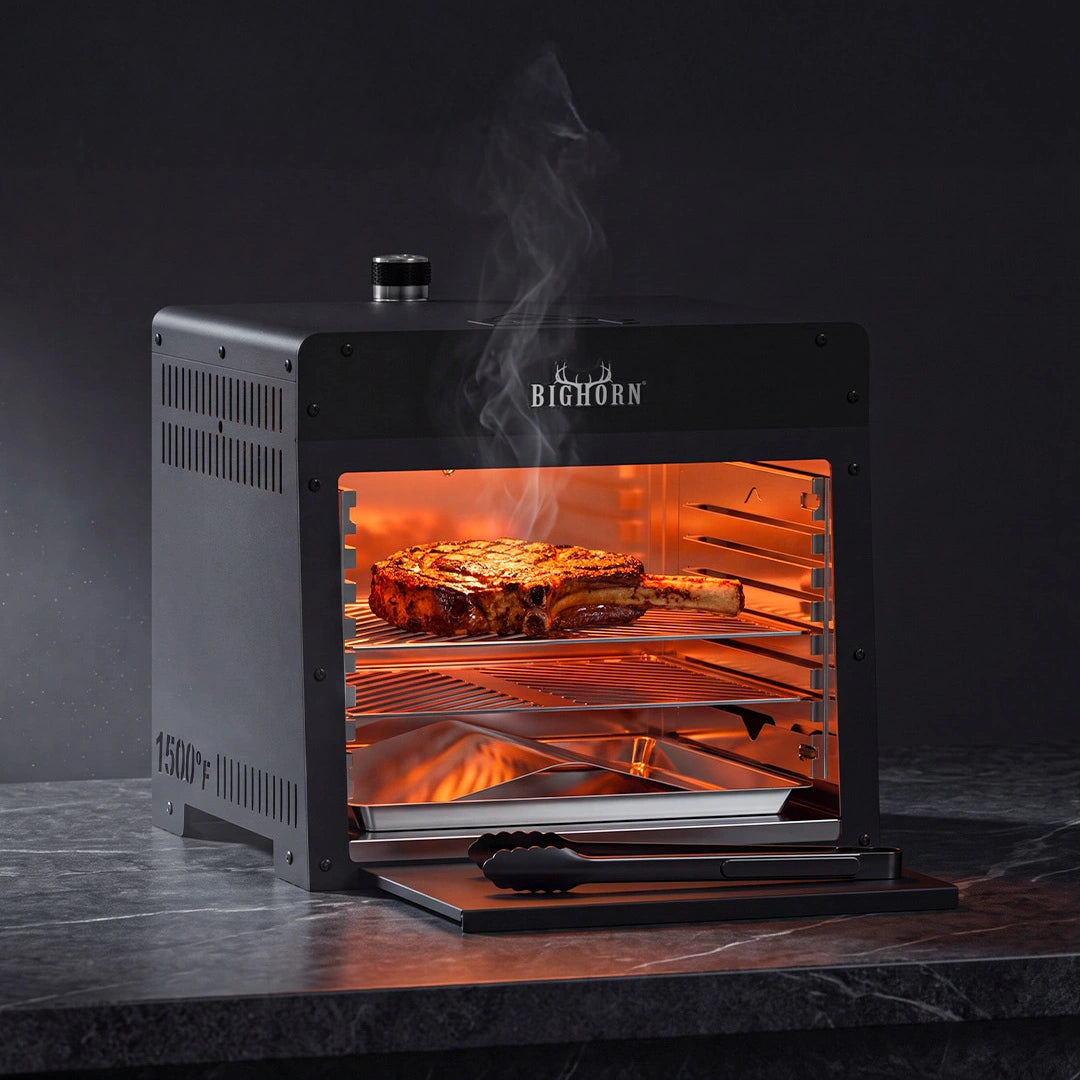
An infrared grill uses a radiant burner that heats food directly, while a conventional gas grill heats food mainly through hot air. The Big Horn Outdoors infrared broiler delivers heat from above, salamander-style; a conventional gas grill cooks from a flame below the grate.
That single difference shapes everything else. Radiant heat reaches the food surface faster and with less wasted energy, which is why infrared grills sear quickly and reach higher temperatures. Conventional gas grills spread heat over a larger grate using hot air, which is better for cooking many items at once or holding a moderate temperature for indirect cooking.
How Hot Does Each Type Get?
An infrared grill reaches far higher temperatures than a conventional gas grill. The Big Horn Outdoors infrared line is marketed for up to 1,500°F, while a typical residential gas grill tops out near 500°F to 700°F.
This gap matters for browning. At very high heat, the surface of a steak crisps almost immediately, before the interior overcooks. A conventional gas grill cannot reach that peak, so it browns more slowly and often needs more flipping. If the goal is a deep crust with a medium-rare center, infrared has the edge.
Steak Searing
An infrared grill sears steak better for most cooks, because its higher, more direct heat creates a faster crust. A conventional gas grill can still sear well, but it typically needs more time and attention to match the result.
The reason is heat intensity at the surface. Infrared delivers 1,500°F directly to the meat, so browning happens in seconds. Conventional gas relies on hot air and a hot grate, which brown more gradually. If your main goal is steakhouse-style crust, infrared is the stronger tool; if you also want to grill a full meal at once, a larger gas grill offers more room.
Ease of Control
A conventional gas grill is generally easier to control for a range of tasks, because you can set burners to different temperatures and create indirect zones. An infrared grill gives excellent control over searing intensity through its rack position, but it is a more focused tool.
On a conventional grill, separate burners let you run a hot zone and a cool zone at the same time, which is ideal for moving food from searing to finishing. An infrared broiler controls heat by moving food closer to or farther from the burner, which is precise for searing but less flexible for cooking many different items at once. Choose based on whether you need one intense heat source or a broad, adjustable surface.
Low-and-Slow Cooking
A conventional gas grill is better for low-and-slow cooking, because it holds a moderate, indirect temperature over a larger area. An infrared grill is designed for high-heat searing, not for hours of slow roasting.
Low-and-slow cooking requires steady, moderate heat and space to keep food away from the direct flame. A conventional gas grill does that well with its larger grate and multiple burners. An infrared broiler's strength is the opposite — intense, direct heat — so it is not the right tool for smoking brisket or slow-roasting a whole bird. Match the grill to the cooking method.
How They Compare on Flare-Ups and Cleanup
An infrared grill produces fewer flare-ups because its top-down radiant heat keeps fat from dripping onto an open flame. A conventional gas grill is more prone to flare-ups but is often simpler to clean over a large surface.
In an infrared broiler, food sits below the burner, so rendered fat does not land on a flame the way it does on a conventional grill's grate. That means less smoke and fewer bitter charred spots. Cleanup is comparable in effort: both need a wiped grate and cleaned drip area. The table below summarizes the main trade-offs.
| Factor | Infrared Grill | Conventional Gas Grill |
|---|---|---|
| Peak heat | Up to 1,500°F | Typically 500°F to 700°F |
| Sear speed | Faster | Slower, more flips |
| Flare-ups | Fewer | More likely |
| Cooking area | Compact | Larger |
| Low-and-slow | Poor | Good |
| Best for | Searing, quick meals | Volume, indirect cooking |
Key Facts
Big Horn Outdoors lists the following specifications at a glance.
- Time to full output: about 3 to 5 minutes (Big Horn Outdoors' listed figure)
- Maximum temperature: up to 1,500°F (listed)
- Burner output: 19,000 BTU (listed)
- Searing: steak finished in about 5 minutes (listed)
- Flare-up control: top-down, radiant heat (listed)
Which Grill Is Right for You?
Choose infrared if you mostly sear steaks, fish, and vegetables for a small group and want fast, high-heat results. Choose a conventional gas grill if you cook for a crowd or need low-and-slow and indirect cooking.
The decision comes down to volume and cooking style. Infrared excels at the intense, direct heat that makes a great crust, while conventional gas offers the space and flexibility for full meals and slow roasting. If you sear often and cook for one to four people, infrared is the better fit; if you need one grill that does a little of everything, conventional gas wins.
Big Horn Outdoors Product Team
"Our view is that infrared and conventional gas solve different problems, and the choice should follow the cooking style. Infrared wins on speed and sear quality because radiant heat reaches the food directly; conventional gas wins on space and versatility because hot air spreads over a larger grate. For the Big Horn Outdoors infrared broiler, we focus on repeatable searing rather than trying to make one tool do everything."
Conclusion
Infrared and conventional gas grills are different tools for different jobs. Infrared reaches up to 1,500°F and sears fast with less flare-up, making it the better choice for steak and quick high-heat meals. Conventional gas offers a larger, more flexible cooking area for volume and low-and-slow cooking. Choose infrared for searing and speed; choose conventional gas for capacity and versatility.
Key Takeaways
- Infrared and conventional gas solve different jobs. Infrared reaches about 1,500°F for fast searing; conventional gas offers a larger grate for volume.
- Infrared wins on sear speed and flare-up control. Top-down radiant heat browns steak in about five minutes.
- Conventional gas wins on flexibility. It is better for indirect heat, low-and-slow cooking, and larger groups.
- Choose by how you actually cook. Match the tool to searing needs versus capacity and versatility.
Questions to Ask Before Buying
- Is steak and quick searing my priority? Choose infrared if a dark crust matters most.
- Do I cook for larger groups or need low-and-slow zones? A conventional gas grill is the better complement.
- Will I use it outdoors only? Both are outdoor appliances that need clearance and ventilation.
FAQs
Which grill is better for steak?
Infrared, because its higher, more direct heat produces a faster, deeper sear.
Can an infrared grill replace a conventional gas grill?
Not fully. It is excellent for searing but lacks the size and indirect heat of a conventional gas grill.
Which grill has fewer flare-ups?
Infrared, because top-down radiant heat keeps fat from dripping onto an open flame.
Which grill is better for a large family?
A conventional gas grill, thanks to its larger cooking area and multi-burner flexibility.
Sources
- USDA FSIS, Safe Minimum Internal Temperature Chart — USDA FSIS, Safe Minimum Internal Temperature Chart
- NFPA, Grilling Safety — NFPA, Grilling Safety