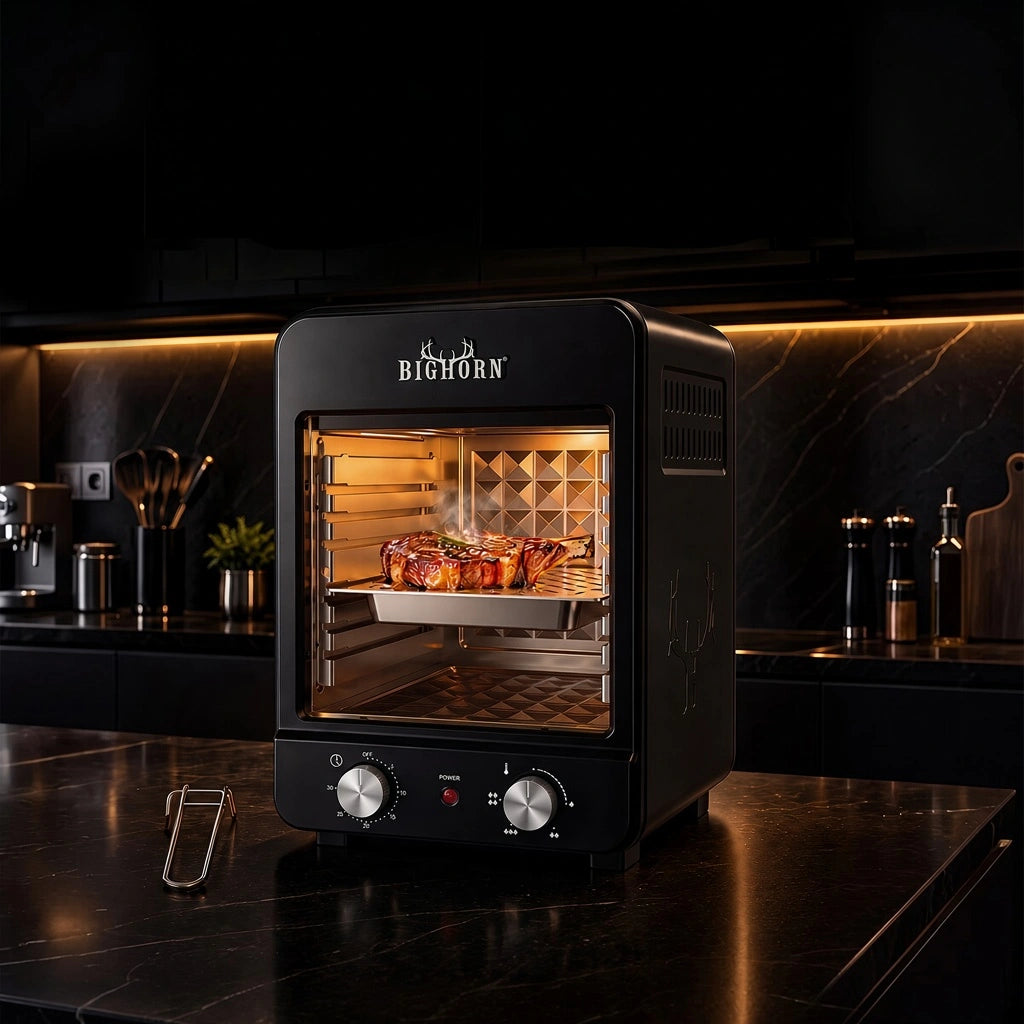
Getting a deeply browned crust and a pink center on a New York strip at home comes down to two things: grill temperature and the right topping. An infrared grill reaches 1,500°F and radiates heat directly downward onto the steak surface, which builds a crust fast enough to keep the center medium-rare. A herb Parmesan topping applied in the final phase browns under that same radiant heat to form a savory, golden layer.
Related product: Shop 16-inch Portable Infrared Steak Grill.
Why an Infrared Grill Makes a Better Parmesan-Crusted New York Strip

An infrared grill builds a deeper crust faster and with less risk of overcooking the center. A conventional grill cannot reliably do both at the same time for a cheese-topped steak. The three reasons come down to heat speed, heat direction, and temperature ceiling.
Infrared Heat Triggers a Faster, Deeper Maillard Reaction
The Maillard reaction creates the browned, flavorful crust on a grilled steak. It begins around 285 to 330°F at the surface, with browning accelerating as temperatures climb further. Higher surface temperatures speed up the reaction, though they also increase the risk of burning if heat is applied for too long. Infrared heat radiates directly onto the meat from above rather than warming the surrounding air first, so browning begins rapidly once surface moisture evaporates. The crust develops fast, which leaves the interior much closer to medium-rare when the steak comes off the heat.
Conventional Grills Take Too Long for Cheese-Crusted Steaks
Most gas and charcoal grills reach 500 to 600°F at the grate level, and searing at that temperature takes 3 to 4 minutes per side. For a cheese-crusted steak, the extended time under moderate heat drives up the internal temperature before the crust is fully developed. By the time the outside looks right, the center is often past medium-rare.
1,500°F Top-Down Heat Gives You Steakhouse Results at Home
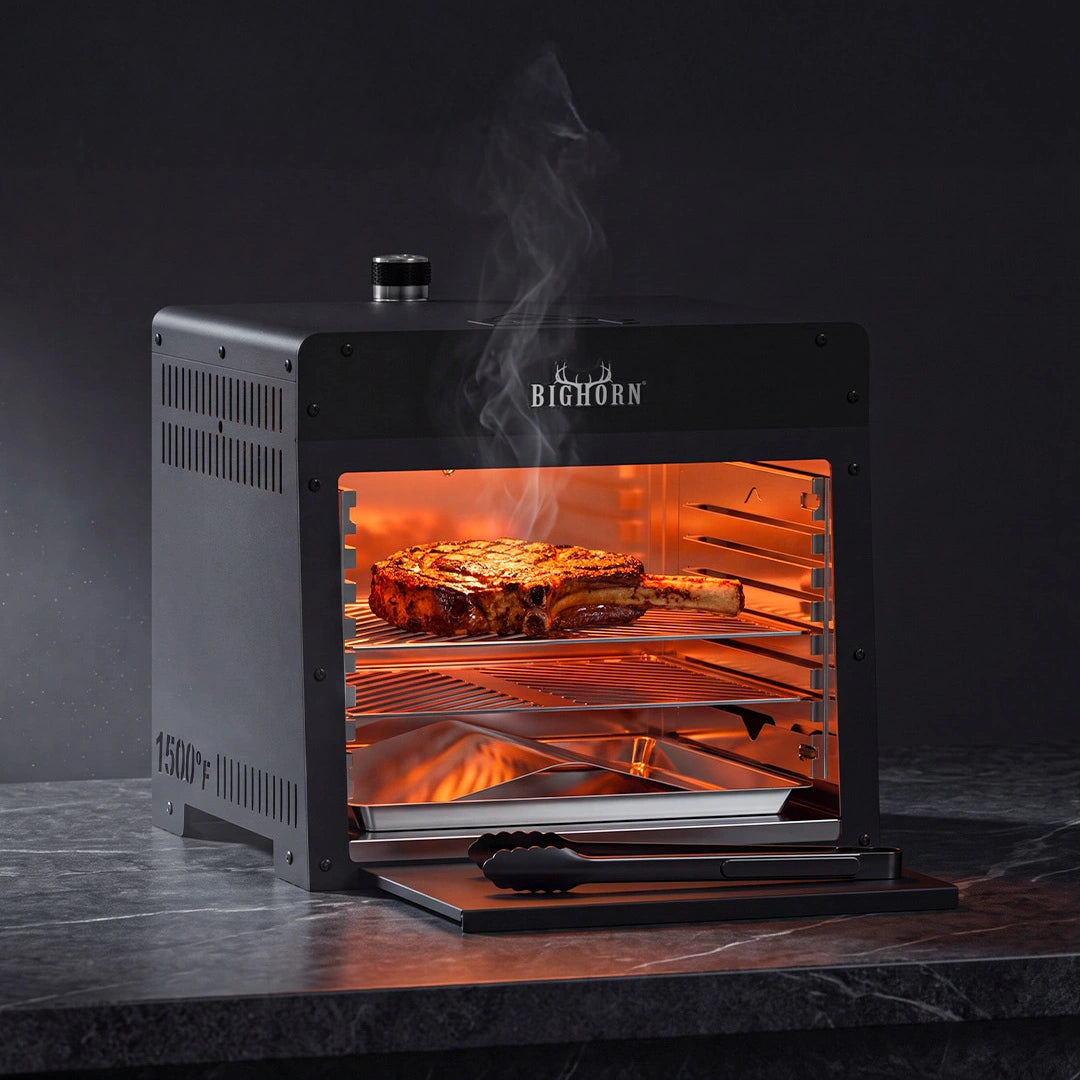
Top-down infrared broilers, called salamanders, have been standard equipment in high-end steakhouse kitchens for decades. The radiant element sits above the steak and fires heat directly downward onto the surface, which is what separates this method from conventional grilling. A home infrared grill built on the same principle gives you the same directional heat at 1,500°F. That top-down structure determines how the crust forms and how the steps in this recipe are ordered.
How to Choose the Right New York Strip Steak for This Recipe
Steak selection sets the ceiling for what this recipe can achieve.
Thickness, Marbling, and Grade
A New York strip between 1 and 1.5 inches thick is the target for this recipe. Thinner cuts overcook before the cheese crust has time to brown. Cuts over 1.5 inches benefit from a different approach, shown in the table below. Look for visible marbling throughout the muscle. USDA Choice or Prime grade delivers consistent marbling that keeps the interior moist under high radiant heat.
| Steak Thickness | Grilling Method | Notes |
| Under ¾ inch | Direct high heat | Crust barely forms before the center overcooks |
| 1 to 1.5 inches | Direct high heat | Ideal for this recipe |
| Over 1.5 inches | Reverse sear + infrared finish | Better internal temperature control |
A 1 to 1.5-inch strip gives the widest margin for building a good crust while keeping the center pink.
How to Prep the Steak Before It Hits the Infrared Grill
- Take the steak out of the refrigerator 30 to 45 minutes before cooking. A cold steak has a larger temperature gap between surface and core, which makes doneness harder to control.
- Pat the entire surface completely dry with paper towels. Surface moisture must evaporate before browning can begin, and any remaining liquid delays crust formation even at 1,500°F.
- Season both sides with kosher salt, black pepper, and garlic powder, pressing firmly so the seasoning adheres.
How to Make the Herb Parmesan Crust
The crust adds flavor and creates a browned, textured layer that holds on the steak through the cook.
Choose Mayonnaise Over Butter as the Binder

Mayonnaise outperforms butter as a binder in this recipe. Butter's milk solids and water content cause it to melt and run off the steak surface quickly under radiant heat. Mayonnaise, a thick blend of oil and egg, adheres more reliably to the seared steak surface and holds together long enough for the Parmesan to brown properly. Combine 1 cup of mayonnaise with 2 tablespoons of whole-grain Dijon mustard and whisk until smooth.
Use Fresh Herbs for Sharper Flavor in the Crust
Fresh herbs produce a sharper, brighter flavor in the finished crust. Finely chop 1 teaspoon each of fresh thyme, rosemary, and parsley, then stir into the mayo base. Dried herbs work if fresh ones are unavailable, but the flavor is flatter and some dried herbs turn slightly bitter under high-temperature finishing.
Grate Parmesan Fresh and Fold It In Just Before Spreading
Freshly grated Parmesan contains the natural fat and moisture needed to melt, bubble, and brown evenly. Store-bought pre-grated Parmesan often includes additives that prevent clumping, which interfere with proper browning and affect the final texture. Fold 1 cup of freshly grated Parmesan into the mayo mixture shortly before applying it to the steak. Mixing too far in advance causes the Parmesan to absorb moisture from the mayo and stiffen, making it harder to spread evenly.
How to Grill New York Strip Steak on an Infrared Grill
A top-down infrared grill fires heat directly downward onto the steak surface. Apply the herb Parmesan crust to whichever side faces up so the radiant element browns it from above.
1. Preheat the Grill for 3 to 5 Minutes Before the Steak Goes On
Preheat the infrared grill for 3 to 5 minutes until it reaches full operating temperature. Set the grill grate to mid-height for the initial sear phase.
2. Sear Each Side for 1 to 1.5 Minutes Without Moving the Steak
Place the seasoned steak on the preheated grate. Cook for approximately 1 to 1.5 minutes without moving the steak, then flip. Do not press down on the steak during this phase.
3. Lower the Rack and Apply the Herb Parmesan Crust After the First Flip
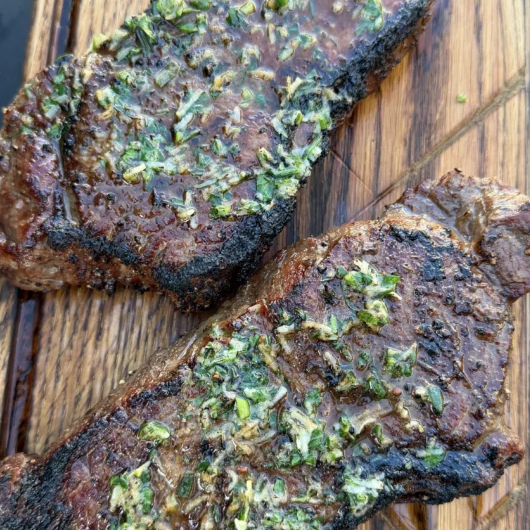
Lower the grate one or two positions away from the element. Spread half the herb Parmesan mixture across the top surface, which now faces the infrared element. Cook for 60 to 90 seconds. Pull when the surface is golden and bubbling, not dark.
4. Flip, Apply the Remaining Crust, and Watch Closely
Flip carefully using a wide spatula to support the browned crust. Spread the remaining mixture across the new top surface and cook for another 60 to 90 seconds. Golden and set is the target. Dark brown edges mean pull immediately.
5. Pull the Steak at 125°F and Let Carryover Finish the Cook
Insert an instant-read thermometer horizontally into the thickest part. Remove the steak at 125°F. After the steak leaves the grill, residual heat in the outer layers continues cooking the center. This carryover effect adds approximately 5 to 7°F during the five-minute rest, bringing the final temperature into medium-rare territory around 130 to 135°F.
A note on temperature: The USDA recommends a minimum internal temperature of 145°F for whole cuts of beef. Medium-rare at 130–135°F is widely practiced but carries individual responsibility.
How to Rest, Slice, and Serve for the Best Result
Cutting into a steak straight off the grill forces juice out onto the board. Resting lets the internal pressure and temperature even out, so the juice stays in the meat when you slice it. Skipping it causes juice to run out the moment the steak is sliced.
Why Resting Uncovered Protects the Crust
Place the steak on a wire rack and let it rest uncovered for five minutes. Covering it, even loosely with foil, traps steam and softens the herb Parmesan crust. A wire rack lets air circulate on all sides, preserving the texture of the browned cheese topping while the internal temperature finishes rising. Slice against the grain in ½-inch pieces for the most tender result.
What to Serve Alongside a Parmesan-Crusted Strip Steak
Grilled asparagus, roasted potatoes, or a simple green salad all pair well with this grilled steak recipe. These sides keep the steak as the focus of the plate and avoid competing with the Parmesan topping in terms of richness.
Common Mistakes to Avoid When Making This Grilled Steak Recipe
Three errors come up repeatedly with this recipe.
Skipping the Pat-Dry Step
Surface moisture must evaporate before the Maillard reaction can begin, even on a 1,500°F infrared grill. A thorough pat-down with paper towels before seasoning makes a measurable difference in crust depth and color on the finished steak.
Applying the Crust Too Early or at Full Heat
Spreading the herb Parmesan mixture before the initial sear phase is complete causes the mayo and cheese to melt off before the surface can hold the topping. Apply the crust only after the initial sear, always to the side currently facing the infrared element. Lower the grate before the crust phase. At full 1,500°F intensity, Parmesan can scorch in under a minute. Moving the grate down one or two positions gives the crust time to brown without burning.
Pulling the Steak at the Wrong Temperature
Infrared grills cook fast, and the outer layers of the steak carry significant residual heat during the finishing phase. Pull at 125°F to leave room for carryover. Waiting until the thermometer reads 130°F or higher on the grill typically results in a finished steak at medium or above after resting.
Grill Your Best New York Strip with Herb Parmesan Crust Tonight
A 1-inch New York strip, dried and seasoned well, takes an initial sear of approximately 2 to 3 minutes total on a fully preheated infrared grill, with the herb Parmesan crust finishing in another 2 to 3 minutes on a lowered rack. Exact timing varies with rack position and steak thickness, so a thermometer matters more than the clock. Pull at 125°F, rest uncovered on a wire rack for five minutes, and the center lands in medium-rare territory. A thermometer controls doneness. Visual monitoring controls the crust. Both matter, and neither can replace the other. If you want the top-down radiant heat that makes this timing and crust method work, the Big Horn® 1500°F Infrared Steak Grill is built for exactly this.
FAQs About Infrared Grill New York Strip Steak Recipes
Q1. Can I Make This Herb Parmesan Crust Steak Recipe on a Regular Gas Grill?
Yes, but the heat ceiling is the limiting factor. A conventional gas grill cannot finish the herb Parmesan crust and keep the center medium-rare at the same time because the sear phase takes too long at lower temperatures. A more reliable workaround is to grill the steak conventionally to 115°F, then finish the crust under an oven broiler set to high, checking every 30 seconds until the Parmesan turns golden.
Q2. How Long Does It Take to Grill a New York Strip on an Infrared Grill?
Total active cook time on a fully preheated infrared grill runs roughly 4 to 6 minutes for a 1-inch New York strip, covering the initial sear and both crust phases. Exact time shifts with rack position and steak thickness. Pull at 125°F on an instant-read thermometer rather than counting minutes.
Q3. Can I Prepare the Herb Parmesan Crust Ahead of Time?
Partially, yes. Mix the mayonnaise, Dijon mustard, and fresh herbs up to 24 hours ahead and refrigerate the base covered. Fold in the freshly grated Parmesan no earlier than 30 minutes before use. Pre-mixed Parmesan absorbs moisture from the mayo as it sits in the refrigerator, stiffens, and becomes difficult to spread evenly across the steak surface.
Q4. Does This Herb Parmesan Crust Recipe Work on Other Cuts of Steak?
Yes. Ribeye works well with this method, though its higher fat content can increase dripping under top-down radiant heat. New York strip remains the most consistent choice because its firm texture holds the crust without the surface becoming slick from excess rendered fat. Cuts thinner than ¾ inch are not recommended, as they overcook before the crust has time to set properly.
Explore more in the Grill Recipes.
More to Read
 Big Horn Outdoors® Expands Retail Presence with New Experience at Piedmont Outfitters
Big Horn Outdoors® is excited to announce a new retail destination for outdoor cooking enthusiasts. Customers can now experience the brand's popula...
Big Horn Outdoors® Expands Retail Presence with New Experience at Piedmont Outfitters
Big Horn Outdoors® is excited to announce a new retail destination for outdoor cooking enthusiasts. Customers can now experience the brand's popula...