Yes—tabletop pizza ovens are very good when you want fast, high-heat pizza without installing a permanent outdoor oven. A capable model can heat a pizza stone far beyond a typical home oven and bake thin pizzas in about 60 to 120 seconds, but the best results require the right fuel, dough, stone temperature, and safe setup.
By the Big Horn Outdoors Product Team
Published: September 28, 2026
What makes tabletop pizza ovens work so well?
A tabletop pizza oven is a compact high-heat oven designed to sit on a stable outdoor table, cart, or approved countertop surface. Its advantage is not simply speed: it combines a hot pizza stone, radiant heat from a flame or heating elements, and circulating hot air to cook the base, rim, and toppings at nearly the same time.
A conventional household oven often tops out around 500°F to 550°F. That is enough for excellent New York-style, pan, and sheet-pan pizza, but it generally cooks a thin pizza over several minutes. A dedicated tabletop pizza oven can run much hotter, allowing dough to rise rapidly before its interior dries out.
The cooking mechanism matters:
- Conductive heat moves from the hot stone into the dough, setting and browning the base.
- Radiant heat comes from a flame, burner, or electric heating element and browns the exposed crust and toppings.
- Convective heat is the hot air moving through the oven chamber, helping melt cheese and cook toppings evenly.
When these forms of heat are balanced, the result is a pizza with a crisp underside, puffed cornicione, fully melted cheese, and controlled blistering. When they are not balanced, one side can burn before another finishes.
High heat also supports oven spring, the fast expansion of gases and steam inside dough during the first part of baking. That expansion creates the airy rim associated with Neapolitan-style pizza. The Maillard reaction—browning that develops when proteins and sugars react under high heat—adds toasted flavor and mottled color to the crust.
Tabletop ovens are therefore especially useful for people who want thin, fast-baked pizza. They are not automatically better for every style. Thick pan pizza, deep-dish pizza, and heavily topped pies often benefit from lower, steadier heat and a longer bake.
Are tabletop pizza ovens worth buying?
Tabletop pizza ovens are worth buying for people who make pizza regularly, value outdoor cooking, and have a safe place to use and store them. They are less compelling for someone who wants only occasional frozen pizza or does not have suitable outdoor clearance.
The strongest reason to buy one is repeatable access to high heat in a compact format. A portable oven can turn a patio, backyard, campsite, or RV cooking area into a pizza station without the cost, construction work, and permanent footprint of a masonry oven.
They can also be practical for entertaining. A pizza that bakes in roughly one to two minutes can be served one at a time, allowing guests to choose toppings and keeping food moving. However, quick cooking does not mean instant cooking. Dough preparation, topping assembly, preheating, stone recovery, fuel management, and cleanup still take time.
A tabletop pizza oven may be a good fit if you:
- Make homemade dough or buy fresh dough regularly.
- Prefer thin-crust, Neapolitan-style, artisan, or fast-baked pizza.
- Enjoy hands-on outdoor cooking.
- Have a sturdy, non-combustible cooking surface and safe overhead clearance.
- Want to cook flatbreads, vegetables, fish, or cast-iron dishes as well as pizza.
- Need an oven that can be moved or stored between uses.
It may be a poor fit if you:
- Need an appliance for unattended cooking.
- Have no safe outdoor area for gas, pellet, wood, or charcoal equipment.
- Prefer thick pizzas that need longer, lower-temperature baking.
- Want every pizza to cook with no turning, no learning curve, and minimal setup.
- Plan to use an outdoor fuel-burning oven indoors.
A tabletop pizza oven is a specialized tool. It excels at intense heat and short bakes; it does not replace every indoor oven or grill.
Which tabletop pizza oven fuel is best?
Gas is usually the easiest tabletop pizza-oven fuel for beginners, pellets and wood provide live-fire character but require more attention, and electric models offer controlled countertop cooking where the manufacturer approves indoor use. The right choice depends on where you cook and how much fire management you want.
Fuel changes both the user experience and the heat-management strategy. A gas burner produces controllable flame with a dial. A pellet or wood fire requires adding fuel, maintaining combustion, and managing airflow. Electric ovens use heating elements and controls rather than combustion, making them appropriate for indoor use only when that exact product is designed and rated for it.
| Fuel type | Best for | Main advantage | Main trade-off |
|---|---|---|---|
| Propane gas | Beginners, frequent pizza nights, entertaining | Fast ignition and adjustable flame | Requires a compatible gas supply and outdoor ventilation |
| Wood pellets | Outdoor cooks who enjoy live-fire cooking | Compact fuel and fire-based cooking experience | Needs refueling, ash cleanup, and closer temperature management |
| Wood or charcoal | Traditional live-fire cooking where approved | Direct fire management and cooking ritual | More variable heat, smoke, and cleanup |
| Electric | Indoor kitchens or covered-use situations only when specifically approved | Controlled heat without combustion | Requires adequate counter space and a suitable electrical circuit |
| Multi-fuel | Cooks who want flexibility | Lets one compatible oven support more than one fuel method | Accessories, assembly, and operating instructions vary by model |
Gas ovens are often the most forgiving choice for a first tabletop pizza oven. You can preheat, launch, rotate, adjust the flame, and repeat with relatively little interruption. A lower flame after launch can help prevent the top from scorching while the stone finishes the base.
Pellet ovens are more hands-on. Pellet combustion depends on dry, food-grade pellets, sufficient airflow, a stable flame, and regular refueling. A pellet-fed oven can produce excellent pizza, but the cook must watch both the pizza and the fire. Too little fuel reduces top heat; too much flame can darken the rim before the center is ready.
Electric tabletop pizza ovens simplify the heat source but still require technique. They are often useful for people who want indoor pizza capability, predictable controls, and less concern about wind. Always follow the specific manufacturer’s placement, ventilation, electrical, and countertop-clearance instructions.
Big Horn Outdoors offers pizza ovens in pellet, gas, electric countertop, and multi-fuel formats. Those categories should not be treated as interchangeable: indoor suitability, temperature range, included components, and compatible accessories depend on the exact model.
How hot should a tabletop pizza oven be?
A tabletop pizza oven should be hot enough to match the pizza style, not simply set to its highest possible temperature. For thin, lightly topped Neapolitan-style pizza, a very hot stone and strong top heat support a bake of about 60 to 120 seconds; thicker pizzas need lower heat and more time.
The stone is the most important temperature to measure because it cooks the bottom of the pizza. An oven chamber can look very hot while the stone remains too cool for a crisp base. Conversely, an overheated stone can burn flour and the underside before the toppings cook.
Use an infrared thermometer to check the stone before launching. Then evaluate the result, not just the number:
- If the top cooks before the base, allow the stone more time to heat or reduce top flame after launch.
- If the base burns while the cheese remains pale, lower the stone temperature, reduce the preheat, or use less flour under the dough.
- If each successive pizza develops a pale base, allow the stone time to recover between bakes.
- If one edge darkens faster, rotate the pizza more frequently toward and away from the heat source.
A common beginner mistake is treating the oven like a standard kitchen oven. High-heat tabletop pizza cooking is active. A pizza may need turning every 15 to 30 seconds, depending on the oven design, flame position, and pizza style.
Stone temperature and dough hydration
Dough hydration—the percentage of water relative to flour by weight—affects how pizza handles high heat. Wetter dough can produce an airy crust but is stickier, harder to launch, and more vulnerable to tearing. Drier dough is easier to handle but can bake up less open and tender.
For a first cook, use dough that is properly fermented, stretched evenly, and topped lightly. Overloading a pizza with sauce, cheese, or wet vegetables slows baking and can leave the center soft before the rim burns.
How much pizza can a tabletop oven cook?
Most tabletop pizza ovens cook one pizza at a time, and the listed size usually describes the largest pizza the cooking floor can accommodate. A 12-inch oven is practical for individual pizzas, while a 14-, 15-, or 16-inch format offers more flexibility for larger pies and skillet cooking.
Cooking capacity is about more than diameter. Consider the oven mouth, stone depth, burner placement, and available clearance for turning a pizza with a peel. A wider opening makes launching and rotating easier, while a smaller opening can retain heat better but may demand more precise peel work.
For a household of two to four people, a compact oven can work well because pizzas cook sequentially. For a larger gathering, plan for workflow:
- Pre-shape dough balls before lighting the oven.
- Set up toppings in small, ready-to-use portions.
- Keep a landing peel or tray beside the oven.
- Cook one pizza at a time rather than trying to crowd the stone.
- Give the stone recovery time if the base begins to pale.
The difference between casual pizza night and a smooth pizza party is preparation. The oven cooks quickly, but the cook still needs a clear station for launching, turning, cutting, and serving.
Setup, portability, and accessories
A portable tabletop pizza oven is only portable if you can safely transport the oven, fuel, peel, and heat-safe setup surface. Check the unit’s weight, folded dimensions, handles, fuel requirements, and cool-down time before treating it as camping equipment.
Big Horn Outdoors began with a backyard cooking challenge in 2012: making high-heat cooking easier to manage while addressing uneven heat, smoke, and instability. That focus remains relevant when choosing a compact oven, because tabletop performance depends heavily on stable placement and controlled heat—not just maximum temperature.
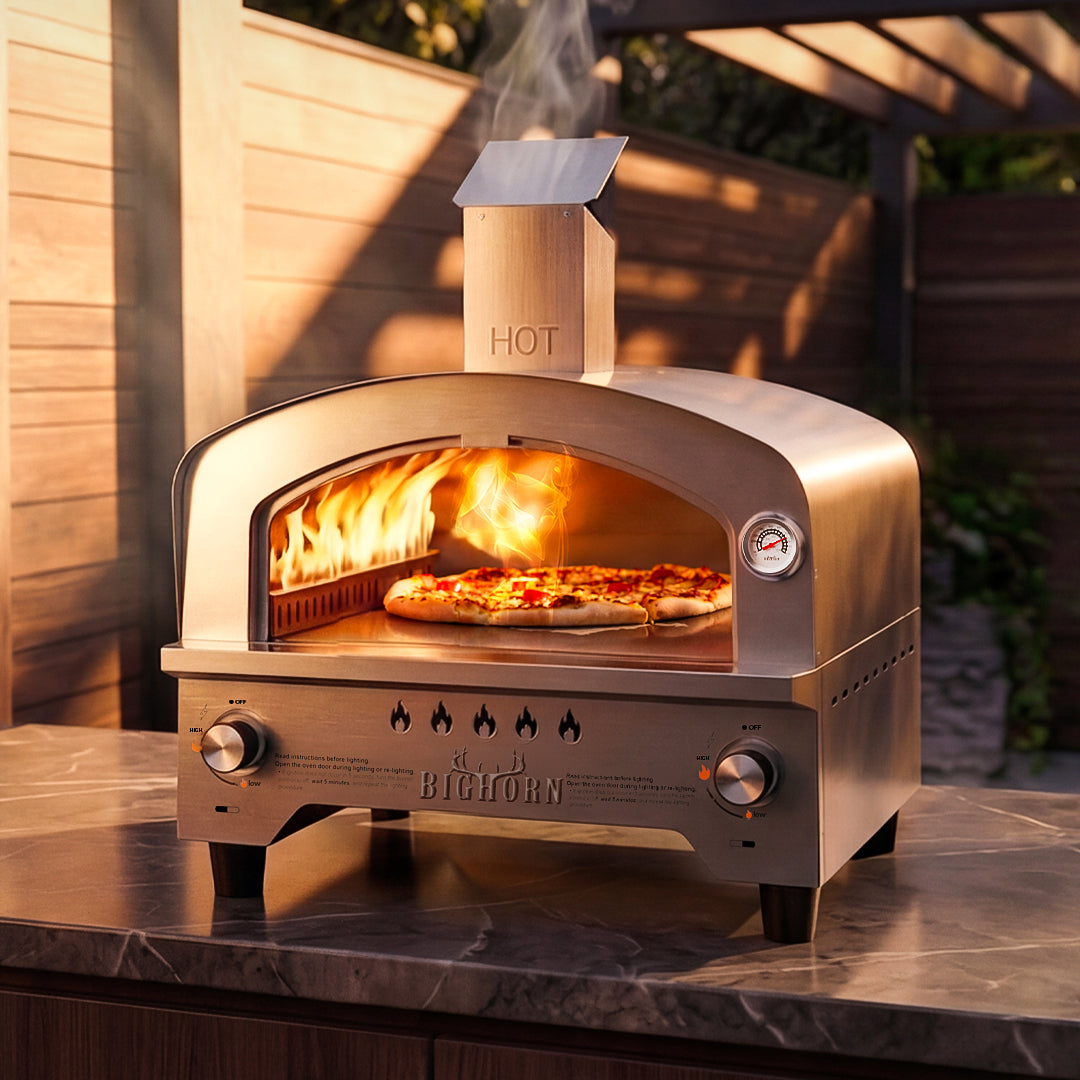
The current Big Horn Outdoors 12-inch wood-pellet pizza oven is one example of the difference between a general category claim and a model-specific fact. The official product page describes a stainless-steel outdoor pellet oven with folding legs, an approximately 24.9-pound weight, and an 18- to 20-minute preheat. Its listed performance reaches up to 887°F and supports pizzas in about 60 to 90 seconds under appropriate conditions. Those details apply to that exact 12-inch model only.
Useful accessories include:
- A pizza peel for launching and turning pizzas.
- An infrared thermometer for measuring stone temperature.
- Heat-resistant gloves for handling hot pans and tools.
- A brush or scraper suited to the stone and oven design.
- A weather-resistant cover for storage only after the oven has completely cooled.
- A stable pizza-oven table or cart that meets the oven manufacturer’s requirements.
Do not assume accessories fit every model. A gas burner, electric heater, cover, stone, or peel must be listed as compatible with the specific oven you own.
Tabletop pizza oven safety essentials
Fuel-burning tabletop pizza ovens belong outdoors unless the manufacturer explicitly states otherwise. Place the oven on a stable, non-combustible surface with clear space around it, keep combustible materials away, and follow the exact manual for fuel, ignition, regulator, and clearance requirements.
Live fire, hot metal, hot stones, and propane systems all require deliberate use. The main risks are burns, flare-ups, unstable placement, gas leaks, and heat or smoke accumulating in unsuitable spaces.
Follow these practical rules:
- Use gas, pellet, wood, or charcoal ovens outdoors only unless the exact manufacturer instructions clearly authorize another setting.
- Never operate a fuel-burning pizza oven in a garage, tent, enclosed porch, vehicle, or other enclosed area.
- Keep the oven away from low roofs, branches, siding, fences, outdoor furniture, and other combustible materials.
- Place it on a sturdy surface that can support the oven and resist heat.
- Keep children and pets outside the cooking zone.
- Inspect gas hoses, regulators, and connections before use, following the manufacturer’s leak-check procedure.
- Use only the approved fuel type. Do not substitute fuel or modify burners.
- Allow the oven, stone, ash, and accessories to cool completely before moving, covering, or storing them.
- Remove ash only when it is fully cold and dispose of it safely.
Wind changes flame behavior and heat retention. On gusty days, use the oven only if its instructions permit conditions to be managed safely. Never improvise wind barriers that trap heat around the oven or block its ventilation.
Cleaning and maintenance protect performance
A tabletop pizza oven stays more reliable when ash, flour, grease, and moisture are managed after every cook. Cleaning should begin only after the oven and stone are fully cool, because a hot stone can crack if exposed to water or sudden temperature change.
Brush excess flour and food debris from the stone with a dry pizza-oven brush or scraper. Avoid soaking a pizza stone. Its porous surface can absorb water, and thermal shock may damage it during the next heat cycle.
For pellet or wood-fired models, empty cooled ash regularly. Ash can restrict airflow, hold moisture, and make ignition less consistent. For gas models, keep burner openings clear and inspect connections according to the owner’s manual. For electric models, follow the manufacturer’s instructions for crumbs, grease, interior surfaces, and heating elements.
Store fuel dry. Damp pellets can burn poorly, produce more smoke, and reduce temperature stability. Before long-term storage, make sure every component is clean and completely dry, then use a cover or protected storage area suitable for the model.
Big Horn Outdoors Expert Views
“A tabletop pizza oven is good because it concentrates high heat in a compact cooking chamber, but heat control—not maximum temperature alone—creates better pizza. Preheat the stone thoroughly, launch a lightly topped pizza, turn it often, and adjust the flame or setting to balance the base with the top. Choose gas for easier repeatability, pellets or wood for a more hands-on fire-management experience, and electric only where the exact oven is intended for indoor countertop operation. Most importantly, use the oven on a stable, approved surface with proper clearance and follow the model-specific manual every time.”
The bottom line
Tabletop pizza ovens are genuinely effective for fast, high-heat pizza, especially if you enjoy thin crust, hands-on cooking, and outdoor entertaining. They deliver their best results when the stone is fully preheated, the pizza is lightly topped, and the cook actively rotates it through the hottest zone.
Choose a gas tabletop oven if you prioritize convenience and repeatable control. Choose a pellet or wood-fired option if you prefer managing a live fire and do not mind refueling and ash cleanup. Choose an electric countertop model only if you need indoor cooking and the exact product is rated for that environment.
For portable outdoor use, check actual weight, folding features, fuel logistics, and safe support requirements—not just the word “portable.” Big Horn Outdoors offers several pizza-oven formats, so compare each exact product page before selecting one based on fuel type, approved location, pizza capacity, accessory compatibility, and your intended cooking style.
FAQs
Can a tabletop pizza oven cook more than pizza?
Yes. Many tabletop pizza ovens can cook flatbreads, vegetables, fish, steaks, and cast-iron dishes, provided the food and cookware fit the oven and the manufacturer permits that use. Lower the heat or manage the flame for foods that need longer cooking than thin pizza.
Do tabletop pizza ovens need a pizza stone?
Most dedicated tabletop pizza ovens use a pizza stone because it stores heat and transfers it directly into the dough. The stone helps form a browned, crisp base, but it must be thoroughly preheated and allowed to recover between pizzas.
Can you use a tabletop pizza oven on a wooden table?
Only if the oven manufacturer specifically permits the setup and the table is protected and stable according to its instructions. In general, use a sturdy, non-combustible surface or an approved heat-resistant platform, maintain required clearance, and keep the oven away from flammable materials.
Are pellet tabletop pizza ovens hard to use?
Pellet ovens have a learning curve because the cook manages ignition, airflow, pellet supply, flame size, and ash. They are manageable with practice, but a gas model is usually easier for a first-time pizza-oven owner who wants consistent heat with less fire tending.
How long does a tabletop pizza oven take to cool down?
Cooling time varies by model, ambient temperature, insulation, fuel type, and whether the oven has been running at high heat. Treat the oven, stone, ash, and accessories as hot until they are completely cool, and follow the exact manufacturer guidance before moving or covering the unit.