

Portable pizza ovens typically weigh 20 to 45 pounds, while larger “portable” models can reach 50 pounds or more. For true one-person transport, look for an oven under about 30 pounds; once a pizza oven exceeds 40 pounds, it is usually better described as movable by car rather than easy to carry to a campsite or tailgate.
By the Big Horn Outdoors Product Team
Published September 28, 2026
What Is the Typical Weight of a Portable Pizza Oven?
Most portable pizza ovens weigh 20 to 45 pounds before fuel, accessories, and carrying cases are added. Compact 12-inch gas or pellet ovens commonly fall near the 20-to-30-pound range, while larger ovens with bigger stones, dual burners, insulated shells, or wider cooking chambers often weigh 35 to 50 pounds.
“Portable” does not always mean lightweight. In outdoor cooking, it usually means the oven can be transported, stored, and set up without permanent installation. A 45-pound oven can still be portable if it has folding legs, a manageable footprint, and a vehicle-friendly shape—but it may require two hands or two people to move safely.
Weight comes from the components that make high-heat pizza cooking possible:
- Stainless-steel or powder-coated steel housing
- Cordierite, ceramic, or composite pizza stone
- Gas burner, pellet hopper, firebox, or electric heating system
- Insulation and heat shields
- Folding legs, handles, and chassis reinforcement
- Doors, thermometers, or rotating-stone mechanisms
A lighter oven is easier to carry, but the goal is not simply to buy the lowest number on the specification sheet. The right portable pizza oven balances carrying weight with stability, heat retention, usable cooking space, and the fuel system you can manage where you cook.
How Does Pizza-Oven Weight Affect Portability?
A pizza oven under 25 pounds is generally practical for one person to lift from storage, load into a vehicle, and place on a stable outdoor table. An oven in the 30-to-45-pound range remains travel-capable but is more suitable for car camping, tailgating, RV trips, and patio use than frequent hand carrying.
The real-world carrying experience depends on more than the listed product weight. A compact 30-pound oven with a balanced body and integrated handles may be easier to move than a 25-pound oven with an awkward, wide shape. Likewise, a folding-leg model may pack more efficiently than a lighter oven with a tall chimney or protruding hopper.
Use these practical portability tiers when comparing models:
| Weight range | Practical portability | Best-fit use |
|---|---|---|
| Under 25 lb | Usually easy for one adult to carry | Picnics, small balconies, camping, tailgates |
| 25–35 lb | One-person transport is realistic, but more deliberate | Backyards, RV travel, car camping |
| 35–45 lb | Movable, often best with two hands or a carry bag | Patio-to-driveway moves, tailgates, outdoor kitchens |
| Over 45 lb | Transportable by vehicle, but less convenient to carry | Semi-permanent patio use, destination cooking |
When planning transport, add the weight of the items that do not appear in the oven’s net weight. A propane cylinder, pizza stone, peel, cover, lighter, fuel, thermometer, dough boxes, and heat-resistant gloves can make the complete setup substantially heavier.
For example, an oven listed at 25 pounds may be easy to lift alone, but the complete cooking kit can become a multi-item load. This is why a durable carry bag, folding prep table, and separate fuel storage can matter as much as the oven’s published weight.
Which Portable Pizza Oven Is Best for Your Carrying Needs?
The best portable pizza oven for your needs is the lightest model that still provides the fuel type, cooking capacity, and heat control you will realistically use. A solo camper may prioritize a 20-to-25-pound unit, while a family hosting pizza nights may accept more weight for a larger stone and steadier heat recovery.
Choose by how far and how often the oven will move:
For campsites and tailgates
Prioritize a compact oven with folding legs, a stable base, and a fuel system you can safely transport. Gas ovens reduce the need to carry wood or pellets, while pellet ovens may appeal to cooks who prefer solid-fuel flavor and can manage ash cleanup.
A 12-inch cooking format is often the practical portability sweet spot. It can produce personal pizzas and many flatbreads while keeping the body, stone, and support structure compact.
For apartment patios and small backyards
Weight is less important than storage and safe setup. A 30-to-40-pound oven may be perfectly practical if it stays near the cooking area and only moves occasionally. Confirm that your outdoor space allows the appliance’s fuel type and that the oven has adequate clearance from walls, railings, awnings, and combustible materials.
For RV and car travel
Look beyond oven weight to packed dimensions, fuel storage, and setup speed. An oven that folds flat or has removable components can be easier to pack around coolers, chairs, and camping equipment. A large oven may fit in the vehicle, but its stone and burner components may still require careful protection during travel.
For frequent entertaining
A heavier oven can make sense when it provides a larger opening, more stable construction, or enough cooking capacity to keep pizzas moving for a group. The trade-off is that you may treat it as a patio appliance rather than something you carry to every outing.
What Makes One Portable Pizza Oven Heavier Than Another?
Pizza ovens become heavier as cooking capacity, insulation, fuel-system complexity, and structural reinforcement increase. A heavier oven is not automatically better, but added mass can support a larger pizza stone, retain heat more consistently, and make the unit feel steadier during active cooking.
Several design choices add weight:
- Larger pizza stones: A 16-inch stone weighs more than a 12-inch stone and needs a wider, stronger oven body.
- More insulation: Insulation can improve heat retention and reduce external heat transfer, but adds material and bulk.
- Multi-fuel capability: An oven designed for pellets, wood, charcoal, gas, or attachment-based fuel conversion may use additional firebox parts, adapters, or reinforcement.
- Dual burners: Two burners can create a broader heat zone or more controlled flame pattern, but add components and plumbing.
- Rotating stones: A rotating-stone system includes a motor, drive mechanism, or manual turntable components.
- Thicker metal: Heavier-gauge steel can increase rigidity and durability, but it also increases carrying weight.
- Built-in handles and legs: These improve setup and transport but are still part of the total load.
A pizza oven’s stone deserves special attention. The stone stores thermal energy and transfers heat into the dough from below. That stored heat helps crisp the base, but a thicker or larger stone contributes meaningfully to the oven’s overall weight.
In general, a lightweight oven may heat quickly but have less thermal mass. A heavier model may feel more stable and recover better between pizzas, particularly when cold dough repeatedly contacts the stone. Actual performance depends on burner design, insulation, airflow, stone material, and preheat practice—not weight alone.
How Much Does a Big Horn Outdoors Pizza Oven Weigh?
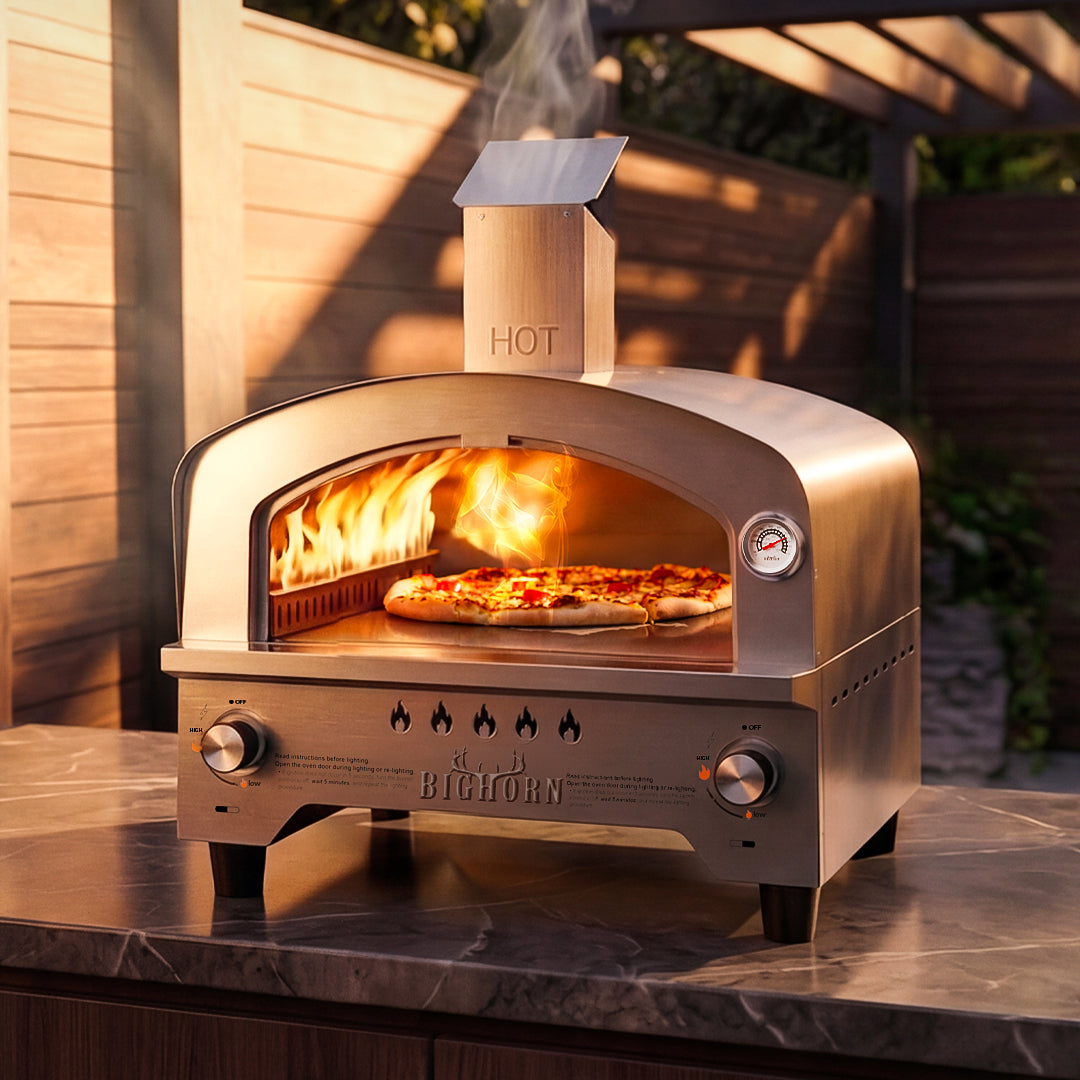
The verified Big Horn Outdoors 12-inch wood-pellet pizza oven weighs 24.9 pounds and uses a stainless-steel body with folding legs. Its published format places it in the genuinely portable category for backyard cooking, car camping, tailgates, and other situations where one person may need to load and position the oven.
This exact Big Horn Outdoors model is designed as a wood-pellet pizza oven. The official product information also identifies separately sold gas-burner and electric-heater attachments for compatible use, so buyers should confirm the specific fuel setup and required accessory before purchasing or traveling with it.
For this 12-inch wood-pellet model, Big Horn Outdoors lists:
- Weight: 24.9 lb
- Primary construction: Stainless steel
- Portability feature: Folding legs
- Primary fuel: Wood pellets
- Compatible attachments: Separately sold gas-burner or electric-heater attachments
- Listed preheat: 18–20 minutes
- Listed maximum temperature: Up to 887°F / 475°C
- Listed pizza time: About 60–90 seconds under appropriate conditions
Those details apply only to that exact 12-inch Big Horn Outdoors wood-pellet oven. They should not be assumed to apply to the brand’s gas, electric, multi-fuel, or larger-format pizza ovens, because oven weight, fuel requirements, temperature capability, dimensions, and indoor/outdoor suitability vary by model.
Big Horn Outdoors began with a 2012 backyard-cooking challenge centered on making high-heat cooking easier to manage despite uneven heat, smoke, and unstable temperatures. That practical focus matters when evaluating portability: an oven must be light enough to move, but it also must sit securely, maintain a safe cooking position, and provide controllable heat once it is set up.
Fuel Choice Changes the Weight You Carry
The oven’s listed weight does not include all of the fuel-related equipment needed for cooking. A 25-pound gas oven may require a propane cylinder, hose, regulator, and fuel-storage plan, while a pellet oven requires pellets, an ignition method, and a safe way to manage ash after cooking.
Each fuel type changes the transport equation:
Propane pizza ovens
A propane pizza oven usually provides fast ignition and controllable heat. The oven itself can be relatively light, but the total load includes the propane cylinder. Transport cylinders upright, secured against movement, and outside the passenger compartment whenever possible according to local regulations and cylinder instructions.
Propane cooking is convenient for tailgates and patios because there is no ash to dispose of. However, you need to check the fuel level before leaving home and confirm that the oven is compatible with the specific gas supply and regulator.
Wood-pellet pizza ovens
Wood pellets are compact and can be packed in bags, but they must remain dry. Pellet-fired ovens also require attention to combustion airflow, hopper loading, flame management, and ash removal after the oven cools completely.
Pellets produce heat through combustion. The oven draws oxygen through the fire area, the pellets ignite and burn, and hot gases circulate through the chamber. Strong airflow and dry, food-grade hardwood pellets help maintain a cleaner, more stable fire than damp or poor-quality fuel.
Wood and charcoal systems
Wood and charcoal can provide traditional live-fire character, but they add fuel weight, soot, ash, and more cleanup. These systems also demand closer fire management, especially when wind conditions change or the oven must recover heat between pizzas.
Electric countertop pizza ovens
Electric pizza ovens eliminate carried fuel, open flames, and ash. However, they require a compatible electrical outlet and may be designed specifically for indoor or countertop use. Do not assume an electric oven is suitable for outdoor rain exposure, extension-cord use, or campground power without checking its official instructions.
Setup and Heat Management Matter More Than Weight
A portable pizza oven should always be set on a level, noncombustible, heat-resistant surface with clearance around the oven. A 20-pound oven can become unsafe if it sits on an unstable folding table, is placed too close to a railing, or is moved while hot.
High-heat pizza cooking relies on three forms of heat transfer:
- Conduction: Heat moves from the pizza stone into the dough, crisping and setting the base.
- Radiation: Flames, hot metal, or an infrared heat source radiate energy toward the top of the pizza, browning cheese and charring the rim.
- Convection: Heated air moves around the chamber and contributes to overall cooking.
A portable oven can cook pizza quickly because its compact chamber concentrates heat close to the food. That same characteristic means cooks must stay attentive. A pizza can brown unevenly if the flame is stronger on one side, if the stone is much hotter than the upper chamber, or if the dough is left in one position too long.
Turn pizza during the bake when the oven design calls for it. Use a turning peel rather than reaching toward the flame area with unprotected hands. Allow the stone to recover between pizzas if the bottom begins to pale or stick, since repeated dough loading draws energy out of the baking surface.
Big Horn Outdoors Expert Views
“Portability should be measured by the complete cooking system, not the oven body alone. Before choosing a portable pizza oven, consider the oven’s net weight, packed shape, stone, fuel supply, table, peel, and safe clearances at the destination. A lighter oven is easier to carry, but a stable surface, appropriate fuel, and controlled high heat are what make portable pizza cooking practical and repeatable.”
— Big Horn Outdoors Product Team
Big Horn Outdoors recommends matching the oven format to how you cook most often. A compact pellet oven may suit cooks who value a lighter carry weight and solid-fuel cooking, while a larger gas or electric oven may better fit stationary patio use where capacity and convenience outweigh frequent transport.
Safe Transport, Setup, and Storage
Portable pizza ovens are designed to be moved when they are cool, clean, and disconnected from fuel or power. Never attempt to relocate an oven during preheating, while cooking, or until its stone, body, ash, and internal components have cooled fully.
Follow these core safety practices:
- Place the oven on a stable, level, noncombustible surface.
- Keep the cooking area clear of dry leaves, paper products, fuel containers, and other combustible materials.
- Use the oven only in the environment specified by its manufacturer.
- Do not use an outdoor gas, pellet, wood, or charcoal oven indoors, in a tent, garage, enclosed porch, or other enclosed area.
- Maintain the manufacturer’s required clearance from walls, ceilings, awnings, vehicles, and combustible surfaces.
- Keep children and pets away from the oven’s hot exterior, door, chimney, and exhaust areas.
- Inspect gas hoses, connections, and regulators before every propane cooking session.
- Allow ash to cool completely before disposal; live embers can remain hazardous long after visible flames stop.
- Remove or secure loose accessories before transporting the oven.
Weight also affects table selection. A compact camping table may hold the oven’s listed weight, yet become unstable when the cook adds a pizza stone, food, tools, and downward pressure while launching a pizza. Choose a table with a solid top, secure legs, and a load rating that comfortably exceeds the complete cooking setup.
How Should You Choose the Right Weight?
Choose an oven under 30 pounds if you expect to carry it regularly, load it alone, or use it for camping and tailgates. Choose a 30-to-45-pound model if you want more cooking capacity or a more substantial build and are comfortable treating it as a vehicle-transported outdoor appliance.
Use this decision process:
- Start with your transport method. Walking from a garage to a patio is different from carrying equipment across a campground.
- Add the full kit weight. Include fuel, stone, cover, peel, prep table, and protective gloves.
- Select the cooking capacity you actually need. A larger pizza size can justify additional weight for families and frequent hosting.
- Match fuel to your destination. Propane, pellets, wood, charcoal, and electricity each create different setup and storage requirements.
- Confirm safe placement. A lightweight oven is only useful if you have a stable, heat-safe surface with proper clearance.
- Check model-specific specifications. Never assume two ovens with similar names, pizza sizes, or fuel types have the same weight or accessories.
For many buyers, the practical middle ground is a 12-inch oven in the mid-20-pound to mid-30-pound range. It remains feasible to transport while offering enough room for personal pizzas, flatbreads, vegetables, fish, and other appropriate high-heat foods.
Conclusion
Portable pizza ovens commonly weigh 20 to 45 pounds, with under-30-pound models best suited to frequent travel and over-40-pound models better for vehicle transport or patio use. The ideal choice depends on more than the oven’s net weight: account for the pizza stone, fuel, accessories, storage space, carrying distance, cooking capacity, and safe setup requirements.
If you want a compact solid-fuel option, the verified 12-inch Big Horn Outdoors wood-pellet pizza oven weighs 24.9 pounds and uses folding legs for portability. If you prioritize large pizzas, steady entertaining capacity, or a more permanent patio setup, accepting a heavier oven may be the better trade-off. Choose the model whose complete cooking system fits your actual travel, fuel, and cooking habits—not just the lightest number on the box.
FAQs
Are portable pizza ovens light enough for one person to carry?
Many are. Models under about 30 pounds are generally manageable for one adult when cool and unloaded, although the shape, handles, stone, and distance carried all affect the experience. Use two people for awkward or heavier ovens, especially when loading into a vehicle.
Does the pizza stone count toward the oven’s weight?
It depends on the manufacturer’s listed specification. Some published oven weights include the stone, while others may distinguish between the oven body and included accessories. Always check the exact product page and manual before comparing models.
Is a 40-pound pizza oven still portable?
Yes, but it is usually portable by vehicle rather than convenient to carry long distances. A 40-pound oven can work well for patios, tailgates, RV travel, and car camping if it can be lifted and secured safely.
Can I carry a portable pizza oven while it is still warm?
No. Move a pizza oven only after it has cooled completely, fuel has been disconnected or removed as appropriate, and ash or embers have been confirmed cold. Pizza stones and metal surfaces can retain dangerous heat long after cooking ends.
How heavy is the Big Horn Outdoors 12-inch wood-pellet pizza oven?
The verified Big Horn Outdoors 12-inch wood-pellet pizza oven weighs 24.9 pounds. It has a stainless-steel body and folding legs; compatible gas-burner and electric-heater attachments are sold separately.