
Yes. A rotating pizza oven is usually easier to use because the stone or tray turns the pizza through the oven’s hottest zone, reducing the need to reach in and manually rotate it every 15–30 seconds. It is especially helpful for beginners, but it does not eliminate the need to manage heat, launch the pizza cleanly, and remove it before the crust or toppings overcook.
Why does a rotating pizza oven feel easier to use?
A rotating pizza oven makes high-heat pizza cooking easier by automatically exposing each side of the pie to the same heat source. In a conventional live-flame pizza oven, cooks commonly turn a pizza one-quarter turn at a time to prevent the side facing the flame from scorching.
High-temperature pizza ovens do not heat evenly from every direction. A flame, burner, or concentrated rear heat source produces a hotter zone near one side of the cooking chamber. That heat affects the pizza in three main ways:
- Radiant heat browns cheese, toppings, and the raised outer crust.
- Conductive heat transfers from the preheated pizza stone into the dough base.
- Convective heat moves around the chamber with hot air and combustion gases.
In a fixed-stone oven, the section nearest the flame generally receives more radiant energy. The cook must use a pizza peel to turn the pie after the dough has set. A rotating stone, rotating deck, or rotating tray performs that turning movement automatically or with a simple manual control.
That reduces a real learning barrier: coordinating a peel inside a very hot, compact oven without tearing the dough, dragging toppings, or leaving one side stationary too long.
A rotating system is therefore easier in the ways that matter most to many home cooks:
- It reduces active turning during a fast bake.
- It helps brown the rim more evenly around the pizza.
- It lowers the chance of burning one edge while the opposite side remains pale.
- It lets the cook focus on flame control, timing, and pizza removal.
- It can make repeated pizzas more consistent when several people are waiting to eat.
The trade-off is that rotation simplifies only one part of pizza making. You still need to preheat the stone, manage the fuel or burner, launch the pizza properly, watch the toppings, and use heat-resistant tools.
What is a rotating pizza oven?
A rotating pizza oven is an oven with a cooking surface that turns during baking, moving the pizza through changing heat zones. The mechanism may be a motor-driven rotating stone, a rotating metal deck, a manually operated turning system, or a rotating tray in an electric countertop oven.
Not every “rotating pizza oven” works the same way. The key distinction is whether the pizza itself rotates relative to the heat source.
| Rotating design | How it works | Best fit | Main limitation |
|---|---|---|---|
| Motorized rotating stone | A powered stone turns during cooking | Beginners and fast, flame-fired pizza | Requires a power source or battery, depending on the model |
| Manual rotating stone or deck | The user turns a control, handle, or stone | Cooks who want more control with less peel work | Still requires attention and timing |
| Electric rotating tray | A tray rotates below upper and lower heating elements | Countertop cooking, frozen pizza, reheating | Usually does not replicate the intense live-flame environment of an outdoor oven |
| Fixed stone | The cook turns the pizza with a peel | Skilled users and cooks who prefer full manual control | Demands more technique during fast bakes |
A rotating stone is not the same as a rotating oven body. The useful feature is the movement of the pizza across the heat pattern. When the stone turns consistently, the pizza repeatedly passes the hottest area rather than remaining parked in it.
For thin, high-hydration dough, that can be particularly valuable. The pizza may cook quickly enough that a delayed turn creates a dark or bitter patch on the crust before the far side has browned.
Is a rotating stone better for beginners?
A rotating stone is often better for beginners because it removes the most time-sensitive skill: turning a soft pizza inside a hot oven. It does not make pizza automatic, but it gives beginners more margin for error when baking pizzas that can finish in roughly 60–90 seconds in high-heat conditions.
Manual turning is not difficult once learned, but it is a multi-step action:
- Wait until the bottom has firmed enough to release.
- Slide the turning peel beneath the pizza without catching or tearing it.
- Lift slightly and rotate the pizza.
- Return it to the stone without folding the edge or dislodging toppings.
- Repeat as heat exposure changes.
A rotating surface reduces those steps after launch. For a first-time outdoor-pizza cook, that can mean fewer damaged pizzas and less anxiety around an open flame.
However, beginners should not mistake automatic rotation for automatic temperature control. A rotating pizza can still overcook if:
- The flame is too high for the dough thickness.
- The stone is much hotter than the top heat can support.
- The pizza is overloaded with wet toppings.
- The dough has excess flour underneath, which can burn and create bitter smoke.
- The pizza remains in the oven after the cheese and rim are finished.
A rotating oven is easiest for cooks who want a more forgiving workflow, especially when making several similar pizzas. A fixed-stone oven remains a strong choice for people who enjoy manual technique and want to position food deliberately in different parts of the oven.
How does rotation improve even cooking?
Rotation improves even cooking by distributing the pizza’s exposure to radiant heat from the flame or burner. It is most useful when the oven has a pronounced hot side, which is common in compact outdoor pizza ovens.
The crust browns through a set of heat-driven reactions. As the surface dries and reaches sufficiently high temperatures, sugars and proteins participate in browning reactions, including the Maillard reaction. Those reactions create the toasted color and savory flavor associated with a well-fired rim.
The problem is that a concentrated flame can trigger those reactions too aggressively on one side. The cheese may blister heavily near the burner while the opposite side remains underbrowned. Turning the pizza changes its orientation to the heat source, which helps the rim color more evenly.
Rotation can also support more even results on the bottom, although the effect depends on the oven’s design. A stone stores heat and transfers it into the dough through contact. If one part of the stone runs hotter because it sits closer to the flame or burner, movement can reduce the chance that one sector of the base receives all the strongest heat.
Still, the stone must be properly preheated. Rotation cannot compensate for an underheated stone. When the stone lacks stored heat, the cheese can brown before the center of the crust sets, resulting in a pizza with a pale or soft base.
For consistent pizzas, manage three variables together:
- Stone temperature: Determines how quickly the bottom sets and crisps.
- Top heat: Determines how quickly the cheese, toppings, and rim brown.
- Rotation speed or interval: Determines how evenly the pizza moves through the heat pattern.
When is a rotating pizza oven not the best choice?
A rotating pizza oven is not always the best choice for cooks who want precise manual placement, flexible pan cooking, or the simplest possible equipment. The moving system adds components and may limit how you position cookware or use specialty accessories.
Consider a fixed-stone oven if you regularly cook styles that benefit from deliberate heat-zone control. For example, an experienced cook may keep a pizza near—but not directly in front of—the flame to finish a pale edge, then shift it away from the burner to finish melting cheese without scorching the rim.
A rotating surface may be less suitable when:
- You prefer to turn pizzas manually and enjoy full control over browning.
- You cook in cast-iron pans, baking trays, or unusually shaped cookware that should not rotate.
- You want the fewest moving parts for transport, cleaning, and storage.
- You are preparing low-and-slow dishes rather than fast pizza.
- You need a larger fixed cooking platform for bread, roasting pans, or multiple dishes.
Rotation can also affect loading technique. The pizza should land centered on the turning surface. A poorly centered pizza can wobble, travel too close to an edge, or be harder to retrieve. Use a properly sized peel and launch with a confident, level motion.
For people who cook mostly pan pizza, Detroit-style pizza, deep-dish pizza, or baked dishes in cookware, an electric countertop oven with adjustable upper and lower heat—or a fixed-deck outdoor oven with enough chamber space—may be more useful than a rotating pizza stone.
Choose fuel and oven format first
Fuel type shapes preheat behavior, heat control, portability, and the amount of hands-on fire management required. A rotating surface can make operation easier, but it should not override the more fundamental choice between pellet, gas, electric, or multi-fuel cooking.
| Oven format | Heat-management experience | Typical use setting | Who it suits |
|---|---|---|---|
| Wood-pellet pizza oven | Requires fire management and fuel feeding | Outdoor patios, campsites, backyard cooking | Cooks who value wood-fired character and hands-on cooking |
| Propane gas pizza oven | Quick ignition and adjustable flame | Outdoor patios, tailgates, RV-adjacent outdoor spaces where permitted | Cooks who prioritize repeatable control |
| Electric countertop pizza oven | Controlled heating elements and preset or manual settings | Indoor countertop use only when the exact model is rated for it | Apartment, kitchen, and convenience-focused users |
| Multi-fuel-compatible system | May offer more than one approved heating method | Depends on the exact model and accessory configuration | Cooks who need flexibility and will follow model-specific instructions |
Big Horn Outdoors offers pizza-oven formats across pellet, gas, electric countertop, and multi-fuel categories, so buyers should verify the exact product page and owner’s manual before assuming a particular oven has a rotating stone, indoor rating, fuel option, or accessory compatibility.
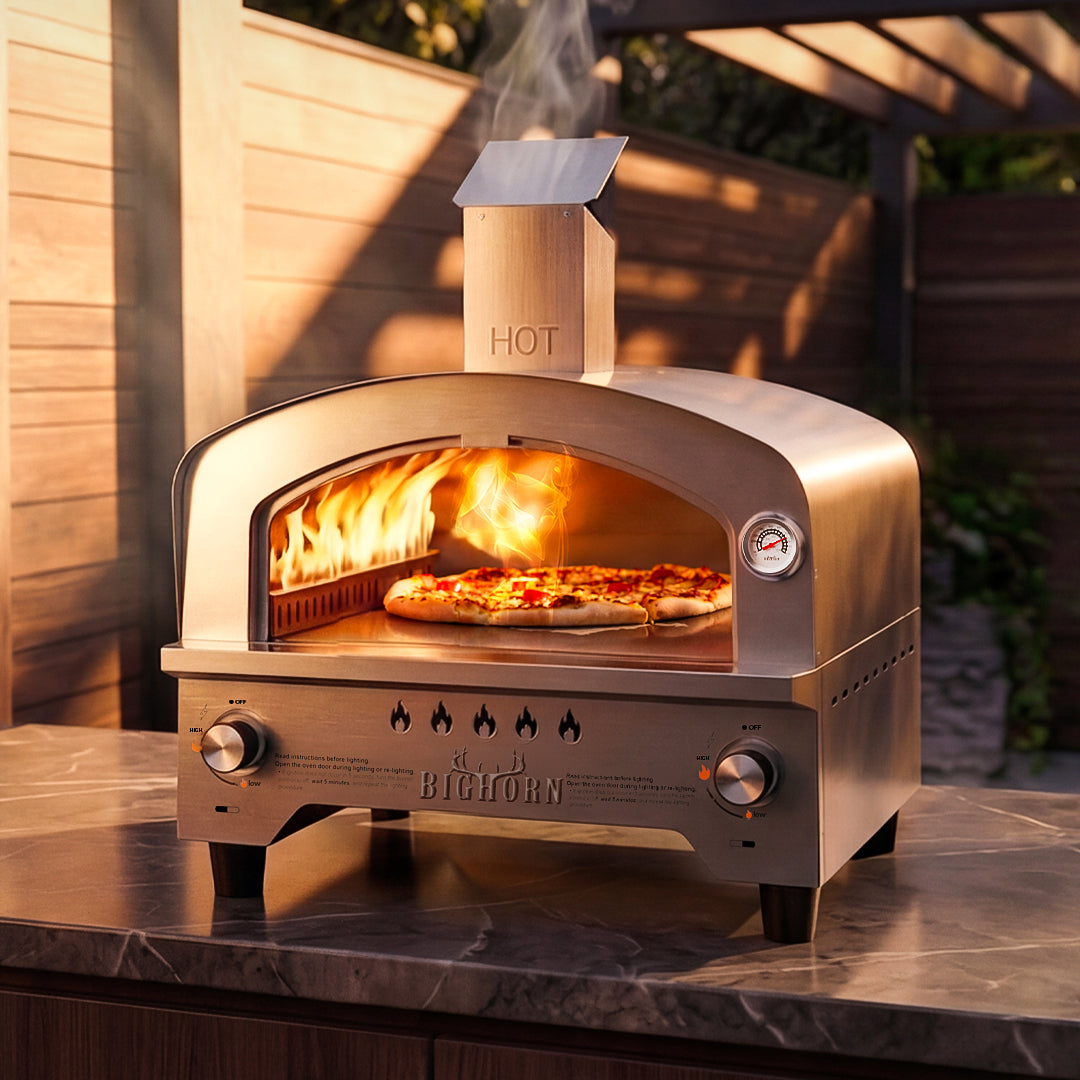
For example, the Big Horn Outdoors 12-inch wood-pellet pizza oven is a stainless-steel model with folding legs that weighs 24.9 pounds. Its verified listed performance includes an 18–20-minute preheat, temperatures up to 887°F, and 60–90-second pizzas under appropriate conditions. It can use separately sold gas-burner or electric-heater attachments, but those capabilities apply only to that specific 12-inch model and should not be assumed for other Big Horn Outdoors ovens.
The practical lesson is simple: choose the fuel and oven environment first, then decide whether rotation adds enough convenience for your cooking style.
Setup and heat management matter most
A rotating pizza oven is easiest to operate when it sits level, has adequate clearance, and is preheated long enough for the stone to store heat. Rotation improves consistency, but stable setup and controlled heat determine whether the pizza cooks through properly.
Before lighting an outdoor gas, pellet, or multi-fuel oven, place it on a sturdy, level, noncombustible surface. Outdoor ovens should be used only in the locations approved by their exact manufacturer instructions. Do not treat a covered patio, garage, tent, RV interior, or enclosed porch as equivalent to an open outdoor cooking area.
For a reliable pizza workflow:
- Assemble the oven and rotation components exactly as the manual directs.
- Confirm that the stone or tray is seated securely and rotates freely before cooking.
- Preheat long enough to heat the stone, not merely the air in the chamber.
- Shape and top one pizza at a time, keeping toppings restrained and evenly distributed.
- Dust the peel lightly; excess flour burns quickly and can create smoke.
- Launch the pizza near the center of the rotating surface.
- Watch the first pizza closely, even if the stone rotates automatically.
- Remove the pizza promptly with a peel, then allow the stone to recover before the next launch.
The first pizza is your calibration pizza. Its underside, rim color, and cheese browning reveal whether you need to adjust flame level, preheat duration, topping load, or bake time.
Big Horn Outdoors Expert Views
“A rotating stone is a practical confidence-builder, not a substitute for heat management. It can reduce the need to turn a pizza by hand and help distribute exposure to a concentrated flame or burner. For the best result, preheat the stone thoroughly, keep the pizza centered, use an appropriately sized peel, and watch the bake from launch to removal. Choose the oven format around your fuel preference and cooking location first; then select rotation if you value a simpler, more repeatable pizza workflow.”
Big Horn Outdoors began with a 2012 backyard-cooking challenge centered on reducing uneven heat, excess smoke, and unstable temperatures. That problem remains relevant to home pizza cooking: consistent results depend on how heat reaches the stone, crust, and toppings—not on any single feature alone.
Safety, cleaning, and maintenance
A rotating pizza oven still requires the same heat, fuel, and clearance discipline as any other pizza oven. Never leave an operating oven unattended, and always follow the clearance, fuel, ventilation, and cleaning instructions for the exact model.
For outdoor gas- or solid-fuel pizza ovens, keep the cooking area clear of dry leaves, paper products, spare fuel, gasoline, and other combustibles. Maintain the specific clearance distances stated in the manufacturer’s manual rather than relying on a generic number. Wind can affect flame direction, combustion, and heat distribution, so avoid using an oven in unsafe wind conditions.
Use long-handled pizza peels, heat-resistant gloves, and closed-toe shoes. Do not move an oven while it is operating or while surfaces remain hot. Keep children and pets outside the working zone.
After the oven cools completely:
- Brush away food debris and cooled ash according to the manual.
- Wipe the exterior with a suitable nonabrasive material.
- Keep the stone dry; avoid soaking it or using soap unless the manufacturer specifically allows it.
- Inspect rotating components for food debris, loose parts, or resistance before the next use.
- Check gas hoses, connections, and regulators before operating a propane model.
- Store removable accessories in a dry place and use a fitted cover only after the oven is completely cool.
Do not cut pizza directly on a rotating stone or coated rotating tray. Cutting can damage the surface and may create debris that interferes with smooth movement.
Is a rotating pizza oven worth buying?
A rotating pizza oven is worth considering if you want easier turning, more even browning, and a lower-skill workflow for fast-cooking pizza. It is most valuable for beginners, busy hosts, and anyone who finds manual peel turning stressful.
Choose a rotating model when you want:
- Less manual intervention during short high-heat bakes.
- More consistent rim browning around the pizza.
- A simpler process for serving multiple pizzas.
- Help managing an oven with a strong rear or side heat zone.
- A beginner-friendly bridge into live-flame pizza cooking.
Choose a fixed-stone model when you want:
- Maximum control over where food sits in the oven.
- Fewer mechanical components.
- A broader platform for pans, breads, roasting, or non-pizza cookware.
- A more hands-on pizza-making experience.
For Big Horn Outdoors shoppers, start with the cooking environment: outdoor pellet or gas, indoor electric countertop, or a verified compatible multi-fuel configuration. Next, match the oven’s size, portability, cooking capacity, and approved accessories to your space and menu. A rotating system is a useful convenience feature, but the best oven is the one whose fuel, location rating, and workflow fit how you actually cook.
Frequently asked questions
Does a rotating pizza oven cook pizza evenly?
Usually, yes. Rotation moves the pizza through the hottest part of the oven repeatedly, which can reduce one-sided scorching and promote more even browning. The result still depends on stone temperature, burner or flame setting, dough thickness, and topping moisture.
Do you still need a pizza peel with a rotating stone?
Yes. You still need a peel to launch and remove the pizza safely. A rotating stone reduces the need for a turning peel during the bake, but it does not replace the loading and retrieval tool.
Can a rotating pizza oven burn pizza?
Yes. Rotation helps distribute heat, but a pizza can still burn if the stone is too hot, the flame is excessive, the dough contains excess flour, or the pizza stays in the oven too long. Watch every bake, particularly the first pizza after preheating.
Is a rotating pizza oven good for Neapolitan-style pizza?
It can be. A rotating surface can help manage the intense, uneven heat used for thin, fast-baking pizzas. However, successful Neapolitan-style pizza still requires properly fermented dough, a fully preheated cooking surface, restrained toppings, and close attention throughout the bake.
Can every Big Horn Outdoors pizza oven use a rotating stone?
No. Do not assume rotating-stone capability, fuel compatibility, or accessory fit across the Big Horn Outdoors range. Confirm the features, included components, approved accessories, and operating environment on the official page and manual for the exact model you are considering.
Final takeaway
A rotating pizza oven is easier to use because it automates the turn that a cook would otherwise make with a peel, helping pizza pass through the oven’s hottest zone more evenly. It is a strong choice for beginners and high-volume backyard pizza nights, while fixed-stone ovens remain better for cooks who want total placement control.
Match your choice to your fuel preference, available space, portability needs, and confidence level. Choose pellet or gas for outdoor live-heat cooking, choose electric only when you need an appropriately rated indoor countertop format, and choose a rotating stone when simpler turning and more consistent browning matter more than fully manual control.