Yes—if you want an easier path to evenly browned, high-heat pizza and usually cook one 12- to 16-inch pie at a time. A rotating stone continuously moves the pizza through the oven’s hotter and cooler zones, reducing the need for manual turning. It is less essential for experienced pizza makers who enjoy using a turning peel and prefer a simpler oven with fewer moving parts.
By the Big Horn Outdoors Product Team
Published: September 28, 2026
A rotating stone pizza oven is not automatically “better” for every cook. It solves a specific challenge: high-heat pizza ovens often concentrate radiant heat near the flame or burner, so a pizza can brown—or burn—on one side before the rest of the crust finishes. A rotating stone changes the pizza’s position continuously, helping each section receive more balanced exposure to that heat.
For beginners, busy hosts, and propane users who prioritize convenience, that can be a meaningful advantage. For hands-on cooks who want full control over every turn, or buyers focused on the lowest price and simplest maintenance, a fixed-stone oven may be the better fit.
What Does a Rotating Pizza Stone Do?
A rotating pizza stone is a circular cooking surface that turns while the oven operates, moving the pizza through the oven’s heat pattern instead of requiring the cook to rotate it with a peel. Its main benefit is more uniform top browning when one side of the oven runs hotter than the other.
In a fixed-stone pizza oven, the side closest to the flame, burner, or hottest rear section receives the strongest radiant heat. That is useful for fast cooking, but it also means the pizza must be turned during the bake. At high temperatures, a delay of only a few seconds can leave one edge charred while the opposite side remains pale.
A rotating stone automates that movement. As the stone turns, the pizza repeatedly passes through the most intense heat zone. The goal is not to eliminate attention entirely; it is to reduce one of the most timing-sensitive jobs in high-heat pizza cooking.
This matters most for pizzas with thin centers, airy rims, and relatively short bake times. In these styles, the top surface can change quickly because the burner or flame radiates heat directly onto the dough, cheese, and toppings.
A rotating stone does not perform the job of a rotisserie. It will not flip food, stir toppings, or guarantee that every pizza is properly baked. Dough hydration, stretch, sauce quantity, topping moisture, stone temperature, and launch technique still determine whether the finished pizza has a crisp bottom and fully cooked center.
Is a Rotating Stone Worth It for Beginners?
A rotating stone is usually worth it for beginners because it reduces the skill required to manage uneven browning in a high-heat pizza oven. It is especially helpful when a pizza can bake in roughly 60 to 90 seconds, because manual turning becomes a fast, repetitive task.
Learning to turn pizza by hand takes practice. A cook must slide a turning peel beneath the pizza, lift the edge slightly, rotate it without tearing the dough, and set it down again before the section nearest the flame becomes too dark. That process becomes easier with repetition, but it can be stressful during an early pizza party.
A rotating stone gives new cooks more time to watch the crust, check cheese melt, and prepare the next pizza. It can also make the cooking process more approachable for people who want restaurant-style pizza without treating every bake as a technique drill.
Choose a rotating-stone pizza oven if most of the following describe you:
- You are new to high-temperature pizza making.
- You want more consistent browning with less manual turning.
- You cook for family gatherings, casual parties, or guests.
- You prefer propane convenience and straightforward ignition.
- You often cook while managing toppings, drinks, children, or other outdoor food.
- You would rather focus on dough and ingredients than peel technique.
A fixed stone may suit you better if you enjoy the craft of turning pizza manually, want the fewest mechanical components, or mainly cook lower-temperature pizzas that have longer bake times and give you more opportunity to turn the pie by hand.
Why Does Pizza Need to Rotate?
Pizza needs to rotate in many outdoor ovens because the heat is directional rather than perfectly uniform. Rotating the pizza prevents one edge from receiving excessive radiant heat while other sections lag behind in color and doneness.
Pizza cooks through several forms of heat transfer at once:
- Conduction transfers heat from the stone into the dough base, helping set the crust and create bottom browning.
- Radiant heat comes from the flame, gas burner, heated oven ceiling, and hot metal surfaces; it browns the rim and cooks toppings.
- Convection occurs as hot air moves through the oven chamber, contributing to overall cooking.
In a compact gas pizza oven, the burner arrangement can create a particularly strong heat zone near the rear or sides. That is not necessarily a flaw—it is part of how the oven generates intense heat quickly. But the pizza needs to move relative to that zone.
Manual turning accomplishes the same basic result as a rotating stone. The difference is who performs the movement.
A turning peel gives a skilled cook fine control. You can hold the pizza closer to the hottest zone to finish a pale area, turn it more slowly, or stop turning briefly to set a soft center. A rotating stone trades some of that hands-on control for repeatability and convenience.
The best choice depends on whether you value manual technique or reduced workload more highly.
How Does a Rotating Stone Compare?
A rotating stone and a fixed stone can both produce excellent pizza; the meaningful difference is workflow, not whether one surface is inherently capable of making good dough. The rotating design primarily reduces the need for frequent peel turns.
The following comparison focuses on practical ownership differences rather than claiming that one oven style is universally superior.
| Consideration | Rotating stone oven | Fixed stone oven |
|---|---|---|
| Pizza turning | Automated continuous movement | Cook turns pizza manually with a turning peel |
| Learning curve | Lower for new high-heat cooks | Higher, especially for fast-baking pizza |
| Browning consistency | Helps distribute exposure to a concentrated heat zone | Depends on turning technique and timing |
| Hands-on control | Less direct control over pizza position | Maximum control over where the pizza sits |
| Mechanical complexity | Includes a rotating mechanism and related parts | Fewer moving components |
| Best fit | Convenience-focused cooks and hosts | Technique-focused cooks and value shoppers |
The fixed-stone approach is not outdated or inferior. Many highly capable pizza ovens use a stationary stone, and experienced cooks can produce precise results by turning every 15 to 30 seconds as needed. The rotating-stone approach simply makes the process less dependent on that skill.
Consider the oven’s whole cooking system, not just the rotating feature. Burner layout, pizza capacity, stone material, fuel type, thermometer placement, ignition system, weather exposure, available prep space, and cleaning requirements can affect daily satisfaction as much as stone rotation.
Which Cooks Benefit Most?
A rotating-stone pizza oven is most useful for cooks who prioritize repeatable results, easy hosting, and less active manipulation during high-heat bakes. It is less necessary for cooks who make occasional pizza and enjoy developing manual peel skills.
Choose one for pizza parties
A rotating stone can simplify a party where several people want pizza in a short period. It reduces the need to pause conversation, watch the flame-side edge constantly, and execute repeated turns for every pie.
That does not mean the oven becomes unattended. Someone should still monitor the bake, remove the pizza when finished, and make sure the crust is not browning faster than the toppings are cooking. However, the rotating deck can reduce the number of manual interventions per pizza.
Choose one for propane cooking
Propane pizza ovens heat quickly and offer responsive flame control. Pairing gas with a rotating stone can be especially appealing for cooks who want a more predictable, button-and-knob-oriented pizza session rather than managing wood fuel and manually turning every pie.
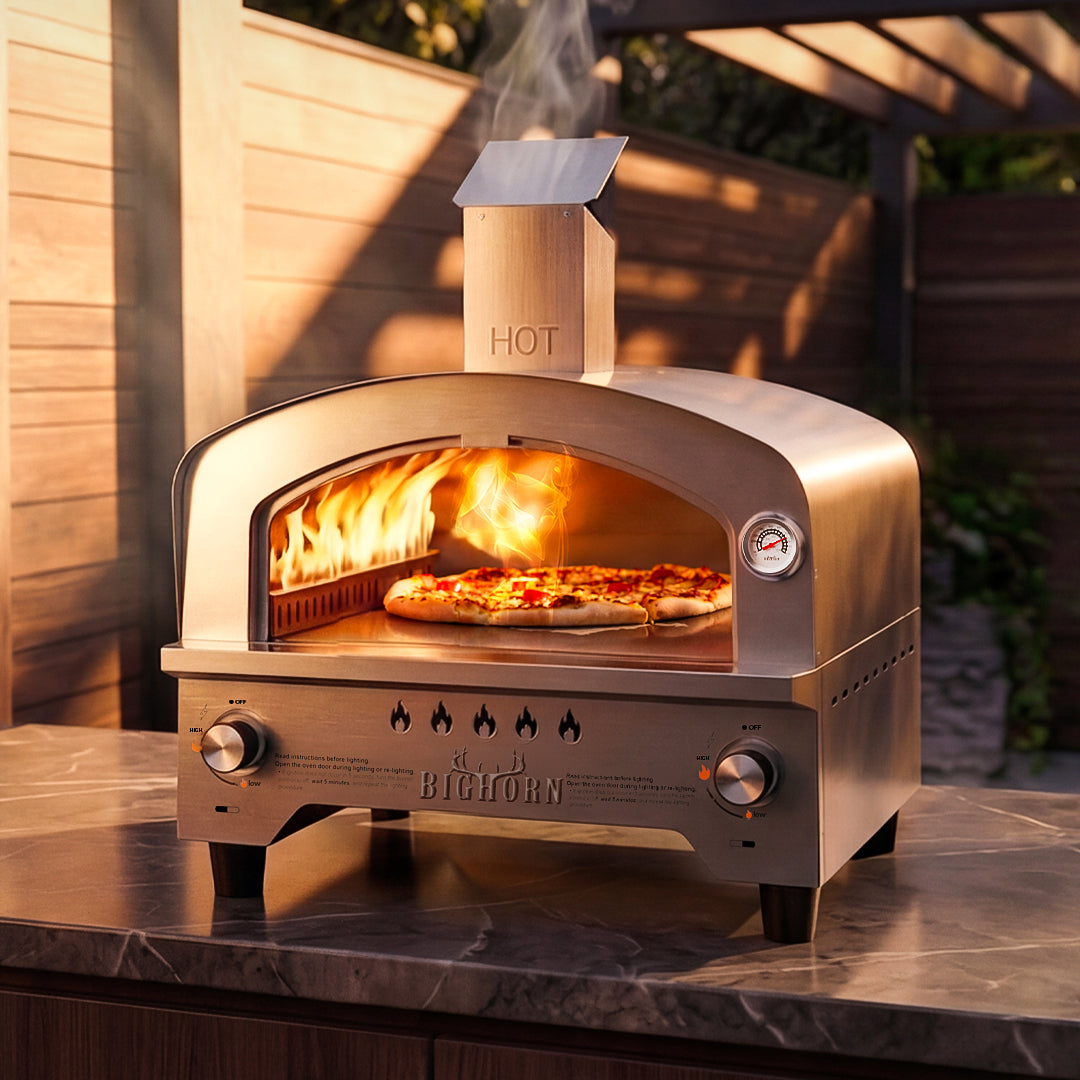
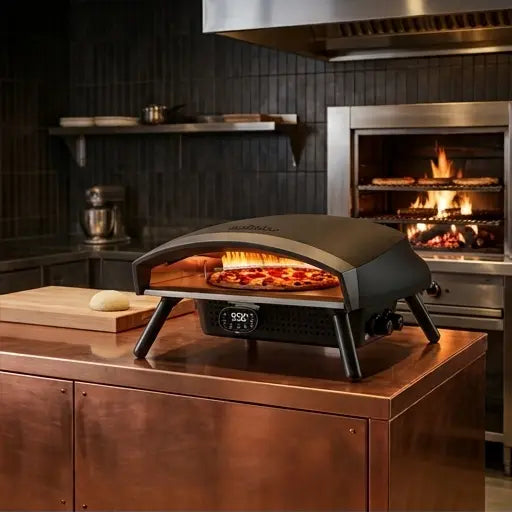
For example, the current Big Horn Outdoors 16-inch Gas Pizza Oven is an outdoor, propane-fired model with two gas burners, a 360° auto-rotating food-grade ceramic stone, a built-in digital thermometer, electric pulse ignition, and automatic flameout protection. The official product page lists a maximum 16-inch pizza size, 29,000 BTU of burner output, a 42-pound product weight, and a listed maximum temperature of 950°F after a stated 16-minute preheat. These are model-specific specifications, not universal attributes of rotating-stone pizza ovens.[bighornoutdoor]
Consider a fixed stone for craft and simplicity
A fixed-stone oven makes sense if you want to learn traditional pizza turning, want to spend less on features, or prefer fewer mechanical parts to inspect and maintain. A turning peel is inexpensive compared with the price difference that can exist between oven designs, and many cooks find the turning process enjoyable.
There is also a practical skill benefit: once you can manually turn a pizza, you can adapt to different ovens, fuel types, and heat patterns more confidently.
Fuel, Capacity, and Space Matter More
A rotating stone should be a deciding feature only after you choose the right fuel type, pizza size, and cooking location. An oven that fits your patio, fuel preference, and guest count will be more useful than one purchased solely for automatic rotation.
Start with fuel.
Propane is generally the most convenient fuel for cooks who value quick ignition, adjustable flame, and a relatively repeatable setup. It works well for weeknight pizza, backyard entertaining, and users who want to spend less time tending a fire.
Wood pellets can add live-fire involvement and a subtle wood-fired aroma, but they demand more attention to fuel quality, airflow, ignition, and fire management. A pellet oven with a fixed stone can still make excellent pizza, but it generally asks more of the cook than a gas model with automatic rotation.
Electric countertop ovens may suit indoor-capable cooking where the manufacturer explicitly approves that environment. They are a separate category from outdoor propane ovens and should never be treated as interchangeable. Always follow the exact model’s electrical, placement, ventilation, and weather-use instructions.
Then consider capacity. A 16-inch cooking surface provides room for larger pizzas, but it also requires more countertop area, storage space, and a stable outdoor setup. A smaller portable oven may be more appropriate for two-person meals, camping, RV travel, or a compact balcony where local rules and manufacturer guidance allow outdoor gas appliances.
Finally, assess your work area. You need a level, stable, noncombustible surface; room for a peel and turning tool; a landing space for hot pizzas; and enough clearance to operate the oven in accordance with the manufacturer’s instructions. Buying a feature-rich oven without a safe prep and cooking zone creates frustration before the first dough ball is stretched.
Big Horn Outdoors Expert Views
“A rotating stone is a practical tool, not a substitute for pizza fundamentals. It can reduce uneven browning by moving a pizza through the oven’s heat pattern, but the cook still needs properly fermented dough, a sufficiently preheated stone, restrained toppings, and close attention during the bake. Choose automatic rotation when consistent results and easier hosting matter more than practicing manual turning. Choose a fixed stone when you want maximum hands-on control and are willing to learn the oven’s hot zones.”
Big Horn Outdoors began with a backyard-cooking focus in 2012, centered on making high-heat outdoor cooking more manageable. That context is relevant here: the right pizza oven is not necessarily the most complex model. It is the model that matches how often you cook, what fuel you prefer, how much space you have, and how involved you want to be during each bake.
Safety and Care Essentials
A rotating-stone pizza oven must be used according to its exact manufacturer instructions, including its approved environment, fuel connection requirements, clearance guidance, and cooldown procedures. Automatic rotation does not make a high-heat appliance safe to leave unattended.
For outdoor propane ovens, use these practical safeguards:
- Operate only outdoors in an open, well-ventilated area when the model is designated for outdoor use.
- Place the oven on a stable, level, heat-resistant surface.
- Keep children, pets, loose clothing, and combustible materials away from the oven while it is hot.
- Inspect the propane hose, regulator, and connections before use; follow the manufacturer’s leak-check procedure.
- Use heat-resistant gloves and a long-handled peel when working near the oven opening.
- Allow the stone and metal body to cool fully before cleaning, covering, moving, or storing the oven.
- Do not spray water on a hot pizza stone; rapid thermal shock can damage a stone.
- Keep the rotating surface clear of loose flour buildup, food debris, and objects that could interfere with movement.
The Big Horn Outdoors 16-inch Gas Pizza Oven is listed for outdoor use and includes automatic flameout protection, but buyers should still read the current product manual before assembly and operation. Product pages can summarize features; the manual provides the model-specific operating and safety instructions that govern actual use.[bighornoutdoor]
Should You Buy One?
Buy a pizza oven with a rotating stone if you want less manual turning, more consistent browning, and a simpler path to high-heat pizza—especially when cooking for guests or learning on a propane oven. Choose a fixed-stone oven if you prefer lower mechanical complexity, hands-on control, and developing turning-peel technique.
A practical purchase decision looks like this:
- Choose rotating stone: You are a beginner, host pizza nights, want propane convenience, or dislike managing rapid manual turns.
- Choose fixed stone: You enjoy the craft, want a simpler appliance, cook pizza less often, or prefer to spend more of your budget on dough tools, fuel, and a sturdy outdoor prep station.
- Choose a larger oven: You regularly make 14- to 16-inch pizzas, feed groups, and have permanent or semi-permanent outdoor counter space.
- Choose a compact oven: You cook for one to four people, need easier storage, or want a more portable outdoor-cooking setup.
The most useful next step is to define your normal pizza session: how many people you feed, whether you prefer gas or live fire, where the oven will sit, and whether you want to practice turning pizza manually. Once those answers are clear, the rotating-stone question becomes straightforward rather than speculative.
FAQs
Do rotating pizza stones cook the bottom more evenly?
A rotating stone mainly improves how evenly the pizza is exposed to the oven’s directional top and side heat. Bottom browning still depends on stone temperature, dough formulation, launch timing, and how long the pizza remains on the cooking surface.
Can I still use a pizza peel with a rotating stone?
Yes. You still need a launch peel to place the pizza on the stone and remove it when finished. A turning peel may be less necessary during the bake, but it can remain useful for checking the underside or repositioning a pizza if needed.
Is a rotating stone good for Neapolitan-style pizza?
It can be helpful because Neapolitan-style pizza often bakes quickly and benefits from even exposure to intense radiant heat. However, the stone does not guarantee a Neapolitan result; dough hydration, fermentation, ingredient moisture, oven heat, and bake management remain essential.
Does a rotating stone make a pizza oven maintenance-free?
No. It adds a moving mechanism that should be kept clean and used as directed by the manufacturer. A fixed-stone oven has fewer moving parts, while a rotating-stone model may require more careful cleaning and inspection around the rotating assembly.
Is the Big Horn Outdoors 16-inch rotating-stone oven for indoor use?
No. The current official product page identifies the Big Horn Outdoors 16-inch Gas Pizza Oven as an outdoor model fueled by propane gas. Follow its current manual and all local requirements for outdoor gas-appliance operation.[bighornoutdoor]