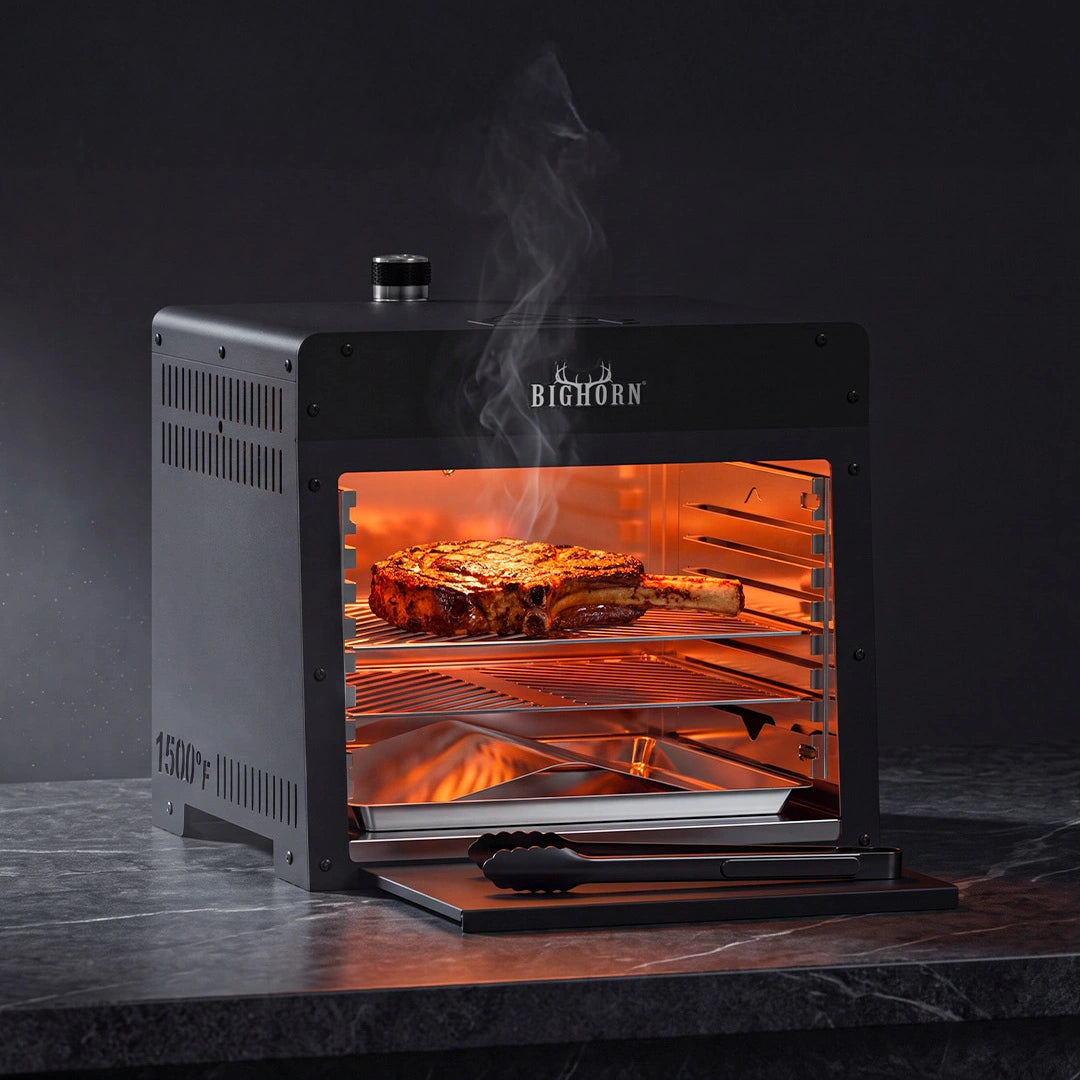

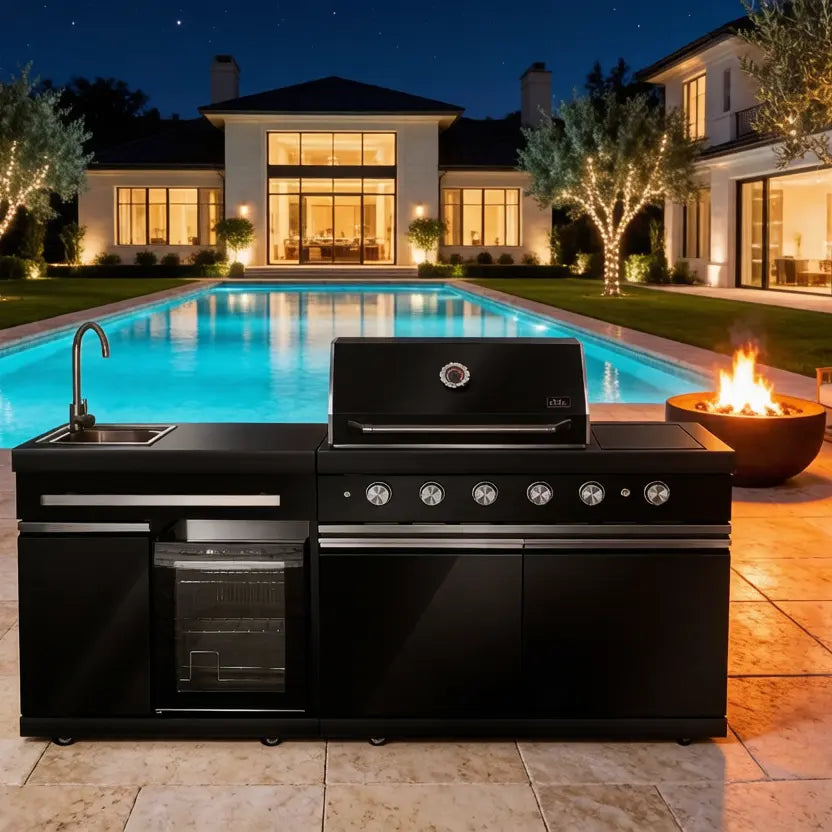
The best steaks for an infrared grill are thick, well-marbled cuts that benefit from a fast, intense sear: ribeye, New York strip, filet mignon, and tri-tip at 1–1.5 inches thick perform best because the infrared crust forms before the interior overcooks. The searing heat is the point — a 1500°F-class infrared grill builds a deep crust in tens of seconds — so the ideal steak is one with enough marbling and thickness to survive that window. This guide covers the cuts, the thickness, and the method that gets the best result.
These are general steak-cutting and technique guidelines for an infrared grill like the Big Horn 16-inch portable broiler; use a probe thermometer for doneness.
What actually matters for this decision
- Thickness. At least 1–1.5 inches gives the sear a window before the center overcooks.
- Marbling. Fat renders into flavor and stays juicy under the intense heat.
- Bone and shape. Even thickness sears evenly; a consistent shape is easier to manage.
- Temperature. A probe thermometer, not a timer, decides doneness on an infrared grill.
Understanding the heat before you decide
An infrared grill radiates intense heat directly onto the surface — the Big Horn 16-inch model reaches about 1500°F (815°C) on a 19,000 BTU ceramic burner — so the surface sears in tens of seconds while the interior stays cool. That is the ideal profile for a steak with a crust you can feel, but it punishes thin cuts (they overcook before the crust forms) and rewards thickness and marbling. The cut and the heat work together: marbled, thick steaks use the sear window to build a crust and finish by carryover.
The key factors, ranked
| Cut | Why it works on infrared | Best thickness |
|---|---|---|
| Ribeye | Well-marbled; renders juicy and sears fast | 1–1.5 in |
| New York strip | Firm, beefy, even shape | 1–1.5 in |
| Filet mignon | Tender; needs a fast sear to build crust | 1.5–2 in (thicker for margin) |
| Tri-tip | Big surface, great for a dual-burner zone | 1.5 in+ |
Matching the choice to your situation
If you want the classic steakhouse result with the least fuss, a 1–1.5 inch ribeye is the best starting cut — marbling survives the sear and the interior finishes reliably. If you prefer leaner meat, a New York strip holds up well; a filet needs extra thickness to give the sear room. For a bigger cook or a dual-burner grill, a tri-tip uses the wide zone. Match the cut to your preferred fat and thickness tolerance.
What the experts look for
Experienced infrared cooks choose steaks by thickness and marbling first — a uniform 1–1.5 inch cut with visible marbling uses the sear window best — and they season simply (salt, light oil) so the crust, not a rub, is the finish. They also use a probe: on infrared heat, doneness is a temperature number, not a timer. The cut that “works” is the one thick enough and marbled enough to take the heat.
Common mistakes and how to avoid them
- Choosing thin cuts. Thin steaks overcook before the crust forms; use 1–1.5 inch minimums.
- Loading sugary rubs. Sweet rubs burn bitter at 1500°F; season simply with salt.
- Ignoring the probe. At infrared temperatures, the thermometer is the only reliable doneness check.
- Overcrowding the grate. Stacking drops heat and steams the surface; cook in batches.
- Fixing a bad cut with technique. No technique rescues a thin, dry cut; pick the right steak first.
Realistic expectations and results
A well-marbled, 1–1.5 inch steak on a fully preheated infrared grill produces a deep restaurant-style crust in tens of seconds per side, with the interior finished to temperature at a lower rack zone. Expect fast crusts, juicy centers, and the need for attention and a probe. The result is the steakhouse-style sear that defines infrared cooking — with the right cut, it is repeatable.
The takeaway in one paragraph
The best steaks for an infrared grill are thick, well-marbled cuts — ribeye, New York strip, a thicker filet, or tri-tip at 1–1.5 inches — because they use the intense sear window to build a crust before the interior overcooks. Season simply, preheat fully, and use a probe. The cut and the heat work together, and the 1500°F-class crust is the result.
See the infrared grill that sears it best. Big Horn portable infrared broiler · infrared grill collection
FAQ
How to cook steak on an infrared grill?
Preheat fully so the stone and grates are hot, season simply, sear 60–90 seconds per side in the infrared zone for a crust, then finish at a lower rack zone or off the direct heat until the probe reaches your target (about 130–135°F for medium-rare). Rest before slicing.
What type of steak is best for grilling on an electric grill?
On an electric or contact grill, use steaks with even thickness (ribeye, New York strip, filet) at 1–1.5 inches, and preheat fully. An electric grill sears more gently than infrared, so thickness and a probe thermometer matter; marbling keeps the steak juicy.
Which infrared grill is best for steaks?
The best infrared grill for steak preheats fast, sears close to the emitter, and offers a lower zone for finishing. The Big Horn 16-inch portable broiler fits with a 19,000 BTU ceramic burner, ten rack positions, and a lower zone around 450°F; the 21.2-inch dual-burner model adds a wider zone.
What is the 3-3-3 rule for steaks?
The 3-3-3 rule is a simplified pan or griddle method: cook 3 minutes, flip, cook 3 minutes, then rest 3 minutes in foil. It is not designed for a 1500°F infrared grill, where the sear window is seconds; use a probe thermometer instead of a fixed timer.