







Gas Grills & Griddle Cooking
Spec sheets love big numbers. Shoppers ask whether more BTUs mean a hotter grill—and the honest version of gas grill BTU explained is that BTU measures fuel burned per hour, not the temperature on your steak.
Two grills with the same total BTU can cook very differently once lid design, burner layout, and cooking area enter the picture. Use BTU as one input, then judge heat where the food sits.
The honest answer: BTU measures fuel input, not heat on the steak
BTU is fuel energy per hour, not grate temperature.
A British thermal unit is the heat needed to raise one pound of water by about one degree Fahrenheit. On a grill badge, the BTU rating is how much propane or natural gas the burners can consume at full output in an hour.
That number tells you fuel appetite. It does not guarantee a hotter sear than a lower-BTU grill with a tighter lid, better burner spacing, or a smaller grate. Propane retailer guidance from Ferrellgas frames BTU the same way: useful for fuel math and rough sizing, misleading as a lone “power” score. When you shop gas grills and griddles, read BTU beside cooking area and burner count.

BTU per square inch: the number that is actually comparable
Comparing raw totals across different grate sizes is how shoppers get fooled. Divide total main-burner BTU by primary cooking area in square inches to get a rough intensity score.
Industry commentary often cites a ballpark of about 75 to 100 BTUs per square inch as a common shopping range for even outdoor cooking, with lower ratios feeling slower to recover and much higher ratios easier to scorch if airflow and lid design do not manage the heat. Treat those bands as conversation starters, not law. Wind, ambient temperature, and thermometer placement still move the reading on the grate.
Write the formula on the store tag: BTU ÷ primary square inches. A compact portable with modest total BTU can out-sear a huge canopy whose energy is spread thin.
Why heat retention and burner design change results
Lid height, firebox depth, burner shape, and grate material decide how much of that fuel energy stays on the food. Cast grates and tight lids hold heat; thin lids and wide gaps leak it into the breeze.
Even burner spacing reduces hot and cold stripes. Infrared burners deliver radiant energy differently from open flame tubes, which is why a sear station can brown a steak quickly without needing the highest total BTU on the cart. Construction quality—how the lid seals, whether wind guards help, whether grease management keeps burners clear—often explains why two “40,000 BTU” grills feel unlike each other on the same night.
For safe outdoor operation while you chase hotter grates, follow NFPA grilling fire-safety guidance and your manual’s clearances.
Typical BTU ranges by grill size (table)
These ranges describe common main-burner totals you will see on retail tags. Always confirm the plate on the model in front of you.
| Grill class | Typical total main-burner BTU | What it usually means |
|---|---|---|
| Portable / 1–2 burner | ~10,000–30,000 | Efficient for small grates; check BTU per sq in |
| Family 3–4 burner | ~30,000–50,000 | Everyday mixed grilling |
| Large 5–6 burner carts | ~48,000–60,000+ | More zones; higher fuel use on high |
| Island / multi-station | Varies widely | Sum of many burners and side appliances—read the breakdown |
Island products list large combined figures because they include side burners and extra stations. Compare the main grate’s share separately when searing is your priority. See current island configurations on the 6+2 burner outdoor kitchen grill island product page for how multi-station layouts are presented, and verify any BTU figure on that live page before treating it as a buying requirement.
Reading a spec sheet without getting fooled
Look for primary cooking area, number of main burners, whether side-burner BTU is bundled into the headline number, and whether the fuel type is propane or natural gas. Ignore marketing adjectives that are not tied to a measurable input or area.
Ask three questions: What is the main-burner BTU alone? What is the primary grate size? Does the lid and burner layout match how I cook—sear, roast, or both? If a sheet only shouts a huge total, request the breakdown. Price tags and sale stickers are not heat ratings; check the product page for current figures rather than memorizing a number from an ad.
Infrared burners: a different way of delivering heat
Infrared burners heat a ceramic or metal surface that radiates energy into the food. The cooking feel is closer to a steakhouse broiler than to a soft open flame under a wide grate.
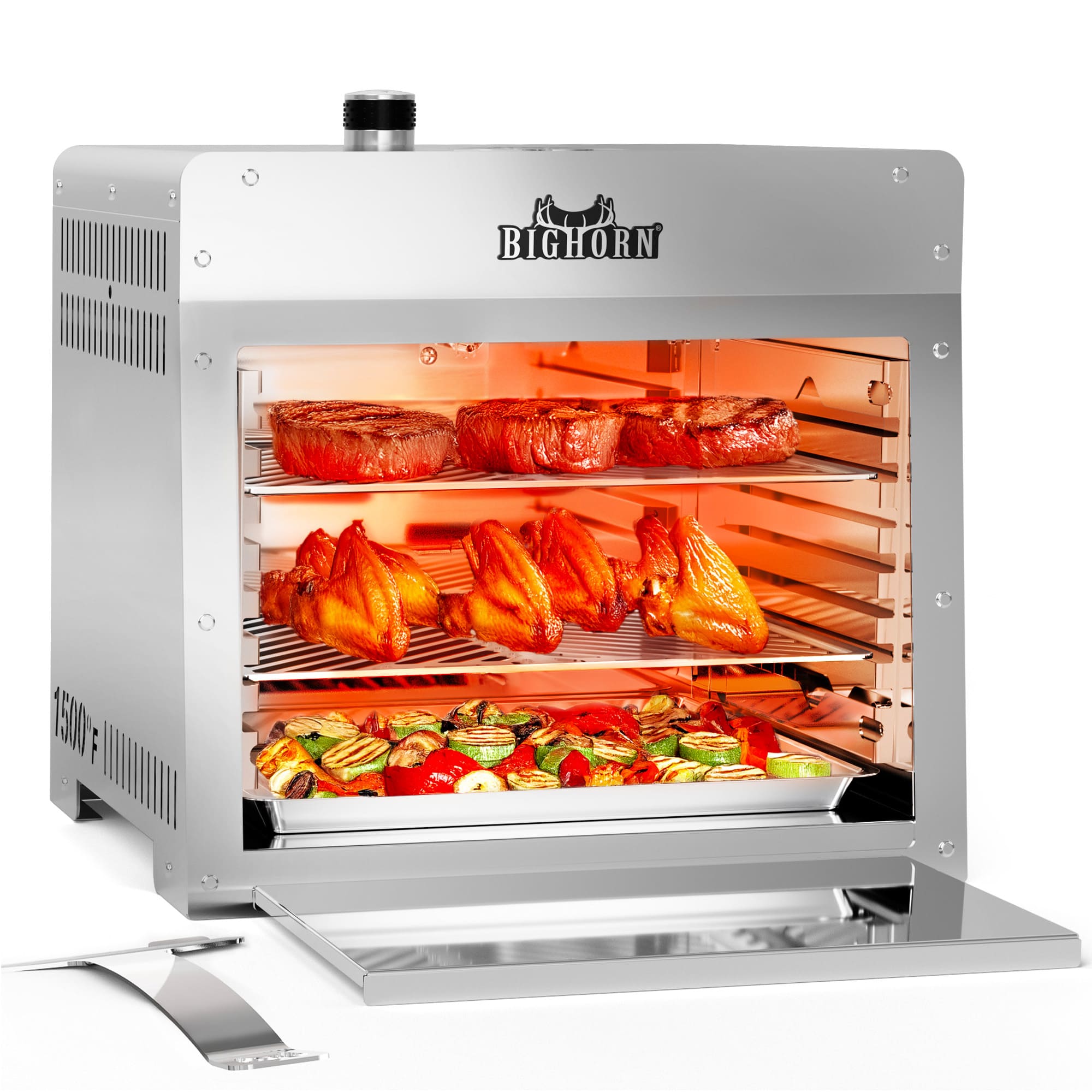
That is why a dedicated infrared station can brown a ribeye quickly even when its BTU number looks modest next to a giant six-burner canopy. You are paying for radiant intensity and focus, not for heating the entire backyard air volume. Explore how Big Horn presents infrared cooking on the infrared steak grill page, and compare radiant tools against conventional carts when crust matters more than maximum grate width.
Food still needs safe finishing temperatures—use a thermometer and follow USDA FSIS grilling food-safety guidance for poultry and ground meats.
When low BTU is a symptom (regulator, hose, tank)
If a grill that used to roar now feels weak, the label did not change—the fuel path might have. Low tank level, a frosted regulator on a cold day, a kinked hose, clogged burner ports, or a failing regulator can all mimic “not enough BTUs.”
Check the obvious outdoors: tank weight, valve fully open, hose condition, spider webs in the venturi, and grease blocking ports. Light burners with the lid open per the manual, and never chase performance by defeating safety devices. Household fire-readiness tips from Ready.gov and consumer education from the CPSC are worth a seasonal reread before you assume you need a bigger grill.
What is the BTU rating of the Weber Traveler?
About 13,000 BTU per hour on the main burner.
Weber’s published specifications for the Traveler portable gas grill (model examples such as 1501740) list a main-burner input around 13,000 BTU per hour with a primary cooking area near 320 square inches, based on Weber’s public product specifications as of 2026.
That modest total looks small next to backyard four-burners, yet it is sized for a compact portable grate. It is a useful reminder that BTU totals must be read with cooking area: a focused portable can cook efficiently without a billboard number. This article names the public spec for context only; compare attributes on paper and choose the grill that fits your space and menu. Natural-gas versus propane fueling questions for home kitchens are summarized at a high level by the American Gas Association.
Conclusion
Treat BTU as fuel input. Compare BTU per square inch, burner layout, and lid design before you crown a winner, and troubleshoot tanks and regulators before you replace a grill that suddenly feels weak.
When you are ready to compare layouts, browse Big Horn Outdoors Grills & Griddles and verify live product specs on each page.
FAQ
What is a good BTU for a grill?
A good BTU rating depends on grate size. Many shoppers look for a moderate BTU-per-square-inch range so the grill recovers heat without constantly scorching food. Judge the total beside primary cooking area, lid design, and burner layout. A compact grill with a lower total can outperform a huge canopy that spreads fuel thinly.
How many BTUs to boil water?
Boiling a pot of water outdoors depends on pot size, starting temperature, wind, and burner focus more than a single universal BTU number. Side burners on grills are convenient for pots, but they are not laboratory burners. Use a burner rated for pot cooking, shield it from wind, and keep the lid off the pot so you can watch a true rolling boil.
How much BTU is in propane?
A common industry figure is roughly 91,500 BTUs per gallon of propane, which is why a full 20 lb grill cylinder is often estimated around 430,000 BTUs of energy. Exact values vary slightly by source and temperature assumptions. Use the figure for planning burn time, then confirm your grill's hourly BTU rating from the data plate.
What is the BTU rating of the Weber Traveler?
Weber's publicly listed specifications for the Traveler portable gas grill cite about 13,000 BTU per hour on the main burner with a compact primary cooking area. That modest total matches a portable footprint rather than a full-size backyard canopy. Always recheck the manufacturer's current spec sheet for the exact model year you are considering.
Explore more in the Gas Grilling Guides.
More to Read
Fireproof Grill Mat Under Pizza Ovens and Infrared Grills
Place a fireproof grill mat to catch grease and sparks under ovens and grills. Confirm the live 48-by-30-inch claims, and use a cart when you need ...
No Oven Spring on a High-Heat Pie: Dough Temp, Launch and Floor
Diagnose no oven spring on a high-heat pizza by checking dough temperature, launch handling, and floor heat before you spend another mix changing t...
Heat-Resistant BBQ Gloves: Temperature Ratings and Wet-Grip Limits
Read a 1472°F glove rating as a short, dry, instant figure. Wet or oily conditions change grip, so let long peels reach into hot ovens and grills.
