Restaurant Style Pizza Oven Guide: Professional Performance for Backyard and Commercial Kitchens

ByJohn White
Share

The global demand for restaurant-style pizza ovens continues to surge as culinary enthusiasts and commercial operators look past standard kitchen appliances to chase perfect, blistering crusts. Achieving an authentic Neapolitan puff or a crispy New York slice requires thermal realities that domestic ovens simply cannot produce: instant ambient heat, high-convection air paths, and thick refractory cooking stones.

For buyers navigating the market, the decision matrix has evolved. It is no longer just about choosing between indoor or outdoor placement, but determining how a unit’s specific heating dynamics—whether gas-powered convection, wood-fired brick radiation, or high-volume electric decks—match their volume demands, skill levels, and fuel setups.

What is a Restaurant Style Pizza Oven?

A true restaurant-style pizza oven is a specialized high-heat thermal enclosure engineered to reach operational temperatures between 750°F and 1,000°F. By maintaining these intense thermal environments, these ovens flash-bake dough within 60 to 90 seconds, instantly trapping moisture inside while heavily caramelizing the exterior. This process depends on two foundational mechanisms: a dense ceramic or stone baking deck that pulls moisture from the dough, and a specialized dome shape or forced-air system that rolls intense heat directly over the toppings simultaneously.

Critical Pain Points in High-Heat Pizza Baking

Home cooks and professional pizzaiolos face identical structural obstacles when trying to replicate authentic pizzeria quality in a standard setting:

  • Thermal Loss and Recovery Lag: Standard kitchen ovens max out around 500°F and suffer massive temperature drops when the door is opened. When baking multiple pies sequentially, a standard deck loses its bottom heat, leading to pale, soggy under-crusts on subsequent bakes.

  • Uneven Browning and Hot Spots: High-heat environments naturally create localized intense heat points near the fuel source. Without manual, micro-managed turning or engineered stone rotation, one side of the pizza will char before the cheese melts on the other.

  • Fuel and Workflow Balance: Wood-fired models offer unmatched artisanal smoky aromas but demand active fire management, long preheating curves, and tedious ash cleanup. Conversely, gas and electric systems provide instant ignition and push-button repeatability but require clean fuel lines and steady power inputs.

The Definitive Pizza Oven Classification Matrix

To select the perfect system, buyers must understand the five primary archetypes of pizza ovens, their thermal profiles, and how industry-leading brands deploy them.

1. Traditional Brick & Refractory Dome Ovens

Brick ovens rely on thick, heat-absorbent masonry to store massive amounts of thermal energy. They operate using a signature "FlameRoll" design, where the fire draws heat up and over the curved ceiling, cooking the top via radiant energy while the floor handles the base.

  • Industry Benchmark: Chicago Brick Oven CBO-750 Hybrid. A dual-fuel countertop powerhouse utilizing commercial-grade refractory cement to comfortably exceed 1,000°F, mirroring the performance of traditional Italian brick structures.

  • Pros: Exceptional heat retention (up to 8 hours), authentic wood-fired flavor profiles, and zero recovery time between sequential bakes once saturated.

  • Cons: Extremely heavy, high initial cost, slow preheating cycles, and generally restricted to outdoor spaces.

2. High-Velocity Conveyor Ovens

Engineered for continuous production, conveyor ovens move pizzas along a automated stainless steel mesh belt through a fixed, high-heat chamber.

  • Impinger Technology: Utilizes forced-air gas or electric burners and internal fans to blast high-speed jets of heated air directly onto the pizza. This strips away the cold boundary layer of air surrounding the cold dough, reducing standard bake times by 20% to 30%. Highly ideal for high-volume, standardized operations.

  • Radiant Heating Systems: Employs heating elements placed rigidly above and below the conveyor belt without active air circulation, delivering consistent, predictable radiant heat for menus focused on simpler ingredient profiles.

  • Pros: Automated consistency, high hourly outputs (up to 100 pizzas per hour), and completely eliminates manual peel handling.

  • Cons: Minimal manual control over individual bakes, large floor footprints, and complex mechanical maintenance.

3. Professional Pizza Deck Ovens

The unquestioned golden standard for traditional New York-style pizzerias. Decks utilize heavy stone or ceramic tiles heated from below, with independent heat controls for the top and bottom of the chamber to manage crust crispness and cheese melt separately.

  • Commercial Benchmark: Bakers Pride Y-600BL Super Deck. A single-deck, gas-powered floor model featuring heavy stone decks and micro-adjustable dampers to distribute intense heat perfectly across high-volume commercial workflows.

  • Pros: Incredible durability, multi-deck stackability to maximize vertical space, and absolute precision over crust-to-topping bake ratios.

  • Cons: Requires experienced operators to manually slide and rotate pizzas with a peel; substantial warm-up times.

4. Compact Convection Pizza Ovens

Convection pizza ovens function by circulating super-heated air uniformly across multiple internal baking racks. They serve as compact, highly economical alternatives to full-scale brick or deck setups, acting like downscaled commercial kitchen ovens tuned specifically for fast ambient heating.

  • Pros: Fast heat-up cycles, highly economical energy footprints, and the ability to hold 2 to 5 baking racks simultaneously.

  • Cons: If overloaded with cold food, air circulation pathways can drop in efficiency, leading to uneven bakes or extended cooking times if time adjustments are mismanaged.

5. Professional Countertop Electric & Portable Gas Ovens

Perfect for low-volume businesses, catering, or premium backyard entertaining. These units leverage advanced modern insulation and compact burner configurations to pack commercial performance into a highly transportable or small-footprint chassis.

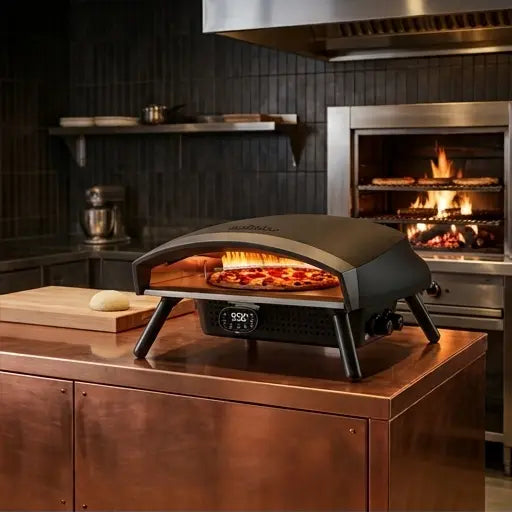
  • Outdoor Gas Benchmark: Ooni Koda 2 Gas Powered Outdoor Pizza Oven. Extensively praised by leading culinary testers like Serious Eats. It hits a blistering 950°F in just 20 minutes, baking a flawless 14-inch artisan pie in 60 seconds flat via advanced gas deck tech.

  • Indoor Electric Benchmark: Waring WPO500 Single Deck Countertop Oven. Hits 840°F on a standard kitchen electrical footprint, holding an 18-inch ceramic deck stone with independent top/bottom heavy-duty switches. For multi-pizza entertainment, the Waring WPO350 Double Deck version offers twin 14-inch stone chambers to double the workflow output.

  • Accessible Budget Benchmark: VEVOR Commercial Pizza Oven. A food-grade stainless steel countertop unit utilizing triple heating tubes for uniform 360-degree baking up to 662°F—perfect for beginner creators and small snack bars.

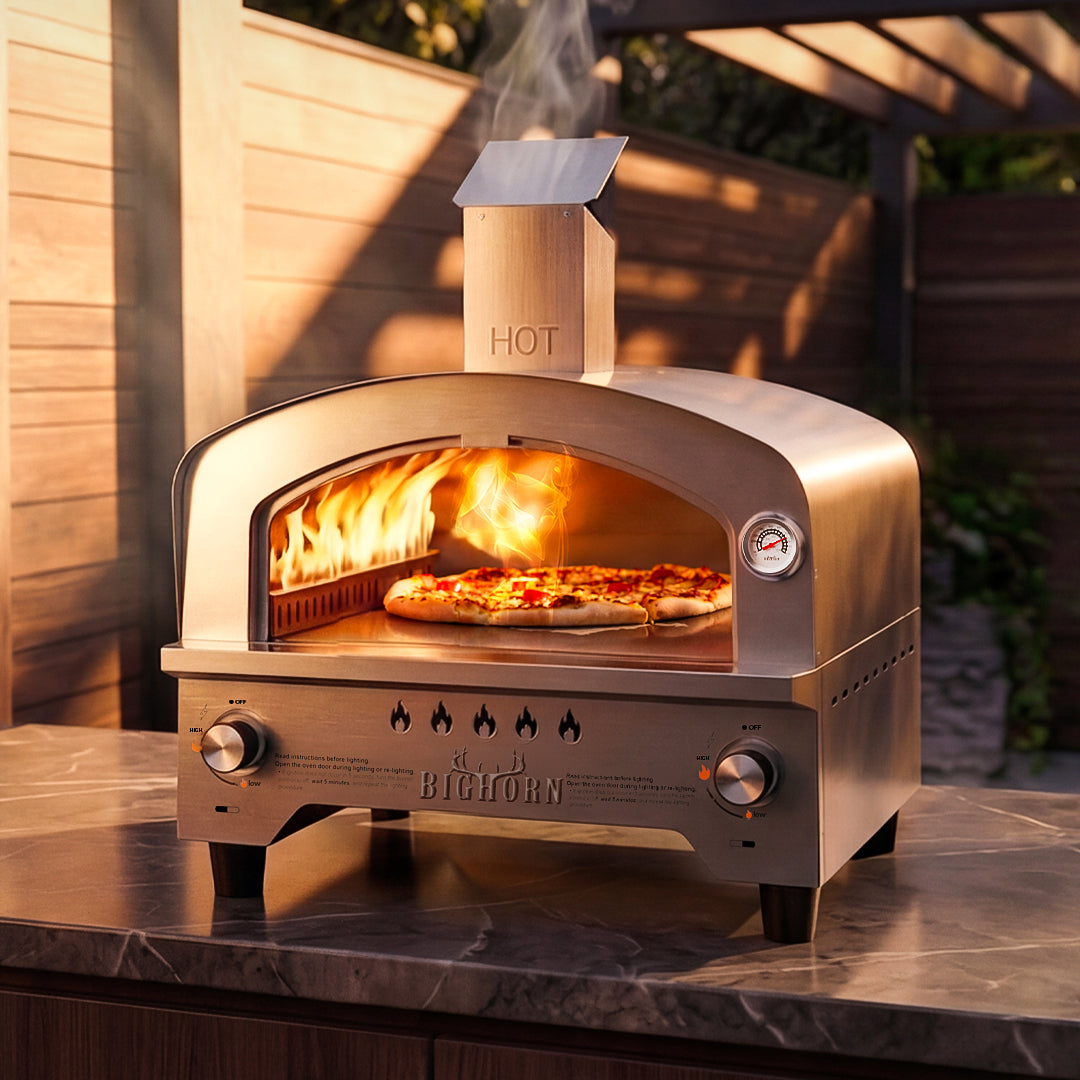
  • Automated Innovation Benchmark: Big Horn Outdoors 16” Gas Pizza Oven. Specifically engineered to solve user rotation errors by integrating an auto-rotating ceramic stone, electric pulse ignition, and an integrated digital thermometer for seamless backyard repeatability.

Deep-Dive Specification & Comparative Analysis

The table below breaks down how these elite options stack up against traditional household cooking appliances across core performance categories:

Oven Model & Type Peak Thermal Profile Speed Benchmark Primary Control Interface Portability & Footprint Ideal Target Audience

Chicago Brick Oven CBO-750


(Hybrid Brick)

Exceeds 1,000°F via refractory dome 60-second bake; zero recovery lag Dual-fuel manual valving & wood management Fixed, heavy outdoor masonry installation Luxury backyard hosts & artisanal chefs

Ooni Koda 2


(Outdoor Gas)

Hits 950°F inside a compact frame 60-second bake; 20-min preheat Micro-adjustable gas dial controller High portability; optimized for yard/camping Mobile caterers & casual enthusiasts

Bakers Pride Y-600BL


(Commercial Gas Deck)

High-intensity stable deck heat High-volume continuous production Independent top/bottom dampers & gas valves Fixed commercial floor appliance High-volume pizzerias & commercial kitchens

Waring WPO500


(Countertop Electric)

Reaches 840°F on stone base Rapid commercial workflow Independent top/bottom toggle switches Desktop footprint; indoor commercial grade Small snack bars, caterers, & indoor kitchens

Big Horn Outdoors 16"


(Automated Gas)

Up to 950°F with ambient dome wrap 60-90 second rapid bake Built-in digital thermometer & auto-rotating floor Portable outdoor chassis with folding legs Beginners seeking absolute repeatability

Standard Kitchen Oven


(Domestic Appliance)

Limited to 500°F - 550°F maximum 8-12 minute bake; severe thermal drops Basic digital display panel Fixed built-in domestic appliance Occasional home baking; non-pizza focused

Step-by-Step Guide to Achieving the Perfect Bake

To ensure professional results and eliminate common handling errors, use this sequence when operating high-heat pizza ovens:

The Baking Sequence

1.Thermal Saturation (Preheating):20 - 45 Minutes。

Fire your oven up to its target temperature. Do not rely solely on ambient air readouts; use an infrared thermometer gun to verify that the center of the ceramic cooking stone has fully saturated to at least 750°F.

2.Peel Preparation and Launch Setup:Keep it Dry。

Lightly dust a wooden or perforated aluminum pizza peel with a 50/50 mix of semolina flour and all-purpose flour. Assemble your pizza directly on the peel quickly to prevent the wet dough from absorbing the flour and sticking. Give the peel a gentle shake to ensure the pie slides freely.

3.The Launch and Thermal Management:The First 30 Seconds。

Slide the pizza onto the back-center of the preheated stone with a confident, smooth forward-and-back snapping motion. If using a manual unit, leave the pizza undisturbed for 30 seconds until the bottom crust sets and detaches from the stone. If using an automated model like the Big Horn 16-inch, engage the auto-rotating stone immediately.

4.Active Turning and Micro-Adjustments:30 - 90 Seconds。

Using a metal turning peel, rotate the pizza 90 degrees every 15 to 20 seconds to protect the edges closest to the main fire path from charring. Maintain this rotation cycle until the cheese is uniformly melted and the crust displays an even, speckled leopard-skin charring pattern.

Thermal Reality Check: Dough behaves drastically different depending on the baking surface temperature. At 500°F (standard oven), yeast dies slowly, forcing moisture to evaporate upward and drying out the dough. At 900°F (restaurant oven), water inside the dough vaporizes instantly into steam, expanding the gluten pockets to create an airy, ultra-light interior structure before the crust burns.

Choosing Your Pizza Oven Eco-System

The initial oven selection is only the core anchor of your setup; maximizing output and maintaining equipment life requires a dedicated ecosystem of accessories:

  • Launching and Turning Peels: Wooden peels are ideal for preparing and launching raw dough without sticking, while thin, perforated aluminum turning peels are required to slide under cooking pizzas smoothly to rotate them mid-bake.

  • Thermal Protection: High-heat outdoor setups require heavy-duty, weather-resistant covers to prevent moisture from absorbing into porous ceramic baking stones, which can cause cracking during subsequent high-heat expansions.

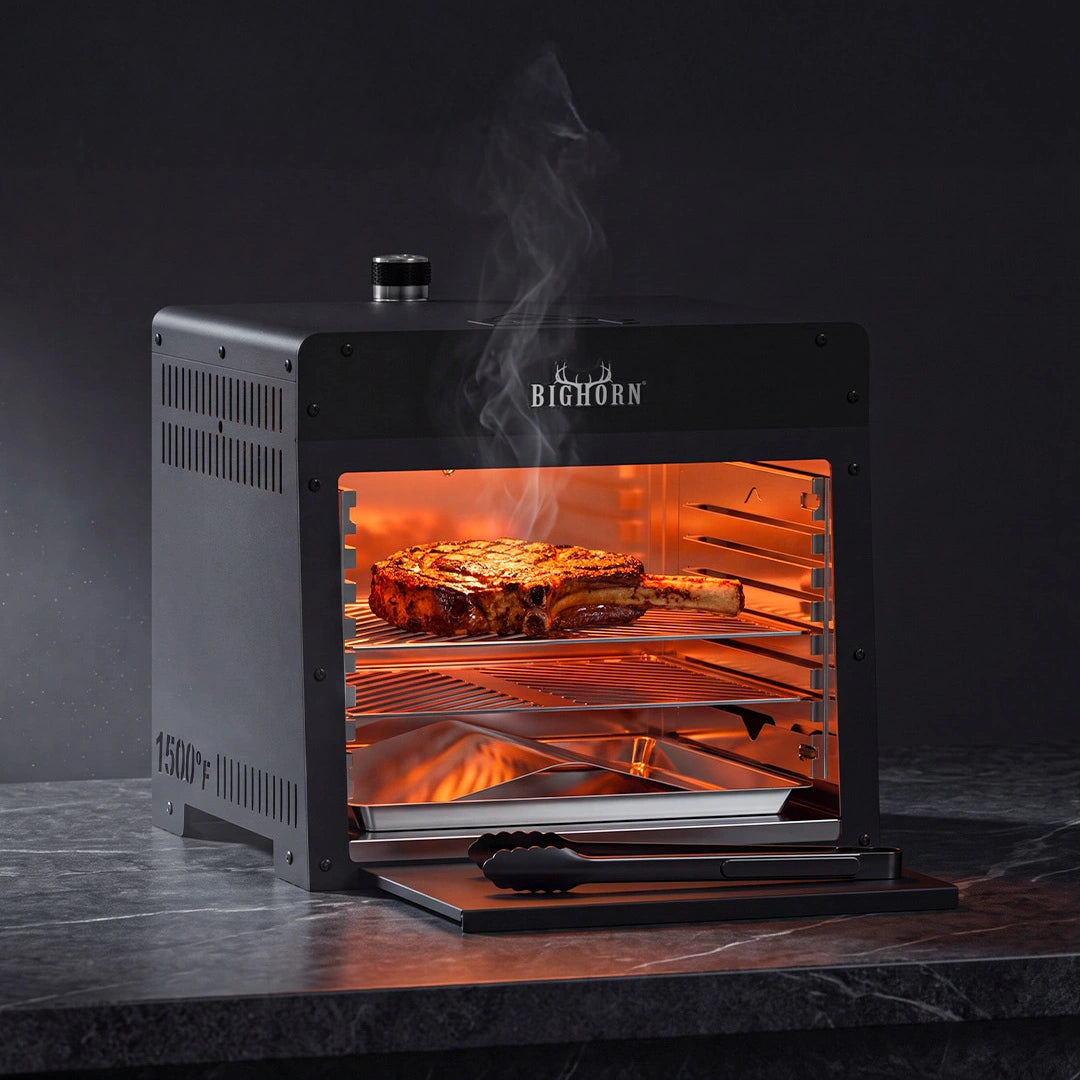
  • Cross-Over Kitchen Equipment: If you plan to expand your high-heat menu beyond pizzas, look into brands that offer companion lines—such as portable infrared grills capable of 1,500°F steak searing—which allow you to share propane lines and build out a cohesive cooking workflow.

Frequently Asked Questions

Why does a commercial pizza stone produce a crispier crust than a standard metal pan?

Commercial pizza stones are crafted from porous clay, cordierite, or ceramic refractory compounds. Unlike metal pans that trap moisture beneath the dough and steam it, these porous stones actively absorb microscopic moisture from the wet dough upon contact, flash-frying the bottom layer for a genuinely crisp finish.

What is the operational difference between gas and wood fuel?

Gas ovens prioritize speed, convenience, and absolute temperature precision via adjustable control knobs. Wood fuel introduces natural wood-ash aromas and traditional culinary romance but requires continuous fueling, manual airflow adjustments, and intensive cleanup.

Can indoor commercial electric ovens run on standard home outlets?

Compact options like the Waring WPO500 are specifically engineered to pull heavy thermal loads while matching standard electrical footprints, but operators must verify total amperage requirements to avoid overloading standard household kitchen breakers during continuous cycles.


More to Read

Rotating Stone Gas Pizza Oven: Is the Automation Worth It? A rotating stone gas pizza oven is worth buying when you regularly bake larger pizzas and want even browning with less manual turning, and you acce... 15-Inch Gas Pizza Oven: Controlling Two Burners for Family Bakes The 15-inch dual-burner gas pizza oven heats the stone more evenly than a single burner, and the skill is learning the two zones: start balanced, a... Portable Gas Pizza Oven: Choosing the Fuel Setup for the Trip A portable gas pizza oven is chosen by the destination: the cylinder logistics, the site's fuel rules, the packed kit, and the cold leak check at e...