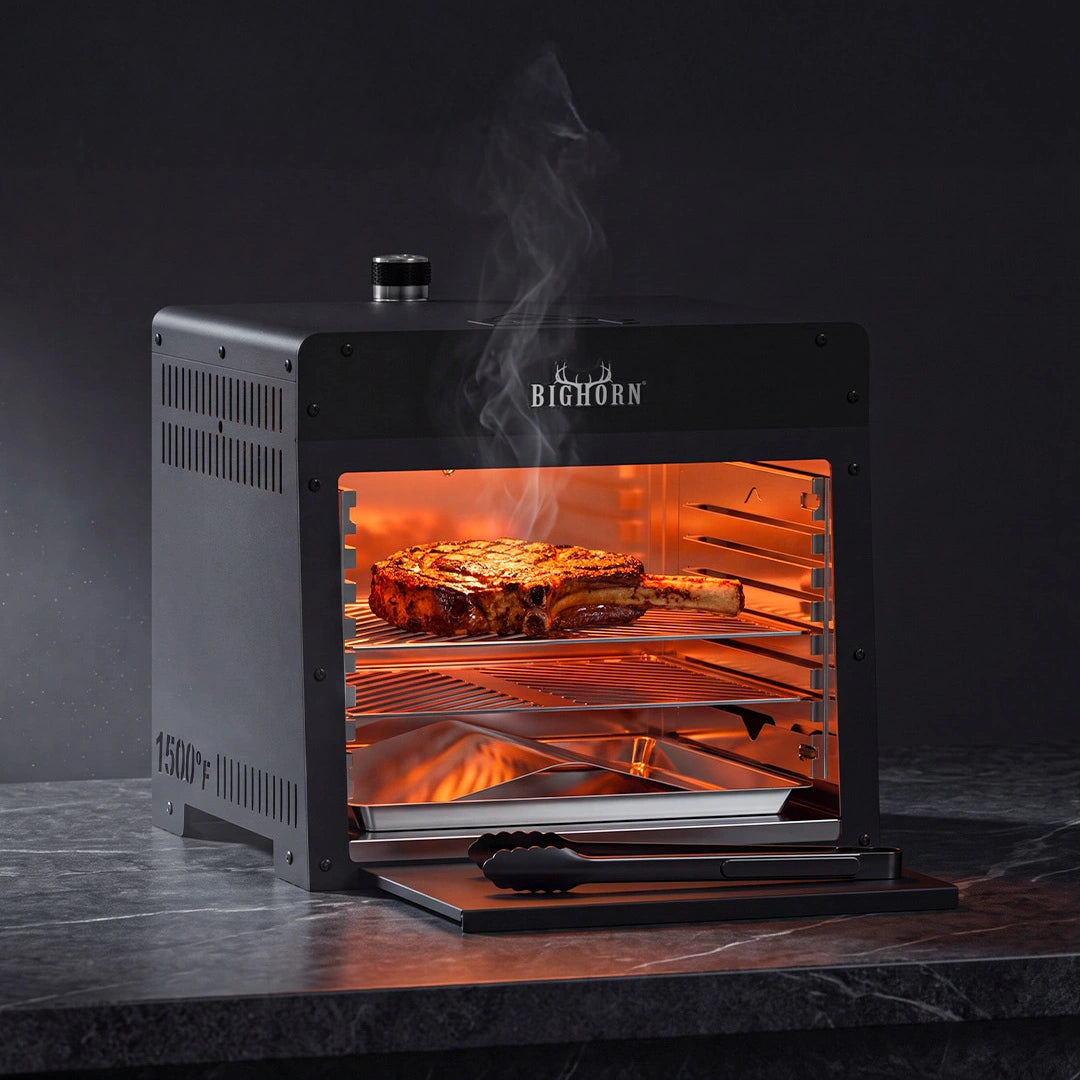
Because its 19,000-BTU infrared burner radiates intense heat directly onto the food. The Big Horn Outdoors 16-inch broiler climbs to 1,500°F in about 3 to 5 minutes, which browns the surface before the center overcooks — the same principle as a restaurant salamander. That concentrated, top-down heat produces the steakhouse crust in about 5 minutes.
What Is a 1500°F Infrared Broiler?
An infrared broiler is a gas cooker that radiates intense heat directly onto food instead of relying on hot air or an open flame. The Big Horn Outdoors 16-inch model pairs a 19,000-BTU infrared burner with top-down cooking, similar to a restaurant salamander.
The key difference is heat delivery. A standard gas grill heats food mostly through hot air rising from a grate below, which wastes energy and causes fat to drip onto burners. An infrared broiler converts gas into radiant energy that travels in straight lines to the food surface. That concentrated energy browns the outside of a steak almost immediately while the interior stays moist — the same principle professional kitchens use with overhead broilers. Because this model's heat comes from above, there is no open flame licking the meat.
How Fast Does a 1500°F Infrared Broiler Heat Up?
This model reaches about 1,500°F in 3 to 5 minutes, far faster than most residential gas grills, which typically top out near 500°F to 700°F. That higher ceiling means less waiting and a faster sear.
The temperature matters because browning accelerates as the food surface gets hotter and drier. At this heat level, the surface of a steak crisps in seconds, long before the center can overcook. The Big Horn Outdoors unit uses constant cyclic heating, meaning the burner holds its output rather than cooling between bursts, which keeps the cooking surface stable. The 19,000-BTU rating describes the burner's total energy output, concentrated over a compact cooking chamber for quick searing.
What You Can Cook in a Portable Infrared Broiler
It handles steak, seafood, chicken, vegetables, and pizza, using two stainless steel cooking grates, ten adjustable rack positions, and an included pizza stone. Moving food between rack positions lets you match the heat to each food.
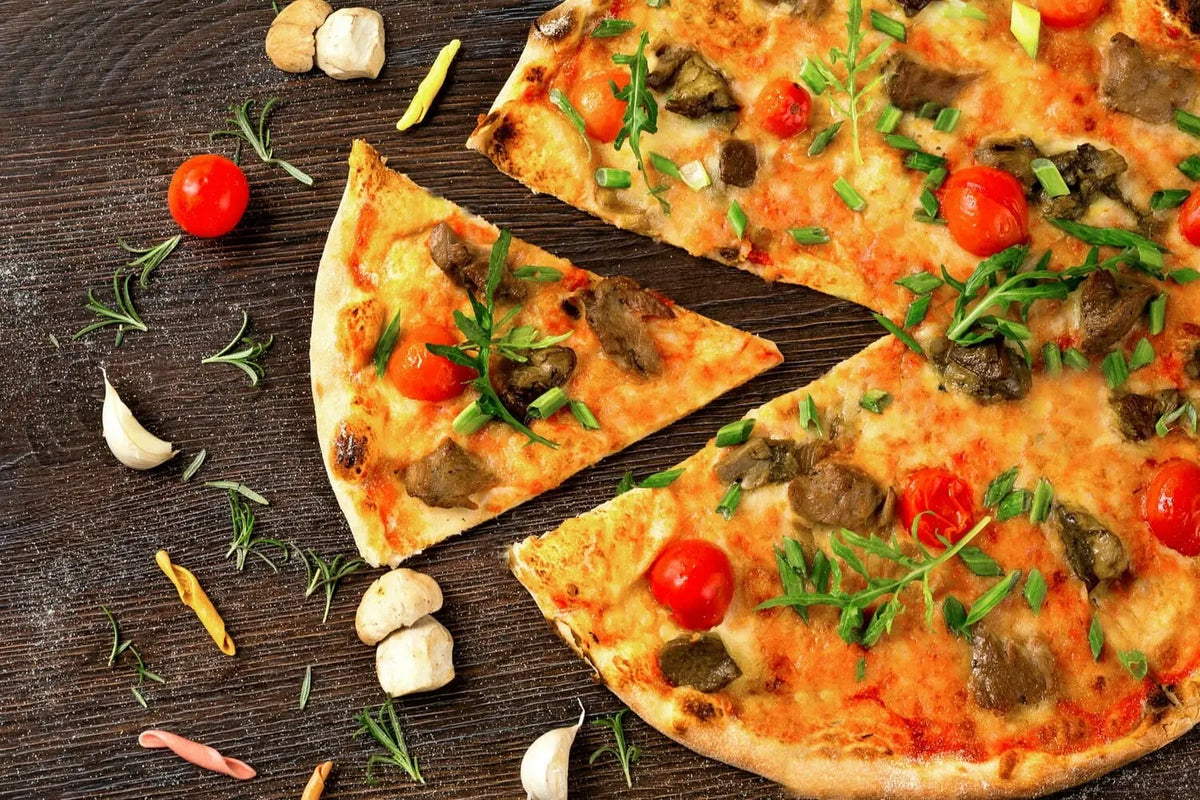
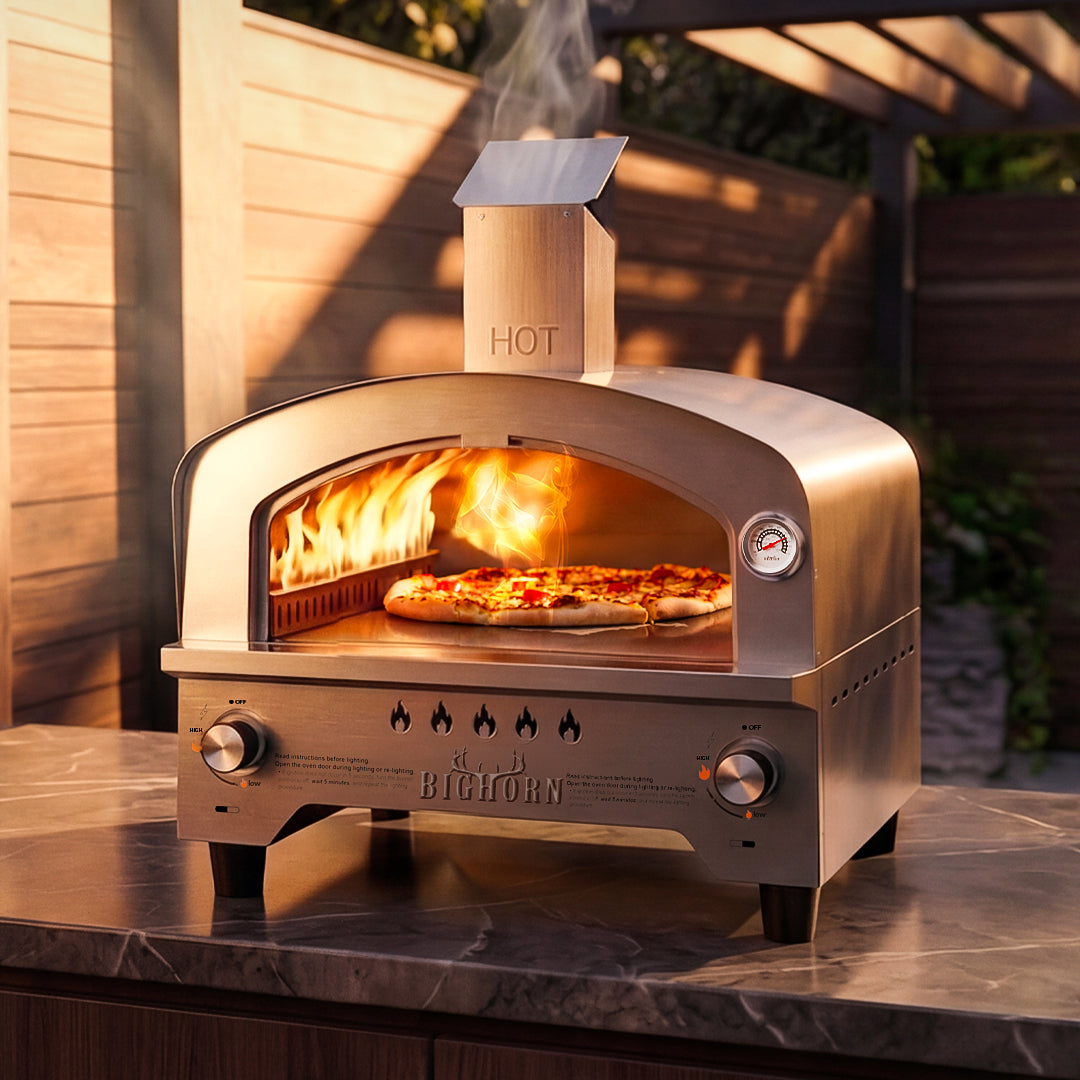
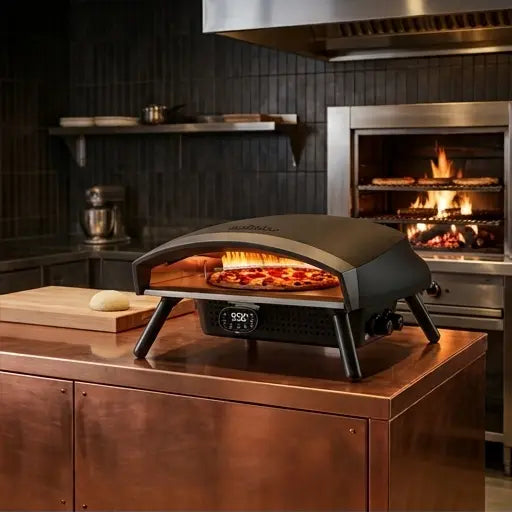
For a thick ribeye, start on a lower rack position to build internal temperature, then raise the food closer to the burner for a final crust. For salmon, a middle position crisps the skin without scorching. Vegetables do well slightly farther from the heat so they caramelize rather than burn. The included pizza stone turns the broiler into a high-heat pizza cooker, letting you bake a thin crust quickly outdoors. Because the grates and stone are removable, switching foods is straightforward.
Why Does Infrared Heat Sear Steak So Quickly?
Radiant heat transfers energy faster than hot air, so the surface browns while the center stays cooler. In practice, a 1.5-inch steak sears faster than a thin cut, and lowering the rack brings food closer to the burner for a harder crust in less time.
The practical takeaway is that crust and doneness are controlled separately. Distance sets how fast the surface browns, while time sets how far heat travels into the center. For a medium-rare result, sear close to the burner until the crust forms, then move the steak to a lower rack position or let carryover cooking finish the center during a brief rest. This also makes the broiler useful for reverse searing: bring the steak most of the way on a lower rack, then move it close to the burner for the final crust.
Key Facts
Big Horn Outdoors lists the following specifications at a glance.
- Time to full output: 3–5 minutes (Big Horn Outdoors' listed figure)
- Burner output: 19,000 BTU
- Steak: 1.25–1.5-inch ribeye, started on a lower rack position and finished close to the burner; target 130–135°F for medium-rare, then rest 5 minutes (the product lists "steak in as little as 5 minutes"). This is a doneness preference; the USDA safe minimum internal temperature for steak is 145°F with a 3-minute rest.
- Pizza: stone preheated with the oven, 12-inch thin-crust dough baked on the upper rack; cook until the base is browned and the cheese is melted
- Cleanup: grates and removable components washed after cooling; pizza stone hand-washed per the manual
Infrared Broiler vs. Conventional Gas Grill: Which Is Better?
For fast, intense searing with less flare-up, an infrared broiler is generally better. A conventional gas grill offers a larger cooking area for indirect or low-and-slow cooking, but it rarely matches the surface heat that gives steak its crust.
The two tools solve different problems, so the choice depends on how you cook.
| Factor | Infrared Broiler | Conventional Gas Grill |
|---|---|---|
| Peak heat | Around 1,500°F | Typically 500°F to 700°F |
| Sear speed | Steak in about 5 minutes | Slower, more flips |
| Flare-ups | Minimal | More likely |
| Cooking area | Compact (16-inch) | Larger grate |
| Best for | Searing, pizza, quick meals | Volume, indirect/low-and-slow |
If most of your cooking is searing steaks, fish, and vegetables for one to four people, the broiler is the more effective tool. If you regularly cook for a crowd and need low-and-slow zones, a larger gas grill is the better complement.
How to Prevent Flare-Ups
Trim excess fat, pat the surface dry, and move fatty cuts to a lower rack position. Because this broiler's burner sits above the food, drippings do not fall onto an open flame the way they do on a conventional grill.
The adjustable rack is the main control: if a cut is rendering a lot of fat, lower it one or two positions to slow the rendering and reduce smoke. Trimming thick exterior fat and drying the surface removes fuel and moisture that would otherwise sputter. Keep the cooking area clean so drippings do not build up and burn on the next cook.
| Food | Suggested Rack Position | Approach |
|---|---|---|
| Thick ribeye or strip | Lower to start, raise to finish | Sear, then rest |
| Salmon fillet | Middle | Crisp skin, avoid scorch |
| Chicken thighs | Lower to middle | Cook through, then crisp |
| Vegetables | Middle to upper | Caramelize without burning |
| Thin-crust pizza | Upper with stone | Fast high-heat bake |
How to Clean and Maintain an Infrared Broiler
Cleaning is straightforward because the cooking grates and other removable components are detachable. Wipe the stainless steel exterior with a mild cleaner after it cools, and clear drippings before each use.
Stainless steel is durable but shows residue, so wipe the front panel and handle while the surface is still slightly warm, using non-abrasive pads to avoid scratching. For the pizza stone, follow the product manual: porous stones often need hand-washing rather than a dishwasher. Any food that drips during high-heat cooking should be removed before it bakes on, which also reduces smoke on the next cook. Light cleaning after each session is easier and safer than a deep clean later.
How to Safely Use a Propane Infrared Broiler
Use it outdoors on a stable, heat-safe surface with clearance from anything flammable. This model measures 16 by 25 by 15.4 inches, weighs 32 pounds, and its stainless steel front panel helps protect nearby surfaces.
Because this model runs on propane, it is designed for outdoor use only and should never be operated in a garage, tent, or enclosed space. The stainless steel front panel shields the surface beneath it from radiated heat, which is useful on a patio or folding camp table. The 32-pound weight and compact footprint are light enough to move and set up at a campsite or tailgate while still feeling stable. Always place it on a level surface, keep the propane connection clear, and allow space around the vents for airflow.
When a 1500°F Infrared Broiler Is Not the Right Fit
Skip it if you regularly cook for more than about four people at once, if your main style is low-and-slow barbecue, or if you only have a small, poorly ventilated balcony. This model prioritizes fast, intense searing over cooking volume.
The broiler is a focused tool, not a general-purpose grill. Its 16-inch cooking area is ideal for searing a few steaks or baking a single pizza, but it will feel cramped if you are feeding a large group. If you mostly smoke brisket, roast whole birds, or need indirect heat, a larger gas or charcoal grill will serve you better. Match the tool to how you actually cook rather than to a single impressive temperature number.
Big Horn Outdoors Product Team
"Our evaluation focus for the 16-inch broiler is repeatability, not just peak temperature. We time the climb to full output against the listed 3–5-minute range, then sear the same steak thickness at the same rack positions to confirm the crust forms before the center overshoots. The top-down burner and adjustable rack matter most in daily use because they let a home cook move between searing and gentler cooking without rearranging the fire."
Conclusion
The Big Horn 1500°F infrared broiler reaches steakhouse temperatures because it pairs a 19,000-BTU infrared burner with top-down radiant heat that climbs to 1,500°F in minutes. That combination browns the surface fast while the center stays tender, which is why a steak can finish in about five minutes. Match it to high-heat searing for a small group, and pair it with a larger grill if you also need low-and-slow volume.
Key Takeaways
- 19,000 BTU of top-down radiant heat climbs to about 1,500°F in 3 to 5 minutes, browning the surface before the center overcooks.
- Rack position controls crust, while cooking time controls doneness, so you can sear hard or cook gently without changing burners.
- The included pizza stone and two grates turn it into a compact high-heat broiler for steak, fish, chicken, vegetables, and thin-crust pizza.
- It is a focused tool for small groups, best paired with a larger grill when you need low-and-slow volume or indirect heat.
- Outdoor propane use only, on a stable, heat-safe surface with clearance from anything flammable.
Questions to Ask Before Buying
- How many people do I typically cook for? The 16-inch chamber is ideal for one to four people, not large groups.
- Do I mostly sear, or do I need low-and-slow and indirect zones? This broiler wins on searing; a conventional grill wins on volume and indirect cooking.
- Where will I use it? It requires an outdoor, well-ventilated spot with stable, heat-safe clearance.
- Do I want pizza capability? The included stone makes high-heat pizza practical, but only one at a time.
FAQs
How long does a 1500°F infrared broiler take to cook a steak?
About 5 minutes for a medium-thickness steak, depending on cut thickness and rack position.
Is an infrared broiler better than a gas grill for steak?
For fast, intense searing with less flare-up, yes. A gas grill is better for volume and indirect cooking.
Can I use a 1500°F infrared broiler indoors?
No. It is propane-fueled and designed for outdoor use only, with proper clearance and ventilation.
Is the pizza stone included?
Yes, the Big Horn Outdoors 16-inch model includes a pizza stone along with two stainless steel cooking grates.
Sources
- USDA FSIS, "Safe Minimum Internal Temperature Chart" — Safe Minimum Internal Temperature Chart
- NFPA, "Grilling Safety" — Grilling Safety