Why Standard Home Ovens Fail
The journey to crafting the perfect artisan pizza does not begin with an impulse to buy heavy outdoor equipment. It begins with culinary frustration: pale, soggy crusts, under-cooked bases, over-processed toppings, and agonizingly slow bake times.
The structural barrier between a mediocre homemade pizza and an authentic, restaurant-quality Neapolitan pie boils down to pure, unadulterated physics: thermal intensity and heat distribution.
Standard indoor kitchen ovens max out at a modest 500°F. At this low temperature, a pizza takes 10 to 15 minutes to bake, drying out the dough and turning the crust brittle rather than airy. To achieve a true Neapolitan pie featuring a light, blistered, and "leopard-spotted" crust (cornicione), you require a specialized cooking environment that reaches a minimum of 700°F to 900°F or more. At this intense heat threshold, a pizza flash-cooks in exactly 60 to 90 seconds. This rapid bake locks moisture inside the dough while instantly melting cheese and caramelizing toppings without dehydrating them.
+-----------------------------------------------------------------------+
| THERMAL PERFORMANCE GAP |
+-----------------------------------------------------------------------+
| Standard Kitchen Oven: Max 500°F (Bake Time: 10-15 Mins) -> Soggy |
| |
| Big Horn Outdoors Oven: 700°F-900°F+ (Bake Time: 60-90 Secs) -> Perfect|
+-----------------------------------------------------------------------+
However, high temperature alone is useless without balance. True wood-fired performance relies on three distinct types of heat working simultaneously:
-
Conductive Heat: Stored directly within a thick, high-density cordierite baking stone to flash-bake the bottom crust from the moment it lands.
-
Convective Heat: Driven by proper ventilation and internal airflow, pulling a rolling flame across the low dome ceiling to cook the toppings from above.
-
Radiant Heat: Emitted down from the insulated interior walls of the oven dome to ensure an even, uniform cook across the entire pie.
Without a dedicated, highly insulated portable outdoor pizza oven, replicating this precise multi-directional thermal balance is physically impossible.
Market Dynamics: The Paradigm Shift in Outdoor Cooking
The residential outdoor cooking market is experiencing unprecedented structural growth. Driven by a permanent consumer shift toward premium backyard hosting and hyper-authentic culinary experiences, the portable outdoor pizza oven category is expanding rapidly across residential spaces. Market forecasts point to continued growth in pizza ovens and portable outdoor pizza ovens, clustering around healthy mid-single-digit to double-digit CAGRs.
This market expansion has transformed the portable pizza oven from a niche, seasonal novelty into a fundamental backyard upgrade. As engineering has advanced, the industry has seen massive updates to safety and performance benchmarks. The implementation of updated gas appliance standards continues to underscore a critical industry truth: as outdoor cooking equipment scales down in size, safety mechanisms, surface temperature boundaries, and fuel control systems must scale up.
For modern buyers, navigating this landscape means balancing traditional fire-driven authenticity with cutting-edge engineering, reliable insulation, and flexible fuel systems that match real-life routines.
The Big Horn Outdoors Product Ecosystem
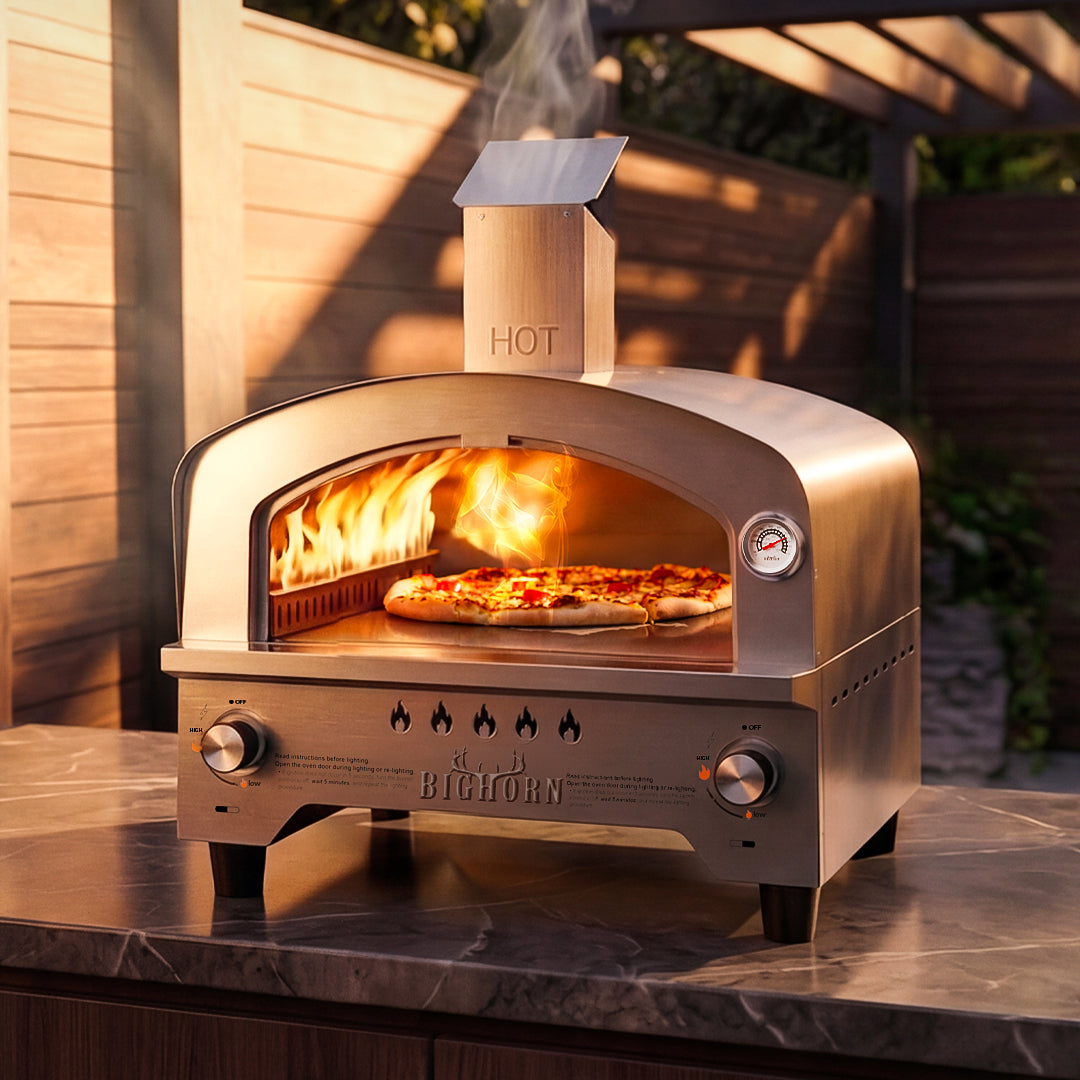
To find the perfect fit for your outdoor kitchen, patio, or camping setup, you must evaluate how different product configurations serve your specific culinary goals. Big Horn Outdoors builds durable backyard cooking tools designed around a broad price band ranging from about $99.99 to $359.99 USD and up, ensuring accessibility for casual buyers and performance-focused outdoor cooks alike.
12" Pellet & Gas Pizza Oven (The Hybrid Pioneer)
Engineered for buyers who want ultimate fuel flexibility without committing to a single format. This hybrid oven allows users to switch between pellet and gas modes without tools, which is useful for cooks who want rich, fire-driven flavor on one day and instant simplicity on another. It packs dual-fuel convenience into a highly mobile frame.
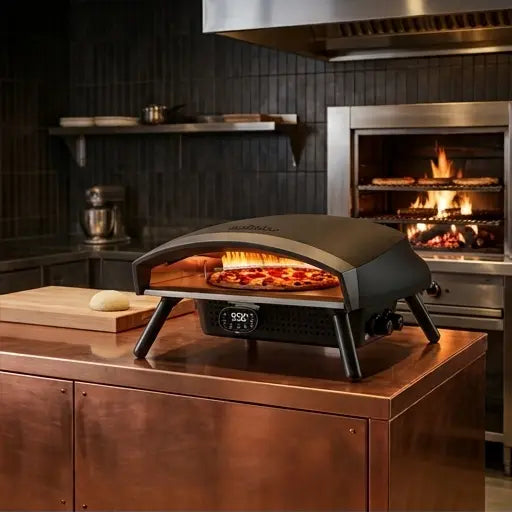
12" Portable Gas Pizza Oven, Black (The Fast-Casual Champion)
Designed for fast, simple backyard use. This model prioritizes quick heat-up times and easy flame control, dropping the learning curve for beginners to zero. It delivers a beautifully textured crust in a streamlined, sleek black aesthetic that fits seamlessly onto any patio table.
16” Gas Pizza Oven (The Heavy-Duty Entertainer)
Built for larger pies and completely hands-off cooking. This premium addition to the collection features an innovative auto-rotating pizza stone, an integrated mechanical thermometer, and full CSA safety certification. The automated rotation completely removes the stress of manually turning the dough, ensuring perfectly even browning under intense convective heat.
Deep-Dive Engineering Analysis: What Makes Big Horn Great?
When analyzing a portable pizza oven, look past basic aesthetics and evaluate five foundational pillars of thermodynamics and industrial design practiced across the Big Horn Outdoors collection.
Heat Retention and Insulation Architecture
An oven's ability to absorb and store thermal energy determines whether you cook a flawless pie or burn the toppings while leaving the base raw. Big Horn Outdoors utilizes premium stainless steel construction engineered with high-density insulation principles.
This creates a thermal barrier that traps intense heat inside the cooking chamber while maximizing fuel efficiency. Superior heat retention guarantees ultra-fast heat recovery times—meaning that when you remove one pizza, the stone surface bounces back to optimal temperature within seconds, allowing you to bake multiple pizzas back-to-back without frustrating temperature drops.
+-----------------------------------------------------------------+
| DOUBLE-WALLED INSULATION PROFILE |
+-----------------------------------------------------------------+
| [Outer Stainless Steel Shell] -> Durable Shield |
| [Engineered Insulation Barrier Layer] |
| [Inner Heavy-Gauge Stainless Steel Wall] |
| =======> TRAPPED RADIANT HEAT (700°F-900°F+) <======= |
+-----------------------------------------------------------------+
Advanced Airflow and Ventilation Aerodynamics
Proper ventilation is the unsung hero of a 60-second bake. High-performance pellet-burning and gas models employ precisely calibrated combustion chambers and air intake channels.
Good airflow acts as a supercharger: it pulls fresh oxygen directly over the fuel source, drives the flame upward, and rolls it smoothly across the top ceiling of the dome. This convective loop ensures that the top toppings cook at the exact same rate as the bottom crust, preventing uneven hot spots.
Fuel Thermodynamics: Choosing Your Heat Source
The fuel you burn dictates both your workflow and the sensory profile of your food.
-
Hardwood Pellets: Highly efficient, easy to ignite, and self-feeding. They deliver a consistent, clean, high-BTU heat with minimal ash buildup, imparting a natural smoky flavor.
-
Propane Gas: The ultimate choice for absolute convenience and precision. It offers instant ignition, zero ash cleanup, and precise flame adjustment with the turn of a dial.
-
The Hybrid Approach: Hybrid models allow you to jump between both worlds seamlessly, satisfying traditional flavor cravings on slow weekends and gas convenience on busy weeknights.
The Physics of the Cooking Surface
The thickness and material composition of your pizza stone are critical. Big Horn Outdoors uses high-grade cordierite pizza stones that are highly thermal-shock resistant, meaning they will not crack under extreme temperature swings.
A larger cooking surface, like the one found on the 16" model, provides two distinct advantages over compact spaces: it allows you to easily cook larger family-sized pies, and it creates accessible differential heat zones where you can push cast-iron skillets closer to or farther from the primary flame bank.
Safety Metrics and Structural Stability
Operating an outdoor appliance at near 900°F requires absolute mechanical stability. Big Horn Outdoors designs its lineup around heavy-duty folding legs, compact dimensions, and outdoor-ready construction that require tool-free assembly. This layout ensures a low center of gravity that won't wobble on patio tables or camp setups, while meeting stringent modern safety and surface control expectations.
Fuel Masterclass: Selecting Wood Pellets for Heat and Flavor
When operating pellet-burning configurations, the pellets you choose are an actual ingredient, directly influencing heat output and aroma.
-
The Gold Standard (100% Hardwood Pellets): Always use premium food-grade cooking pellets made from Oak, Hickory, Ash, or Maple. These dense woods burn clean, leave minimal ash, and maintain a steady, intense heat output. Oak provides a neutral, classic profile, while Hickory offers a bolder, robust backyard aroma.
-
The Heating Pellet Danger Zone: Never use commercial home-heating pellets. These are not food-grade and often contain binders, softwoods, or chemical additives that create toxic, bitter smoke, ruining your food and coating your cordierite stone with resin.
-
Moisture Control: Keep your wood pellets stored in an airtight container. Humid or damp pellets expand, crumble, and fail to light efficiently, leading to sub-optimal temperatures and excessive smoke.
Operation Guide: From First Unboxing to Master Fire Tender
+-----------------------------------------------------------------------------------------+
| OUTDOOR FIRE TIMELINE |
+-----------------------------------------------------------------------------------------+
| [Hour 0: Setup] -> [Hour 1: Low Curing Fire] -> [Hour 3: Cool Down] -> [Ready for 900°F] |
+-----------------------------------------------------------------------------------------+
| * Curing removes moisture & prevents thermal shock cracking * |
+-----------------------------------------------------------------------------------------+
Step 1: Structural Placement and Safety Clearance
Position your oven on a completely flat, stable, non-combustible surface such as a concrete slab, stone patio table, or dedicated metal utility cart. Never operate a high-temperature oven on unprotected wooden decks or under low hanging tree branches, canvas awnings, or covered balconies. Maintain ample clearance on all sides.
Step 2: The Initial Conditioning Process
Before cooking your very first pizza, it is highly recommended to fire the oven once to burn off any manufacturing residuals. Build a moderate fire or turn on the gas burner to a medium setting. Let it run steadily for 20 to 30 minutes. This process conditions the internal steel dome and preps the porous cordierite pizza stone for a long and productive life.
Step 3: Igniting and Preheating
To achieve optimal high temperatures efficiently:
-
For pellet models, load the fuel tray with high-quality hardwood pellets and light them using a natural firestarter. For gas models, connect the propane regulator and turn the control dial to ignite the burner.
-
Preheat until the stone and chamber reach maximum cooking temperature (typically 15 to 20 minutes depending on the model).
-
Use an infrared laser thermometer to measure the exact center of the cooking stone. Do not rely solely on ambient air temperatures; your stone must reach its target temperature range to prevent the crust from lagging behind the toppings.
Step 4: The Art of the Launch and Rotate
When your stone is primed, dust your pizza peel with a light coating of semolina flour or coarse cornmeal to prevent sticking. Launch your pizza into the center of the stone with a swift, confident forward-and-back snapping motion.
If your oven does not feature an integrated auto-rotating stone floor, wait exactly 20 to 30 seconds for the base to set, slide a turning peel beneath the pie, and rotate it frequently for even browning and a uniform cook.
Step 5: Post-Bake Cool Down and Maintenance
When your cooking session concludes, let the oven cool fully before cleaning, moving, or storing it. Never attempt to extinguish a hot oven by pouring water inside, as the sudden, violent temperature drop will instantly shatter the cordierite pizza stone and warp the steel frame.
Allow the unit to cool completely for several hours. Once cold, sweep out any ash or loose food debris, wipe down the exterior steel with a damp cloth to keep it looking sharp, fold the legs, and store the unit in a dry place or under a waterproof cover.
Beyond Pizza: The Multi-Functional Outdoor Culinary Station
A premium portable outdoor oven is a highly versatile, high-performance cooking station. The intense, dry heat that creates artisanal crusts can be leveraged to prepare full, multi-course menus.
+---------------------------------------------------------------------------------------+
| THE RADIANT TEMPERATURE SCALE |
+---------------------------------------------------------------------------------------+
| 900°F - 800°F =====================================> Gourmet Neapolitan Pizza |
| 700°F - 600°F =====================================> Cast-Iron Steaks & Seared Fish |
| 500°F - 400°F =====================================> Roasted Meats & Vegetables |
| 300°F =====================================> Skillet Breads & Flatbreads |
+---------------------------------------------------------------------------------------+
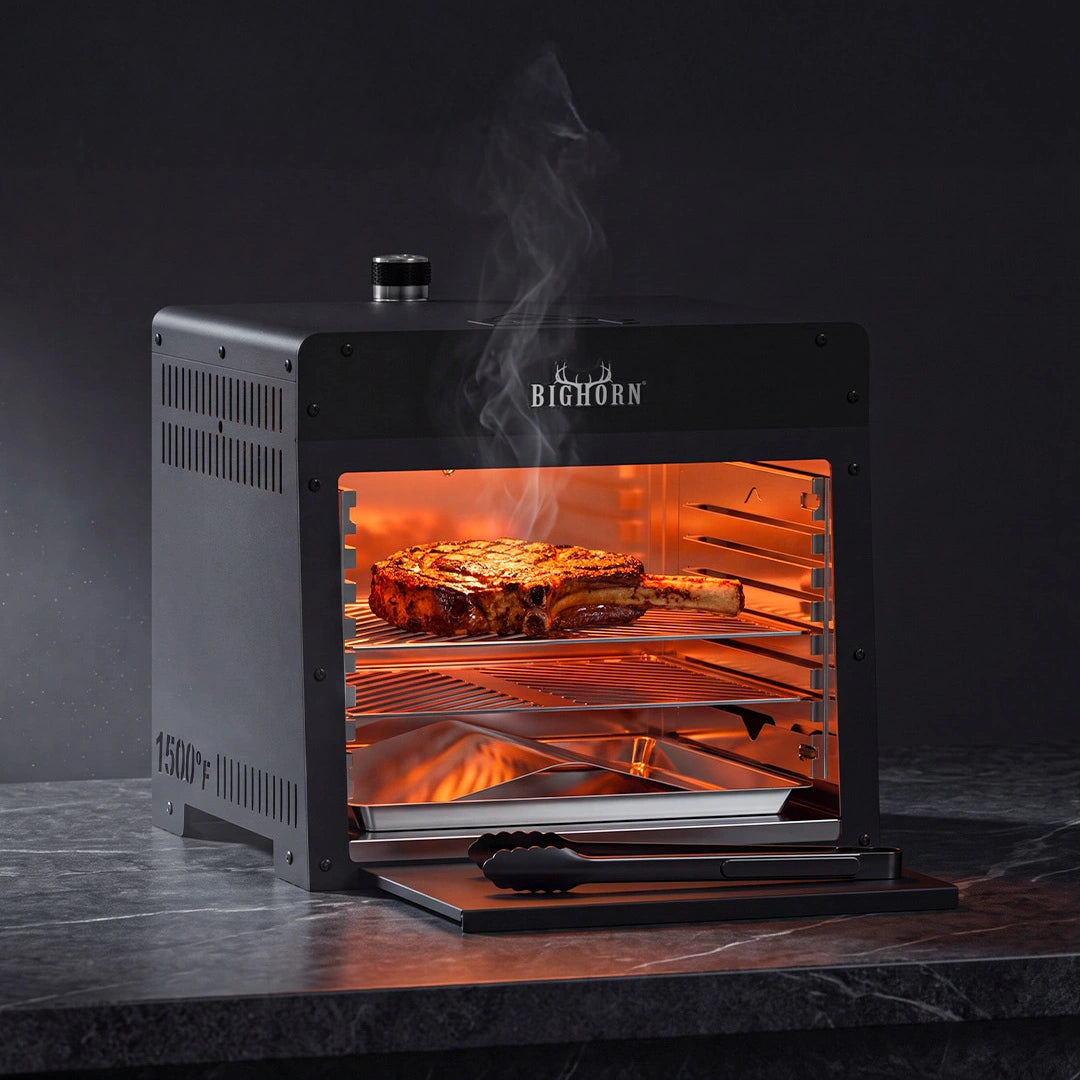
High-Heat Searing (Steaks, Chops, and Seafood)
By preheating a heavy cast-iron skillet directly inside the oven dome, you create an ultra-intense searing station that far exceeds the capabilities of standard indoor stovetops. Drop a thick-cut steak onto the screaming-hot iron; the dry heat creates deep, flavorful caramelization in minutes while keeping the interior perfectly tender. This method is also ideal for delicate proteins like fish fillets and shrimp, which benefit from a fast sear that doesn't dry them out.
High-Heat Roasting (Poultry and Seasonal Vegetables)
Slide a tray of seasoned vegetables like broccoli florets, asparagus stalks, or diced bell peppers into the oven. The intense heat blister-chars the skins while locking in sweetness, finishing them perfectly in a fraction of the time required by a regular kitchen oven. Whole chickens, spatchcocked poultry, and gourmet sausages develop an incredibly crispy skin while roasting rapidly.
Residual Heat Baking (Artisanal Breads and Flatbreads)
Do not let your heat go to waste after your main cooking session ends. As the heavy stone floor slowly drops in temperature, the oven transforms into a world-class hearth baker. The trapped residual heat is ideal for baking rustic loaves of bread, artisan flatbreads, or rosemary focaccia, utilizing every ounce of energy your fuel source produced.
Strategic Use Cases: Resolving Everyday Hosting Dilemmas
Scenario A: The Weeknight Family Dinner
-
The Old Way: A home oven struggles to create crisp crusts quickly, so dinner takes longer and the result is less textured. Kids grow impatient waiting 15 minutes per pie.
-
The Upgraded Way: Utilizing a portable gas or hybrid oven from Big Horn Outdoors. A short preheat time allows you to serve multiple pizzas with incredible consistency and better browning in minutes flat, making weeknight dinners fast and interactive.
Scenario B: High-Volume Backyard Entertaining
-
The Old Way: The host relies on a traditional grill or indoor kitchen, which separates cooking from the gathering, slows down service, and results in cold food.
-
The Upgraded Way: The portable oven becomes part of the event. Placed directly on an outdoor serving station, it keeps cooking highly interactive and social. With rapid 60-to-90-second bake times, the host can continuously serve piping-hot, fresh pizzas to a hungry crowd without missing out on the conversation.
Scenario C: Camping and Tailgating
-
The Old Way: Camping meals are restricted to basic camp stoves or open fire pits, resulting in unevenly cooked food and limited menus.
-
The Upgraded Way: Thanks to foldable legs, compact dimensions, and simple tool-free assembly, a lightweight Big Horn oven packs perfectly into the trunk. Campers and tailgaters gain access to high-heat roasting, natural wood-fired flavors, and gourmet stone-baked pizzas deep in the woods or outside the stadium.
Comprehensive FAQ: Expert Answers to Essential Queries
What separates a portable pizza oven from a regular outdoor oven?
A portable pizza oven is built specifically for extreme high heat, compact transport, and fast pizza-style baking rather than general low-and-slow smoking. It combines the flavor and heat profile of traditional wood-fired or high-intensity gas cooking with a smaller footprint, shorter setup time, and easier storage than a permanent brick installation.
Is a portable outdoor oven hard to use for beginners?
Not if the design prioritizes straightforward operation. Models featuring foldable legs, simple tool-free assembly, and intuitive flame controls dramatically lower the learning curve, allowing complete beginners to turn out excellent, crispy pizzas on their very first try.
How hot does an outdoor pizza oven need to get?
Dedicated pizza ovens run in the 700–900°F range or higher for proper crust development. This intense heat range is exactly what helps achieve rapid 60-to-90-second baking times and the characteristic browned spots on the crust without drying out the interior dough.
Can these portable ovens cook other foods besides pizza?
Yes. Many high-quality pizza ovens easily handle roasted vegetables, meats, fish, skillet breads, and other high-heat foods when used with proper bakeware, such as cast-iron skillets. Multi-use cooking is a standard capability across well-insulated designs.
Which is better: a wood-pellet model or a gas-only model?
That depends entirely on your backyard routine and flavor goals. Gas models prioritize ultimate ease of ignition, zero cleanup, and precise flame control. Wood-pellet and hybrid models appeal to users who value fire-driven flavor and want a traditional cooking character. Hybrid options offer the ultimate flexibility by providing both paths in a single machine.
Summary: Choosing Your Outdoor Cooking Solution
For buyers who want restaurant-style pizza without the massive commitment of a permanent brick build, a portable outdoor pizza oven offers the perfect middle ground between authenticity and convenience.
When mapping out your content plan and internal linking structure, target high-intent search queries by cross-linking this guide directly to the main Pizza Oven Collection page at bighornoutdoor.com. For organic search optimization, weave in long-tail keyword variants naturally across your product copy—such as "portable wood fired pizza oven for backyard," "portable outdoor pizza oven with stone," "dual fuel pizza oven for camping," and "small outdoor pizza oven for home use." These variations accurately match how real-world buyers compare flavor, footprint, and fuel convenience, bridging the gap between flavor-led customer research and product-led evaluation.